Community Corner
No Necropsy Results Yet for Euthanized Humpback Whale: NOAA
The community continues to mourn the whale and demand answers.


WESTHAMPTON, NY — As a heartbroken community continues to mourn a juvenile humpback whale euthanized after becoming stranded on a sandbar in Moriches Bay, the wait for answers continues.
"We are still waiting the necropsy results from the lab," Jennifer Goebel, media relations for National Oceanic Atmospheric Adminstration Fisheries division. "Depending on how busy they are, it can take two to four weeks to get results and a final report."
Meanwhile, the many who either tried to save the whale or who are devastated by the outcome of its tragic story continue to post on theLocals Only Facebook page.
Find out what's happening in Westhampton-Hampton Baysfor free with the latest updates from Patch.
Some share photos of whale images they've spotted in the clouds. One posted a Christmas ornament, shaped like a whale, they've hung on their Christmas tree, in memory.
And many share posts about whales who were rescued internationally after becoming stranded. "Hope that one day we are able to make the same difference saving these whales as other countries," one resident wrote.
Find out what's happening in Westhampton-Hampton Baysfor free with the latest updates from Patch.
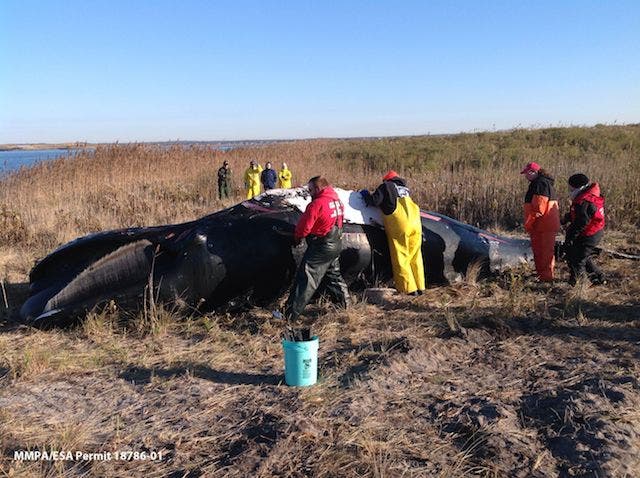
According to a statement released by the NOAA, on Monday, Nov. 28, approximately 20 representatives from the Northeast Marine Mammal Stranding Network partners, including Riverhead Foundation for Marine Research and Preservation, International Fund for Animal Welfare, Marine Mammals of Maine, Marine Mammal Stranding Center, Wildlife Conservation Society, Specially Trained Animal Rescue Team, and NOAA Fisheries, conducted a necropsy on the juvenile female humpback whale that stranded in Moriches Bay, New York, on Sunday, November 20.
"The purpose of the necropsy is to document the whale's life history, to examine any injuries, and to obtain tissues samples for health information, such as pathology," the release said. "After the necropsy was completed today, the whale was buried at the necropsy site in Cupsogue Beach County Park."
At a vigil held on Sunday, Nov. 27, residents raised environmental concerns about the impacts of burying the whale, who had been euthanized with potassium chloride, at Cupsogue, where piping plovers nest and children play.
"We are committed to learning as much as we can from this stranding event," NOAA said in the update.
As necropsy proceedings began on the whale, at least some signs of "trauma" were initially evident, experts said.
Morin was on hand at Cupsogue Beach in Westhampton for the necropsy and said the whale — which was euthanized despite a public outcry and scores of volunteers wanting to help save its life — was found to have a hematoma, although she wasn't initially clear if that trauma was suffered before or after she became stranded.
As events unfolded and the whale was brought, strapped to a barge, from the sandbar to Cupsogue Sunday, hearts were heavy, said Victor Vecchio of NOAA.
"Grown men were crying," he said.
Another boat helped to push the barge to the beach, where the necropsy was performed about 30 feet from the water and about one-eighth of a mile from where a press event was held; reporters were not allowed to take photos of the necropsy scene, despite requests; the scene was too "gory," officials said.
Discussing a question-and-answer session held Sunday, where NOAA reps were present to hear the public's concerns, Vecchio said their objective was just to "listen" to residents; those concerns will be taken into account for future action plans.
"People felt the agency wasn't listening or addressing their concerns," Vecchio said.
Livid and heartbroken residents held a vigil for the whale, where many said they felt that attempts to help fell upon deaf ears, and others said they felt the NOAA team came too late — when the whale had already been pecked at by gulls for days and was heard crying at night — to do anything but euthanize her.
Morin said first the whale was moved to the beach, then an external exam was done, and finally, the full necropsy would be completed.
"We did find some signs of trauma," he said, adding that it was "too soon" to determine any exact issues the whale had been facing.
He did say that any hematoma would have had to have occurred before the whale's death, so it was definitely a pre-mortem injury.
The goal, he said, is to be "respectful" olf the whale and the team performing the necropsy.
After the necropsy, lab samplings and other tests will follow, with definitive results possibly not available for days or weeks, said Colleen Coogan of NOAA Fisheries.
Morin said there had been some issues working in the team's "favor" when moving the whale, such as decomposition gases that had built up, allowing the whale to float, as well as a tide conducive to the move.
Still, a toe strap that can normally hold 10,000 pounds broke in the move.
Although at 29.5 feet long and 15 tons, the juvenile female whale was still "relatively small", moving her was not an easy task, he said. A grown female humpback whale can grow to more than 50 feet long and weigh 30 tons, he said.
Many have asked why the public was not allowed to help. Morin explained that although humpback whales are no longer endangered but have been de-listed and are now, instead, threatened, they are still protected by the Marine Mammal Protection Act, which was created to keep individuals from harassing or harming them.
"The lies and deception are so disturbing to me. I'm so angry," said Alex Lampasona, who helped organize rescue efforts; he said valiant attempts by the community were blocked by officials despite volunteers' best attempts at securing a helicopter, crane, tugboat and even a barge to free the whale.
NOAA has said residents should not attempt to rescue the whale themselves because one "flip of the tail" could be deadly and hurt volunteers.
Lampasona, however, said he and others are outraged. "We are thinking this whale was destined to die."
Angry residents are circulating a petition to change that legislation to allow for members of the public to be trained to help in future stranding situations.
To sign "The Local Marine Mammal Contingency Plan" petition, click here.
Coogan said a team of six agencies was working on the whale and would determine if she had become ill, injured or just ran into "bad luck," something not uncommon in juvenile whales, who, just like juvenile humans, sometimes make "bad choices" and take risks.
Of the outpouring of support for the whale, Coogan said, "Long Islanders are very passionate," and that's something NOAA wants to encourage.
When asked why NOAA couldn't have been on the scene sooner, Coogan said the whale was being monitored by agencies nationwide and said it would be difficult to "orient" and release a whale of such a large size.
In the release of a smaller animal, Coogan said someone has to hold it and steady it as it orients itself. In addition, she said, there was no way to move the whale from where she was stranded without damaging her physically.
"Maybe in 100 years" a procedure will exist to move a whale without hurting it, she said. And when the NOAA team was on scene, there was "no way" the whale was well enough to be saved, she said.
In addition, the idea of building a trench around the whale was considered but had proven unsuccessful internationally and could have led to the whale's drowning, she said.
She also said the threat to humans was real, even with a compromised whale; she'd once seen a whale "smash" someone's legs who was trying to save its life.
But Coogan said the vet who made the decision to euthanize, Dr. Craig Harms, professor of aquatic animal medicine at North Carolina State College of Aquatic Veterinary Medicine, was steadfast in his commitment to treat the whale humanely and felt leaving her to suffer any longer, for the next high tide, would have been inhumane.
The vet, she said, has received a "lot of blowback," something Coogan said was unfair. "These are people that miss holidays, miss Christmas, spend their whole lives trying to help animals," she said. "Then they are accused of not caring."
Coogan said she saw a whale put down with her two children once, a painful memory none of them will ever forget. "There's a feeling of helplessness when an animal dies," she said.
But the anger and despair was felt by the many who spent hours and days organizing manpower, a barge, a helicopter and an excavator to save the whale, even creating a Locals Only Facebook page to chronicle efforts.
At the vigil, organizers said the show of unity was heartening and, as they erected a cross on the beach in the whale's honor, with a permanent memorial to follow, they said the fight to ensure no other whale would die in vain would continue.
Necropsy photo courtesy of NOAA
Get more local news delivered straight to your inbox. Sign up for free Patch newsletters and alerts.