Community Corner
NOAA Says Euthanizing Humpback Whale 'In Its Best Interests, To End Its Suffering'; Residents Outraged
NOAA experts said the whale was probably already sick and wouldn't have survived; residents believe it was given no chance.


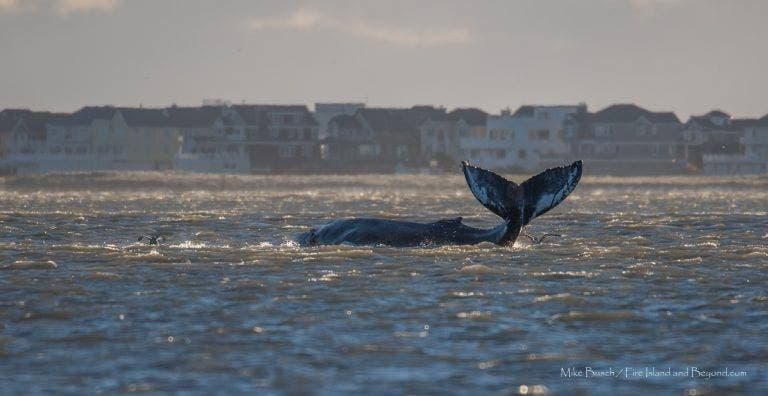
Experts who euthanized a humpback whale stranded on a sandbar in Moriches Bay Wednesday said they made the decision in the whale's best interest, "to end its suffering."
NOAA Fisheries held a call with reporters Wednesday afternoon to give an update on veterinary assessment and actions taken.
Craig Harms, professor of aquatic animal medicine, North Carolina State College of Aquatic Veterinary Medicine, Kim Durham, rescue program director, Riverhead Foundation for Marine Research and Preservation, Sarah Wilkin, national stranding and emergency response coordinator, NOAA Fisheries Office of Protected Resources, and Deborah Fauquier, veterinary medical officer, NOAA Fisheries Office of Protected Resources, were all on hand to answer questions.
Find out what's happening in Westhampton-Hampton Baysfor free with the latest updates from Patch.
The juvenile whale, Kate Brogan of NOAA fisheries public affairs said, elicited a very emotional response from the public who had "deep concern for this whale."
Harms said the situation was "incredibly difficult to deal with, logistically and emotionally."
Find out what's happening in Westhampton-Hampton Baysfor free with the latest updates from Patch.
The whale, he said, had endured "at least six low tide cycles prior" to being euthanized. Being subjected to those events caused the eventual gravitational collapse of its cardiovascular system, he said.
Also over that time, the whale was scavenged by gulls, causing skin damage and third degree burns on the greater part of its torso. The whale's eyes were moving "back and forth randomly," he said, a sign of neurological deterioration.
The whale, he said, had been through both low and high tide cycles; high tide was the best chance the whale would have had to get free and self rescue, and it "was not able to take advantage of that. It was not going to survive, it was just a matter of how long." Whales, he said, can "hang on in a situation like that for at least a few days or more. We made the decision in the best interest of the whale, to end its suffering."
Scientists used heavy sedation and pain reliever followed by potassium chloride to euthanize the humpback whale in Moriches Bay, the experts said; the potassium chloride was used instead of any drugs that might have been hazardous to scavengers and was the best alternative for the environment.
"This event was very challenging. There was a high level of emotion," Durham said.
Why was nothing done sooner?
When asked by reporters why nothing was done sooner to help the whale, Wilkin said there had been "quite a bit of activity" since Sunday, with monitoring and assessment done through photos and videos. It's typical protocol to wait through a few high tide cycles, as it's in the best interest of the animal to free itself, she said.
"If it's healthy it will typically be able to get itself" free, she said. "The fact that it did not free itself starts to leave us to think there were underlying health compromises." Even if it had been able to free swim again, it would likely have gotten re-stranded, she said.
NOAA also discussed intervention options used in other areas of the United States and abroad but "ultimately ruled them out," she said.
Durham said the Riverhead Foundation "actively monitored this animal" from the time it first appeared in the bay a week ago.
Also, the experts said, the whale was 33-feet, not 25, as initially believed, weighing 28,000 to 30,000 kilos, much larger than first thought.
While dredging was considered, an alternative that has worked successfully in some instances worldwide, NOAA experts said it could also "end up badly," with the whale falling sideways and suffocating. "The logistics were incredibly daunting," Harms said.
NOAA officials said they would like to debrief internally and externally, learn from the episode, and access resources on a state level, formalizing a plan for future strandings, something New York State Senator Ken LaValle has called out to see happen.
Durham said the Riverhead Foundation is currently working with the New York State Department of Conservation on a plan.
Next, a full necropsy of the whale will be performed to determine if there were underlying health issues; all agreed the necropsy is critical.
One eyewitness asked why the whale was still splashing as the vets euthanized it; the vet said often there are involuntary movements, such as urination or a "last swim", but the whales do not feel anything as "their brain is not sensing that," Harms said.
The whale's body will likely be towed to shore in the next 48 hours, Durham said.
Harms said when large whales get stranded, all that he's seen have had physical issues that make them unable to swim free.
Residents livid
But it's too little, too late for the sea of residents who tried to help the whale.
"The lies and deception are so disturbing to me. I'm so angry," said Alex Lampasona, who helped organize rescue efforts; he said valiant attempts by the community were blocked by officials despite volunteers' best attempts at securing a helicopter, crane, tugboat and even a barge to free the whale.
NOAA has said residents should not attempt to rescue the whale themselves because one "flip of the tail" could be deadly and hurt volunteers.
Lampasona, however, said he and others are outraged. "We are thinking this whale was destined to die."
He added, "This whole thing could have been avoided. They chose not to listen." Lampasona said he was calling and offering help from the first day, but was told NOAA was assessing the situation and that there was a rescue plan.
"Like a moron, I listened to them," he said, alleging that some were threatened with arrest if they tried to take rescue matters into their own hands.
Volunteers also were on hand offering to stay with the whale during low tide, keeping its body wet and the seagulls away, but were not allowed to do so, Lampasona said.
"The worst part of it all is we had an excavator say he could have the whale free in 15 minutes," he said.
The plan was to excavate sand on both sides of the whale, until the sand beneath collapsed, creating a fish bowl, where the whale would be safe until the rest of the sand was dug away and the whale could move 20 to 30 feet to the channel, Lampasona said.
"The whale was 20 to 30 feet from freedom," he said.
Other volunteers were "waving their checkbooks in the air, asking, 'What do you guys need?'" he said. "This was inexcusable."
And, Lampasona added, if NOAA had determined the whale was sick as of Monday, "Why didn't they euthanize him on Day One, rather than let him be picked apart by gulls? No matter how you slice it, that is just wrong."
In other parts of the world, he added, videos depict stranded whales being saved.
Chuck Bowman, president of the board of directors of the Riverhead Foundation for Marine Research and Preservation, confirmed earlier on Wednesday that vets sent by the National Oceanic and Atmospheric Administration's fisheries team made the decision and euthanized the whale at around 1:30 p.m.
"It's just very sad, that's all I can say," Bowman said. "The Riverhead Foundation usually has good outcomes. But this wasn't one of them."
In a statement, made by a veterinary team from NOAA, the Riverhead Foundation for Marine Research and Preservation, International Fund for Animal Welfare, and North Carolina State University, experts discussed the fate of the whale, which has been stranded since Sunday.
Tears anger on shore as stranded whale is euthanized. Onlookers say fed response was too slow. pic.twitter.com/JXHPY5upSm
— GREG CERGOL4NY (@GREGCERGOL4NY) November 23, 2016
“The veterinary team assessed the animal this morning and determined it was thin, limp, weak, minimally responsive, had evidence of neurological abnormalities, and extensive skin injuries with evidence of infection. Based upon these findings, the most humane option was to euthanize the whale since its chance of surviving in the wild was minimal. The whale was successfully euthanized using injectable medications with the time of death being approximately 1:20 p.m."
The statement also said that "the animal will soon be moved to a safe location for necropsy to study what caused the stranding, which may reveal important information about how to prepare for or respond to future events."
The whale, which was first reported last week feeding in Seatuck Cove, stranded in very shallow water of one to two feet in Hart’s Cove, the statement said; the Riverhead Foundation attempted to help move the whale off the sandbar on Sunday afternoon, but was unsuccessful. The whale wasn’t able to free itself during the subsequent high tide cycles, and efforts to create wave action by boat to aid the animal’s movements also failed, the statement read.
Marine mammal biologists are working with NOAA’s Office of Law Enforcement, the U.S. Coast Guard and the New York Department of Environmental Conservation to ensure the safety of the public, NOAA said.
"We are deeply grateful for the assistance provided by our partners with the State of New York, including Governor Cuomo himself in making state assets and personnel available to us immediately," said John Bullard, director of NOAA's Greater Atlantic Regional Fisheries Office. "It's clear that this response was not limited by resource availability; rather, the tidal conditions and other oceanic or biological factors that led to this stranding overtook any ability by our responders to rescue it. We are thankful to our partners and the community for their caring response and respect for law enforcement as we pursue this humane option."
Generally speaking, when large whales strand, even if they were previously observed feeding, there may be underlying health issues such as illness or malnutrition, NOAA officials said. "Thus, refloating a large whale may not be in its best interest, as it is already sick. Additionally, marine mammal biologists warn that efforts to haul whales off beaches can cause more harm to the animal as strong pressure on the tail or flippers can result in internal injuries, and put people involved at risk."
The statement continued: "While it is not common to see humpback whales within Moriches Bay, it is common to see them off the south shore of Long Island, and several other animals have been sighted further west and off the New Jersey coast in the past several days."
NOAA recently revised the Endangered Species listing of humpback whales globally earlier this year and a number of populations are no longer listed, including those most commonly found off New York.
A heartbroken community mourns
The outcome outraged the large group of residents who have united to try and save the whale, bringing boats to the bay and even setting up a GoFundMe page and a live feed cam on the Locals Only Facebook page.
"Only a matter of a few feet separated this whale from life," a post on the page said shortly after the whale was euthanized. "Tragic mishandling of a situation by our government. They should have been there on Sunday afternoon when it was first breached. Not four days later. Pathetic."
Derek Wells, who runs the page along with his partner, was deeply troubled by the end result. "I am extremely disappointed in the efforts made by NOAA. They were too little too late, and I do not believe that there was ever a rescue planned at all. Like most of their whales' breaches, it was an access and euthanize."
Wells said he plans to fight back.
"I am working with a lawyer who works with the Stranded No More Group to get a formal letter drafted to our local representatives," including Sen. Chuck Schumer, Rep. Kathleen Rice, Congresman Lee Zeldin, Sen. Kirsten Gillibrand, Congressman Peter King, and anyone who represents Long Island, urging them to take steps for emergency procedures for such situations. "With the increase of bunker in the area, this is bound to happen again. We should act to get things changed while everyone is still passionate about this," he said.
The valiant efforts of his fellow residents were inspiring, Wells said. "As far as the the efforts go, we tried our best to fight big government, and I am proud to be a a member of this community."
Adrienne Esposito, executive director of the Citizens Campaign for the Environment, was livid Wednesday. "I'm not only sad, I'm angry. We had absolutely no plan and no response for this situation. Congressman Zeldin and Senator Ken LaValle need to form a whale response task force so we prevent this from happening in the future. Doing nothing is not an option; we are better than that."
She added that the scenario could easily happen again. "And when it does we need to be ready for it. Some people are already naming the whale Morey after Moriches Bay. It is also the Latin root for death. So let's honor Morey's death by making sure it doesn't happen again."
Elected officials also expressed unhappiness at how the situation was handled. New York State Senator Ken LaValle called for a Senate hearing to address issues that arose during whale rescue efforts.
"It’s with great sadness, dismay and frustration to learn that the NOAA veterinarian euthanized the whale today," he said in a statement. "Over the past several days, I, along with many others, have been involved in efforts to free the whale that has been beached on a sandbar in Moriches Bay."
LaValle added, "We are supposed to be the stewards of the earth' in this instance we failed miserably. When situations such as this occur, we need take fast corrective actions. Even if the efforts prove not to be ultimately successful, it’s our human obligation to attempt to save nature’s mammals and other animals."
The senator said it was "painfully apparent" that with the many levels of government, "there are jurisdictional items that need to be addressed to streamline emergency responses. While it is too late for us to save this particular whale, there will be other circumstances to come that will demand quicker action. Accordingly, today I am calling for hearings of the New York Senate Environmental Conservation Committee to begin to tackle the issues that have arisen over this week. It’s critically important that we are able to react to these types of situations quickly."
Bowman said now that the whale is euthanized, the New York State Department of Environmental Conservation and the Riverhead Foundation will decide together how to dispose of the whale's 20-ton remains.
On Tuesday, New York State Gov. Andrew Cuomo issued a statement saying he would do everything possible to save the humpback whale.
In a statement, Cuomo said: “New York State is providing full authorization and cooperation to the National Oceanic and Atmospheric Administration to help save the humpback whale in Moriches Bay. I have directed the Department of Environmental Conservation to make available all state equipment and resources, and coordinate with NOAA on a plan to ensure the well-being of the stranded whale.”
Photo courtesy of Michael Busch.
Video courtesy of the Locals Only Facebook page.
Get more local news delivered straight to your inbox. Sign up for free Patch newsletters and alerts.