Schools
Officials, Cops, Discuss Curtailing Homelessness After University Of Texas Student's Murder [UPDATED]
Requiring merchants to lock dumpsters, banning 'single serve' alcohol sales at convenience stores, making benches uncomfortable among ideas.


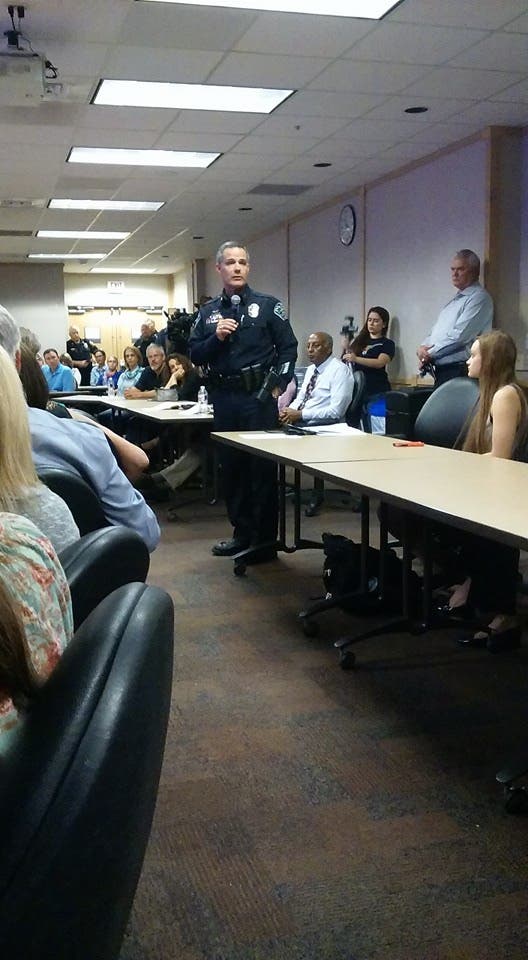

AUSTIN, TX -- In the wake of the murder of a student on campus grounds, University of Texas at Austin officials will continue to focus on the homeless population around the college -- but with attention to the "criminal transient" elements of that community.
That was the main point of discussion during a meeting of the Safety Coalition, a group comprising law enforcement officials from UT, the Austin Police Department and city officials. It was the first meeting of the group since the murder of freshman Haruka Weiser, killed by a runaway youth from Killeen along a darkened stretch of Waller Creek that runs through the campus.
Officials insisted at the meeting and before that the group had scheduled the gathering long before the murder that occurred in early April, one official noting the group started in 2006. It meets once a year -- on occasion twice a year -- to discuss security issues on campus, officials said.
Find out what's happening in Austinfor free with the latest updates from Patch.
"Let me assure you, this meeting was established long before the recent events on cafocusob Harkins, associate vice president for campus safety at UT-Austin. In a press advisory before the meeting, UT Police Department spokeswoman Cindy Posey made the same point.
Harkins noted the last meeting of the Safety Coalition took place last October. In further assuaging concerns, Harkins ticked off a list of the safety measures already in place: Shuttles that run until 11 p.m. to transport students to their dorms or apartments; the "Sure Walk" program for those averse to walking alone across campus at night; vans that transport students off-campus to their homes.
Find out what's happening in Austinfor free with the latest updates from Patch.
Since the student's homicide, police attention has focused on the West Campus portion of the university area. Of particular focus has been the homeless population, given that the 17-year-old charged in the murder was a runaway youth who was taken to an emergency shelter by police -- officially making him homeless -- when they encountered him the day after the killing, not realizing at the time he was the suspect.
Meechaiel Criner, the youth accused of killing the student, was taken to a LifeWorks shelter after firefighters were called to where he was burning items in a trash can.
A firefighter later recognized him from surveillance video from the crime released days later, and police retrieved him for arrest at the shelter where they had transported him earlier.
Given Criner's transient status, the focus of solutions to security challenges on campus has focused on the homeless population in the vicinity. At Monday's gathering of the Safety Coalition, that focus remained while university officials await the findings of the Texas Department of Public Safety study on broader security measures.
That report won't be concluded until August, and will likely include enhanced lighting, more surveillance cameras and revamped safety protocols, Harkins said.
But more immediate measures are to be taken in the coming days, Austin Police Department Chief Art Acevedo said. A so-called "homeless outreach team" -- dubbed a HOT team -- is being established locally patterned after one in Houston, Acevedo said.
"That's probably going to be the piece that going to make a tremendous difference once we get that first team going," the police chief said, referring to such a team's ability to distinguish the benign homeless person from the criminal transient element.
In response to Acevedo's question as to when the first team will be deployed -- an ETA, as he put it -- Assistant Chief Chris McIlvain said he expected an outline of the plan by this Friday. By next week, the HOT team should be operational, the assistant chief said.
"One of the things we want to do is be able to get that done right now with the [city] budget coming up to see if we can find permanent and additional teams based on the actual need not just the West Campus, not just on the Drag but in the central business district and throughout Austin," Acevedo said.
"Homelessness and criminal transients is an issue not just in Austin but around any major city," Acevedo added.
Houston officials have lauded the homeless outreach team in that city. In a recent press release, Houston officials touted the team's "silver medal" showing in the 2015 Community Policing Award, the top honor going to the NYPD's homeless outreach team efforts.
HOT team members undergo specialized training in community policing practices used to deal with a growing homeless population. They perform their work in tandem with officials who specialize in dealing with individuals afflicted with mental illness.
Also mentioned by officials at the hour-and-a-half long meeting was the idea of expanding existing ordinances, making them more robust in attacking the homeless issue.
A city ban on panhandling should extend to the West Campus area, and a new ordinance will be examined to prohibit the sale of single-serve sales of alcohol by convenience stores -- the piecemeal purchase style that is the hallmark of a homeless person, it was inferred.
Carl Smart, director of the Austin code department, outlined other potential safeguards: Requiring area merchants to install locks on trash dumpsters to deter "dumpster diving"among homeless people or illegally placement of materials inside the trash receptacles; banning soliciting along West Campus; changing the type of benches across the West Campus to make them less inviting to transients as places on which to sleep.
"The benches there are so comfortable, and allow for easy, overnight sleeping," Smart said. "So maybe changing the type of benches in there that kind of discourage that kind of activity."
Other areas of concern are more problematic and harder to solve. One parent mentioned that church officials in the vicinity of the university have conceded their altruistic mission of feeding, clothing and sheltering homeless people might inadvertently contribute to their presence. She wondered if they might somehow be stopped from doing their work -- with Acevedo himself wondering aloud if a separate ordinance might be designed to curb such activity.
McIlvain quickly put the kaibosh on such musings during his portion of the presentation, noting the religious nature of church officials' work and the fact it's done on their private property (which would make it virtually impossible for police to curtail their activities).
"They're willing to work with us, but we don't have control over what they do," McIlvain said. "They understand the issue, but that's what they do," he added, in reference to their faith-based efforts.
Acevedo made a point to stress that the campus -- despite the student's recent killing -- is among the safest in the country. Overall, crime is down some 33 percent from last year, he said, while property crimes are down about 17 percent. The death of the student, while tragic, was the first on-campus killing since sniper Charles Whitmire barricaded himself in the UT tower while heavily armed, killing 14 people in 1965.
Acevedo has harkened to that past tragedy in the past when speaking of the relative safety of the UT campus.
The police chief also urged students to be more engaged in reporting all incidents to police, calling them the "eyes and ears" of police as it relates to campus safety. He made that strong suggestion in explaining the police force marshals resources based on data related to criminal activity in a region, such "data-driven" decisions contingent on robust reporting of crimes.
Without rich data, it's hard to know where to focus police efforts, he suggested.
He reiterated that plea for student reporting in answer to a couple of the parents attending who said their children are frightened by some of the homeless around campus, and some students report having been accosted.
"She's much more afraid now than before," one mother said of her UT-attending daughter, referencing the days since Weiser's murder.
In response, the police chief acknowledged that in bolstering the police presence on campus since the murder (some 50 cops have been added to patrol the campus), they may have inadvertently prompted some homeless people to move to other areas still in proximity but farther from West Campus.
Another parent expressed frustration that the Safety Coalition meets but once a year -- twice at most -- and should think about establishing quarterly meetings.
The suggestion prompted Acevedo to note that police don't sit idly by waiting for meetings, but are continually assessing the need for their presence in the city's hot spots.
"Regardless of meetings, we don't just sit around as a police department and wait for 911 calls," the chief said. "We're constantly looking at data, analyzing data, we have tactical briefings...on a daily basis. I don't want you to think just because there's not a meeting that the police department is just blindly waiting for 911 calls."
Instead, police continually deploy resources accordingly. One such time of the year when police focus more attention on campus is during the beginning of school when uninitiated students arriving from other parts of the country might not be as watchful of their property upon their first arrival.
"We are actually constantly deploying our resources on a daily basis based on emerging threats, on historical threats --- like I said when school starts back up -- we know we have to deploy heavily because students have really bad habits, the innocence of being a student, you know, to try to protect them so we don't have that spike."
One parent urged Austin City Council Member Kathy Tovo, who was present but not a featured speaker, to reconsider her proposal to have public toilets installed. The toilets were posited as yet another feature that might have an unintended effect of creating an inviting environment for homeless people.
In response, Tovo said the toilets would be focused more on the downtown sector and wouldn't be installed strictly for the homeless to use, but any visitors to the central business district.
Ray Arellano, an assistant city manager for Austin whose office oversees public safety, said city officials are with parents calling for enhanced security: "We all share your concerns about safety," he told those gathered. "We all have a vested interest."
Stephanie Harden, the deputy director of the city's Health & Human Services department, also spoke to those gathered, along with UT Police Department Assistanc Chief David Carter.
>>> Photos of Acevedo and McIlvain by Tony Cantu; photo of Haruka Weiser courtesy of her family.
**************************************************************************************************
From earlier:
AUSTIN, TX -- University of Texas at Austin officials on Monday will stage a public meeting of its Safety Coalition to discuss campus security -- the first such meeting since the murder of a freshman on campus grounds earlier this month.
University officials insist the meeting was planned long in advance of the death of UT-Austin freshman Haruka Weiser, a dance major who was killed by a runaway while walking along the darkened path fronting the portion of Waller Creek that runs through campus.
UT Police spokeswoman Cindy Posey told the Austin American-Statesman the 3 p.m. gathering is a regular meeting of the Safety Coalition, a collection of law enforcement officials from UT and the Austin Police Department along with city officials.
Still, Posey noted new questions related to security on campus that have been raised in the wake of Weiser's death will likely be discussed at this afternoon's meeting. She noted the meeting is unrelated to the ongoing review by the Texas Department of Public Safety on security launched at the behest of UT President Gregory L. Fenves, due to be released in August.
The meeting will be staged at the Student Services Building, 100 W. Dean Keeton St., in Room G1.310 (the Glenn Maloney Room). Those wishing to attend can park in the 27th Street garage, to the north of the Student Services Building, and bring their parking ticket to the event for validation. .
The event will be live-streamed on Periscope. Those unable to attend can send questions to uocomm@austin.utexas.edu.
Get more local news delivered straight to your inbox. Sign up for free Patch newsletters and alerts.