Health & Fitness
Can People Still Get And Spread COVID-19 After Being Vaccinated?
The chances are very low, according to one University of Alabama at Birmingham infectious disease researcher.
January 27, 2021
By Adam Pope
Find out what's happening in Birminghamfor free with the latest updates from Patch.
More than a month after the first vaccines for COVID-19, many people still have questions regarding what happens after receiving the full dose. While there is not hard data on the subject, the chances of getting and spreading the virus after being vaccinated are very low, according to one University of Alabama at Birmingham infectious disease researcher.
Paul Goepfert, M.D., a professor with the UAB Division of Infectious Diseases, says the bottom line is that the vaccine most likely does not prevent spread of the virus, but probably does reduce the length of time a person sheds virus.
Find out what's happening in Birminghamfor free with the latest updates from Patch.
Can a fully vaccinated person who is subsequently exposed to the virus continue to pass that virus on to others?
Goepfert says, in theory, the vaccine helps the body develop antibodies to fight off an infection; but while that is happening, the vaccinated person who was exposed to the virus could still be infectious to others, similarly to the flu.
“That is still unknown for COVID,” he said. “Animal data suggests that a COVID vaccine decreases the amount of time for viral shedding to four days; but during that time, the animal — or person — would still be infectious.”
Simply put, the vaccine does not kill or destroy the virus if you are exposed. It simply trains your body to successfully fight off the virus so you do not get sick.
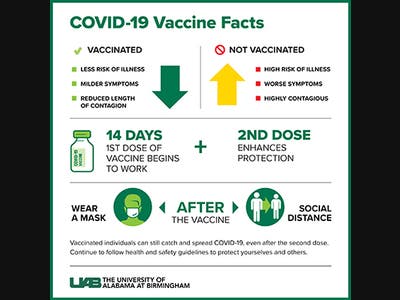
Goepfert says, with that being correct, it seems reasonable that a vaccinated person could continue to spread virus. This has ramifications for continued mask wearing and social distancing, even after large numbers of people have been vaccinated. Because of this, UAB medical experts advise that if your employer or institution offers sentinel testing, you should continue to participate after receiving the vaccine.
“We only know that the vaccine prevents against getting sick with COVID,” he said. “We don’t know if it prevents spread. My suspicion is that it will significantly reduce spread although not completely. At least one study is hoping to look at the effect of vaccine on asymptomatic spread. Until then, we need to wear a mask even if vaccinated.”
Goepfert also added that the vaccine will take effect roughly 14 days after the first dose. The second dose likely extends the duration of that protection but only a bit more, if any, to the protection (i.e., 92 percent to 95 percent efficacy).
This press release was produced by the University of Alabama at Birmingham. The views expressed here are the author’s own.