Politics & Government
Gubernatorial Candidates Debate In Birmingham
Six gubernatorial candidates met in Birmingham for a structured debate ahead of June's primaries.


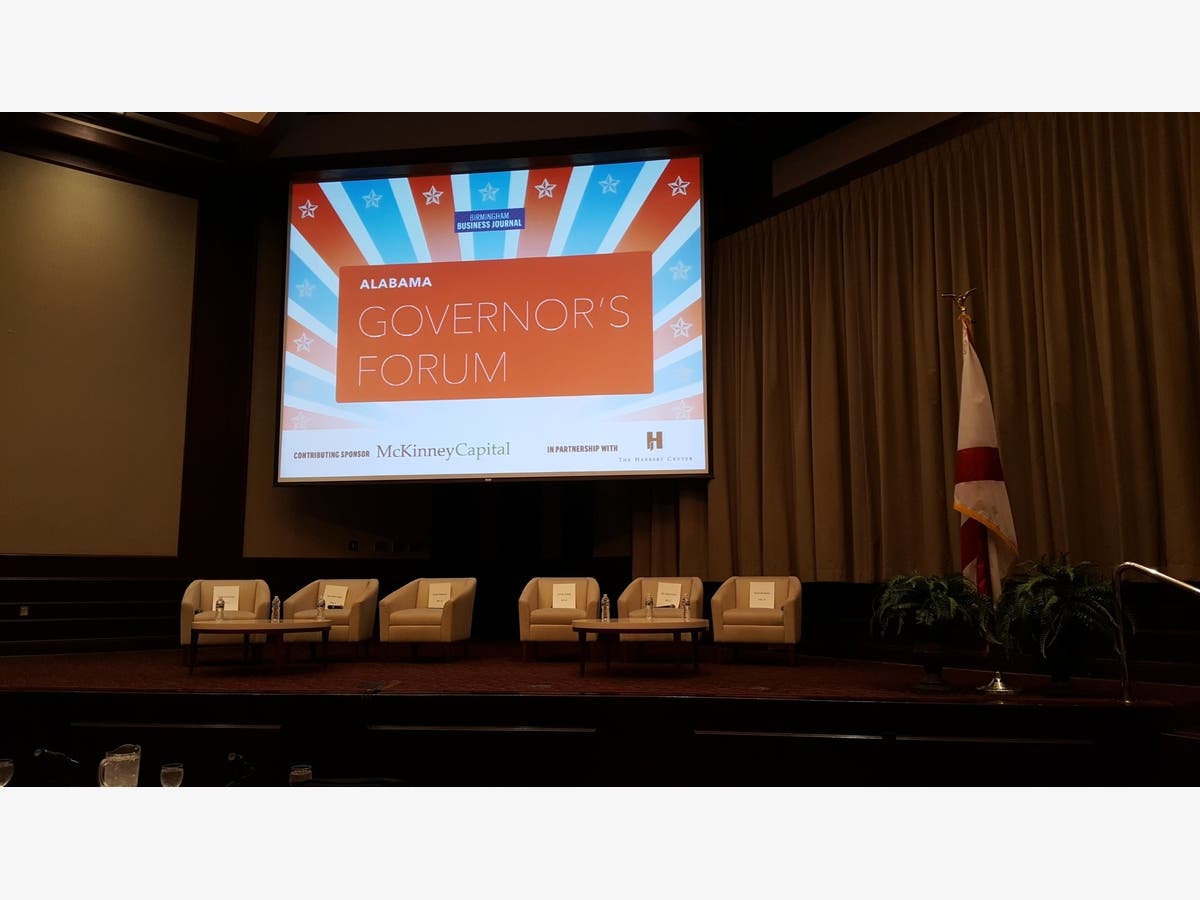
BIRMINGHAM, AL - Six candidates running for governor of Alabama convened at the Harbert Center in Birmingham Thursday morning for a debate sponsored by the Birmingham Business Journal and WBHM. The panel included three Republicans - Huntsville Mayor Tommy Battle, evangelist Scott Dawson and Sen. Bill Hightower - and three Democrats - former Chief Justice Sue Bell Cobb, Rep. James Fields and Tuscaloosa Mayor Walt Maddox. Absent on the Republican side was incumbent Gov. Kay Ivey, and Democrats Doug Smith and Anthony White.
The candidates had similar approaches to many of the issues discussed, although some issues brought out a few of the differences in political philosophies of the candidates - namely separated by parties.
Discussing infrastructure, all of the candidates said they support infrastructure spending, but had differing opinions on how that funding should be sourced. Hightower pointed out that Alabama has "the nmost earmarked budget in the country," and that taking away the earmarks from funds would add more transparency and cut down on waste and fraud when it comes to infrastructure spending.
Find out what's happening in Birminghamfor free with the latest updates from Patch.
Maddox agreed with Hightower regarding the transparency needed with infrastructure spending, and added that the state needs to prioritize each project and transmit that priority list to the public.
"It takes 10 years to build a road," Battle said. "(Addressing the state's infrastructure problems) is not a 'want to' issue, it is a 'have to.'" He said the public just needs to trust that the government is doing what it says it is going to do.
Find out what's happening in Birminghamfor free with the latest updates from Patch.
On the subject of renewable energy, the candidates did have differing opinions on the matter. "We are celebrating 4,000 new jobs in Huntsville, but in Walker County we are losing jobs," Dawson said referring to the coal industry in Walker County. "These coal workers are are facing the reality of losing their livelihood. We should always be looking for every way to conserve energy, but it breaks my heart to see so many people out of work in the coal industry. Alabama coal is burning cleaner than ever now."
Fields said renewable energy sources like solar energy and wind energy may not be feasible for Alabama. "We aren't like Texas, where wind is always blowing," he said. "Coal is burning cleaner now, and Alabama has great resources, and we must use those resources. We need to change the way we do business."
Hightower said he is supportive of the coal industry, but also supports the use of hydroelectric power. "I am against carbon credits," Hightower said. "We don't want to raise the price of energy, but we do need to have the ability to shift back and forth."
Maddox addressed Dawson's point of lost coal jobs with a talling point regarding advanced technology. He help up his smartphone and said, "How many jobs do you think have been lost because of this?" Maddox asked. "I'd say a lot have been lost just because of this iPhone here." Maddox said advanced technology will often cause a shift in job demand in some areas, but said the state needs to address its energy issues. "We have no water management plan, no energy plan, no plan to address these issues." Maddox said he is for hydroelectric power and for renewable energy. "This election is about the future of our state."
Battle said when it comes to renewable energy solutions, "It is not a one size fits all situation." He said keeping energy costs down is the key to recruiting new industry to the state. "if it is not cost-efficient, then we can't look into it."
Cobb touted her establishment of the state's first Green Committee while she was Chief Justice, and said the state needs to make recycling affordable.
Addressing how their experience - or in some cases, lack thereof - can translate to being an effective governor, the candidates each made a case for themselves based on their professional records.
Fields said, despite never holding a statewide office, he thinks his background makes him a strong candidate. "I have never been mayor of a city, but I was elected to the state House," Fields said. "I am a person of integrity, commitment and family values, and I want to move this state forward."
Hightower said his record shows his qualifications. "I am the only one up here with a voting record," he said. "I have worked to bring industry to Mobile, and I have an understanding of the needs of the entire state."
Maddox was asked how he, as a Democrat and pro-lottery candidate, could get elected in a predominantly Republican state. Maddox pointed out that he has a masters degree in Public Administration from UAB, and that he was named the 2012 Municipal Leader of the Year for the entire country after his handling of the devastating tornadoes that his Tuscaloosa in 2011. "I know how to handle a crisis," Maddox said. "You don't have to guess how I will operate under pressure."
Maddox added that he is proudly a Democrat, saying, "Like many, I could have switched parties for political convenience."
Battle was asked how his experience as a mayor would translate to governing an entire state. Huntsville has enjoyed tremendous economic success in Battle tenure as mayor, and was recently named one of the top 10 cities in the country by U.S. News & World Report. "For the same reason we were ranked number seven in the country by U.S. News, we can extend that to the entire state," Battle said. "We want to make the workforce equal in Alabama, and make sure the governor's office reflects this state."
Cobb was also asked how she, as a Democrat, could win the office in a deeply Republican state. "I am the only person on this stage who has won a statewide office," Cobb said. "Judges are the gatekeepers of the most expensive operation of the government. I want to bring the state together. Clean water, improved infrastructure, is as bipartisan as it gets. She pointed out that the victory by Democrat Doug Jones in the special Senate election in December shows that a Democrat can win in Alabama. "Party labels do not indicate whether you are a good person or a good leader."
Dawson pointed out that he has been a pastoral leader for so long that his experience would translate to government leadership seamlessly. "Everything rises and falls with leadership," Dawson said. "For 30 years I have worked with pastors, and they are the CEO's of their congregations. Alabama needs a leader that will bring unity to our state."
The candidates also discussed tax incentives for businesses, and all agreed that any incentives should be looked at as an investment, and if the state is not seeing a return on the investment, then the incentives should not be available.
As well, the candidates were asked about the opioid crisis in Alabama, and all candidates agreed that fighting "pill mills" and making it harder for doctors to over-prescribe opioids was a solution.
On the issue of allowing individual municipalities to determine their own minimum wage, as opposed to a statewide wage, the opinions were split along party lines. All three Republican candidates said cities should not be allowed to determine their own minimum wage, and that free enterprise is the best way to determine wages. The three Democrats were in favor of municipalities determining their own minimum wages.
The statewide primary election are June 5, with runoffs on July 17.
Photo from Harbert Center
Get more local news delivered straight to your inbox. Sign up for free Patch newsletters and alerts.