Community Corner
Helen Keller Born; Wallace Makes Stand: June In Alabama History
June includes some important anniversaries in Alabama history, some good and some that many would like to forget.


BIRMINGHAM, AL - The month of June has plenty of significant anniversaries in Alabama history - some events memorable for good reasons, while others are more infamous. Either way, some major events in state - and the country's - history happened in Alabama in June.
As part of Patch's recognition of Alabama's bicentennial, we look at this month in Alabama history, June edition:
June 5, 1956:
Find out what's happening in Birminghamfor free with the latest updates from Patch.
Fred Shuttlesworth and other local black ministers establish the Alabama Christian Movement for Human Rights (ACMHR). Founded in response to the State of Alabama’s recent ban on the NAACP, which lasted eight years, ACMHR was central to the civil rights movement in Birmingham.
June 9, 1943:
Find out what's happening in Birminghamfor free with the latest updates from Patch.
The Tuskegee Airmen - flyers from the 99th Fighter Squadron who were among those trained at Tuskegee Army Air Field during World War II - are involved in their first air battle with German fighter planes in the skies over North Africa.
June 11, 1901:
Gov. William J. Samford dies while in office and is succeeded by the president of the Alabama Senate, William D. Jelks. The Constitutional Convention, then in session, would recreate the office of Lieutenant Governor in the 1901 Constitution.
June 11, 1963:
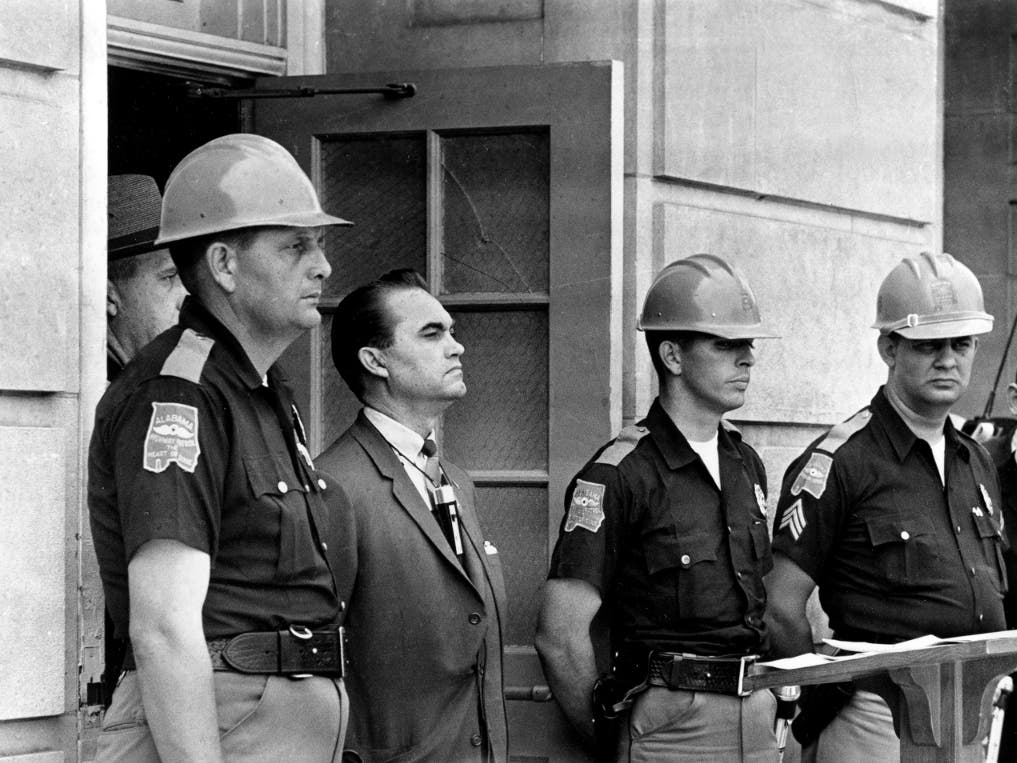
Gov. George Wallace makes his infamous stand in the schoolhouse door to block the admittance of African Americans to the University of Alabama. The event was televised nationally and remembered as one of the pivotal moments in the Civil Rights Movement.
June 12, 1832:
Alabama’s first railroad, the Tuscumbia Railway, opens, running the two miles from Tuscumbia Landing at the Tennessee River to Tuscumbia.
June 12, 1933:
Actor and singer Jim Nabors is born in Sylacauga. Nabors began acting while a student at the University of Alabama, and is best known for portraying Gomer Pyle on “The Andy Griffith Show” from 1960 to 1964, and later on his own series, “Gomer Pyle, USMC.”Nabors lived the last several years of his life in Hawaii running a macadamia nut farm. He died in 2017.
June 18, 1916:
The National Guard’s 4th Alabama Infantry assembles in Montgomery in response to a call from President Woodrow Wilson. The 4th Alabama, under the command of William P. Screws, was one of four state units dispatched to the Mexican border to guard American interests while Gen. John Pershing attempted to capture Mexican revolutionary and bandit Pancho Villa.
June 18, 1954:
Albert Patterson, Democratic Party nominee for state attorney general, is assassinated in his hometown of Phenix City. The murder drew national attention because of Patterson’s promise to rid Phenix City of corruption and organized crime.
June 22, 1937:
Alabama native Joe Louis defeats James Braddock to become the first black heavyweight boxing champion since Jack Johnson in 1908. Born near Lafayette as Joseph Louis Barrow, the “Brown Bomber” held the world heavyweight title until 1948.
June 27, 1880:
Helen Keller is born in Tuscumbia. Both blind and deaf, Keller's story has been an international inspiration for people with disabilities. President Lyndon B. Johnson awarded her the Presidential Medal of Freedom, one of the United States' two highest civilian honors. In 1965 she was elected to the National Women's Hall of Fame at the New York World's Fair.
Get more local news delivered straight to your inbox. Sign up for free Patch newsletters and alerts.