Community Corner
A Century Ago: Tuscaloosa Militiamen Accused Of Lynching Miner
A hundred years ago this month, a group of Alabama National Guardsmen were charged in the lynching of a striking Walker County coal miner.


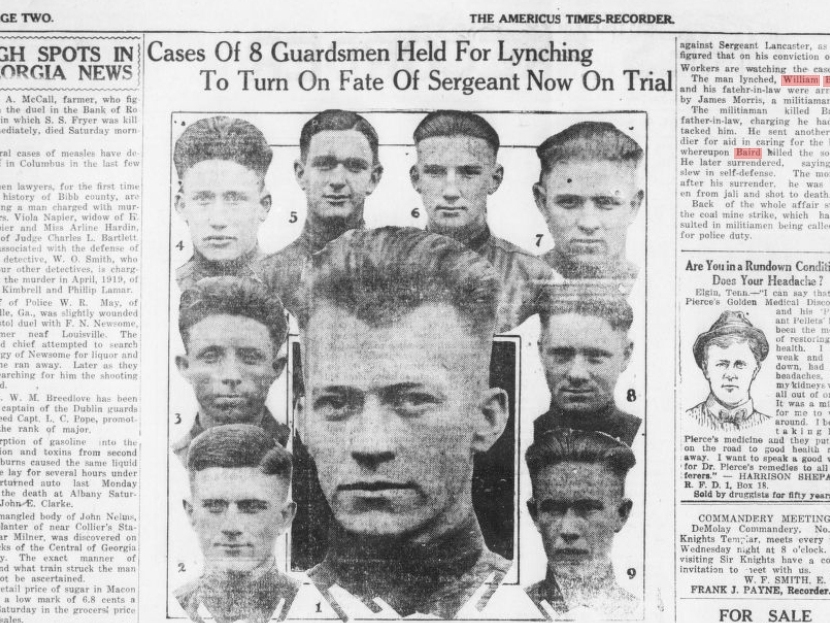
“Twenty miles from a railroad, in a town whose only direct communication with the outside world is one private telephone, the most interesting case in Alabama’s history is being tried”
- Associated Press report from Hamilton, Alabama on Feb. 8, 1921.
TUSCALOOSA, AL — The lynching of accused murderer and Walker County coal miner Willie Baird dominated newspaper headlines a century ago in January 1921, bringing nationwide interest to a case that would see nearly a dozen Alabama National Guardsmen from Tuscaloosa acquitted of first-degree murder. Baird's untimely and violent death also came amid a large-scale coal miner strike in Walker County that resulted in numerous deaths prior to the one that would be followed across the country.
Find out what's happening in Tuscaloosafor free with the latest updates from Patch.
Understanding the events around Baird's death also means contextualizing the history it was backdropped by, as Walker County became a tinder box of labor disputes leading to clashes between miners and uniformed representatives of the state.
Click here to subscribe to our daily email newsletters and breaking news alerts delivered to your inbox and mobile devices for free. You can also support local journalism by donating as little as $5 a month to become a supporting member or by downloading our free Patch mobile app.
Find out what's happening in Tuscaloosafor free with the latest updates from Patch.
One Associated Press report mentioned Baird's death as being the ninth since the beginning of a strike the previous September beginning in the Patton Junction community of Walker County. On Sept. 16, 1920, strikers killed the general manager of the Corona Coal Company, along with a guard, prompting Alabama Gov. Thomas Kilby to dispatch a National Guard unit from Tuscaloosa, Company M, to quell the violence, protect the company and maintain order.
Amid a winter of escalating tensions, Nauvoo resident John "Adrian" Northcutt — reported to be a local union leader and itinerant Nazarine minister — was allegedly arrested at his home on Dec. 22, 1920 by the soldiers from Company M. Shortly after the soldiers arrived at the home, Northcutt's son-in-law, Baird, claimed he heard seven shots ring out and ran over to find Northcutt dead with Private James Morris standing over the body.
Newspaper reports from the time provide conflicting accounts, depending on their view of the labor strike, with some claiming what happened next was an act of self-defense, while others were quick to presume innocence on the part of Morris. The consensus view, however, says that Baird then shot Morris to death, later claiming he was defending himself.
Baird eventually surrendered to the authorities on Jan. 12, 1921 and was held in the Walker County Jail awaiting trial. The day after his arrest, though, a "mob of masked men" descended upon the jail, reportedly pistol-whipping the jailer with a revolver and threatening his life if he did not turn over the keys to Baird's cell.
The Associated Press reported: "Baird was taken from the jail by a small party of masked men to a lonely spot three miles north of Jasper and shot to death … his body was found beside the road later in the day by a rural mail career”
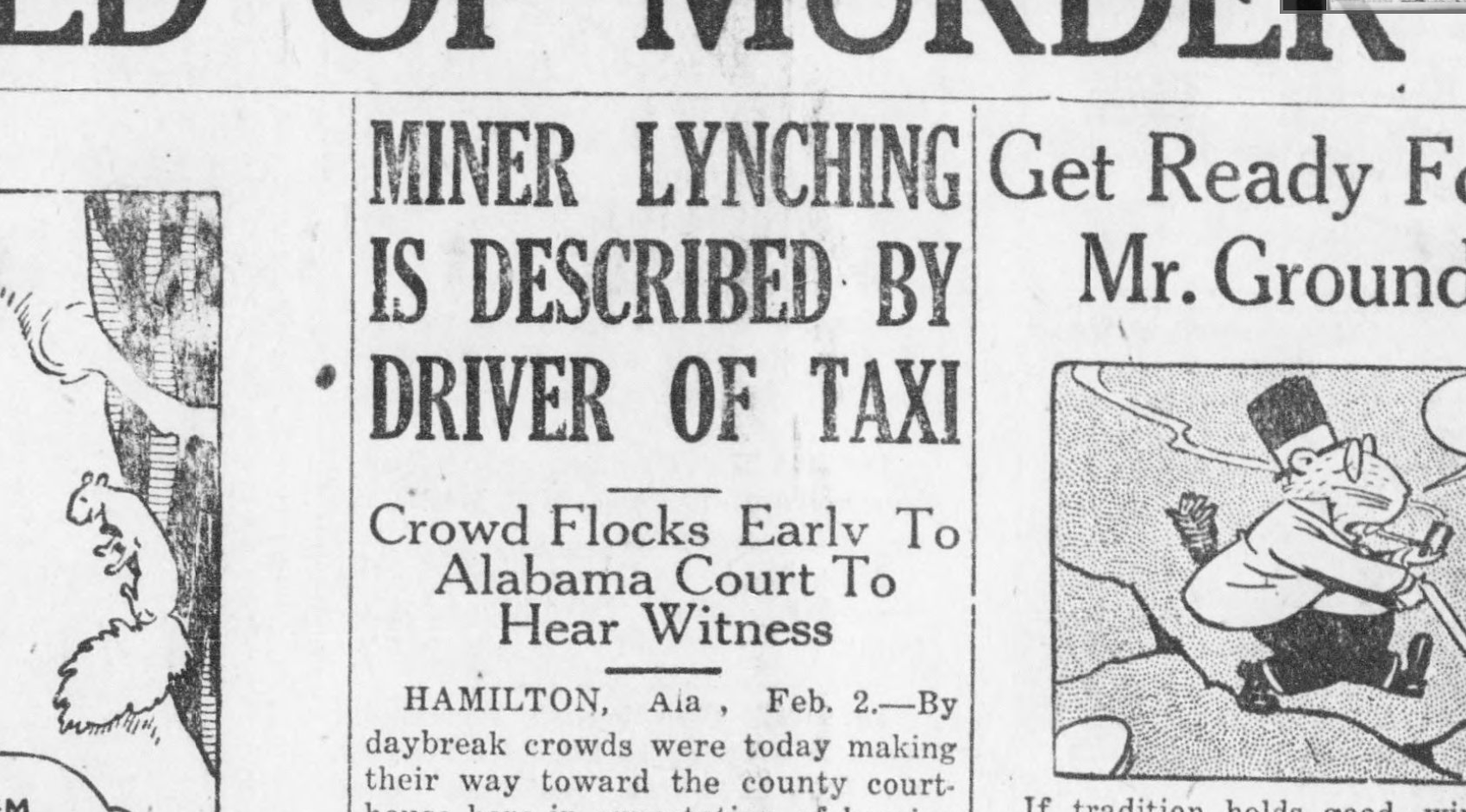
The same newspaper wire report says more than 20 bullet holes were found in Baird's body, along with 29 empty cartridges at the scene.
While lynchings were unfortunately commonplace news events during this time, the death of striking white coal miner would not go unnoticed. Later that January, nine members of Company M were indicted for first-degree murder in connection to the lynching.
Despite the brutal nature of the accusations, the Guardsmen received substantial local support back home in Tuscaloosa, where a large group of people were said to have met and appointed a commission to raise money for their defense. The supporters also accused state prosecutors of "railroading" the men and denying them access to their attorneys when they were jailed in Birmingham.
One newspaper report cited Judge Horace Wilkerson, special assistant attorney general, who denied the accusations, referring to the meeting of supporters as a “smoke screen designed as an agency for the creation of propaganda calculated to produce public sentiment favorable [to the men]."
The ensuing legal drama over the next couple of months would see newspaper readers entranced by the proceedings. After both sides argued for a change of trial venue, the men were eventually transported by train to the city of Hamilton in Marion County. A wire report in the Pensacola Journal said on Jan. 24, 1921 that the men could be heard singing popular songs on the train as they were taken to Hamilton.
Sgt. Robert Lancaster was tried first in early February 1921, which was met with fanfare and widespread public interest.
“Twenty miles from a railroad, in a town whose only direct communication with the outside world is one private telephone, the most interesting case in Alabama’s history is being tried,” the Americus Times-Recorder reported. "People directly interested in the case flocked to Hamilton and turned farm houses for several miles around into hotels. More than 120 witnesses were summoned."
One of the witnesses called to testify was a taxi driver who confessed to transporting the men by car from Townley to Jasper to take Baird from the jail. Despite this illuminating revelation, the jury could not come up with a verdict after 38 hours of deliberation and the Lancaster was freed by mistrial.
Other cases of the soldiers were tried individually, eventually resulting in 11 men being acquitted of first-degree murder, despite no public denial of involvement in killing Baird, with officials claiming the murderous act had components of self-defense.
At the same time as the trial, violence raged in Walker County as a total of 16 people were killed during the strike. This ultimately led union miners to seek a resolution to the labor dispute and Gov. Kilby was brought in as the arbitrator for the negotiations.
The governor's decision would deal a crippling blow to union efforts in Alabama, as the settlement did not recognize the union. The decision also blocked the companies from reinstating striking miners and quashed any proposed pay increases.
Historian George Brown Tindall wrote that the union closed its Alabama offices as a result of the decision, effectively stalling any union progress for the next decade.
Ryan Phillips is the community publisher for Tuscaloosa Patch. A Tuscaloosa native and graduate of the University of Alabama, Phillips is an award-winning journalist, columnist and editor with previous stops at the Starkville Daily News, Weather.com, the Associated Press, the Birmingham Business Journal and the Anniston Star. To contact Phillips with news tips or advertising inquiries, email ryan.phillips@patch.com.
Get more local news delivered straight to your inbox. Sign up for free Patch newsletters and alerts.