Sports
COLUMN: Where It All Began For Alabama & Georgia Football Rivalry
Tuscaloosa Patch founder Ryan Phillips takes a look back at the very first meeting of Alabama and Georgia on the gridiron in 1895.


*This is an opinion column*
TUSCALOOSA, AL — I was driving back from Christmas shopping in Birmingham Friday afternoon when I passed one of the most beautiful sights an Alabama Crimson Tide fan could ever expect to see.
Click here to subscribe to our free Tuscaloosa Daily newsletter and breaking news alerts
Find out what's happening in Tuscaloosafor free with the latest updates from Patch.
In the gleam of the afternoon sunlight, eight white charter buses carrying the Million Dollar Band was led by an escort of Alabama State Troopers as the caravan made its way in the opposite direction toward Atlanta.
Next stop — the SEC Championship Game.
Find out what's happening in Tuscaloosafor free with the latest updates from Patch.
With so much on the line for the 2021 installment of the conference championship, which pits Alabama against an unbeaten, top-ranked Georgia team, it's hard not to get caught up in the buzz and excitement around the big game that features two historic programs.
Saturday's matchup will be the 71st time the two teams have faced off, with the Crimson Tide leading the series 41-25-4.
It's important to note that the Bulldogs have not beaten the Tide since 2007, when a quarterback from Tampa named Matthew Stafford led Georgia to a thrilling 26-23 overtime win in Bryant-Denny Stadium.
But before multimillion-dollar NIL deals, air-conditioned charter buses and Georgia becoming a part of the Alabama fight song, the rivalry would sprout from humble beginnings over a century ago on a patch of dirt and sod just off of Cherokee Avenue in Columbus, Georgia — roughly three hours south of the UGA campus in Athens.
Known today as Weracoba Park, Wildwood Park played host to the very first meeting of the "Crimson White football team" and Georgia on Nov. 2, 1895. At this time, the UGA student body consisted of less than 200 people and the forward pass was still illegal in the fledgling game of football.
The game would be played just six months after the birth of future Alabama coaching legend Wallace Wade in Trenton, Tennessee, and a little more than a decade before Birmingham Age-Herald sports editor Doc Roberts coined the term "Crimson Tide."
It would also be another 30 years before Crimson White editor Ethelred "Epp" Sykes would urge Alabama to "go teach the Bulldogs to behave" in the school's fight song "Yea Alabama!"
After Alabama started its football program in 1892, Okolona, Mississippi-native Eli Abbott — who played tackle on the very first Alabama football team and would go on to work a long career as the city engineer in Greenwood, Mississippi — was named Alabama's second head football coach in 1893.
Abbott was a tough man with a penchant for fighting, as was noted in newspapers of the day. In one such instance, a letter to the editor of The Marion Standard provided an account of Abbott "laying out" three Sewanee players during a game in Birmingham and jumping on one man "with both knees." He would be barred from playing a position on the field during the 1895 season.
Long before the concept of super conferences and the birth of the SEC, this was at a time when Alabama played in the Southern Intercollegiate Athletic Association, along with other original members that included Auburn, Georgia, Johns Hopkins, North Carolina, Sewanee, Vanderbilt, and Virginia.
Following an abysmal 0-4 showing under his leadership in 1893, Abbott would steer Alabama in the right direction, going 3-1 during the 1894 campaign. In his last season as head coach, before returning for a brief one-year stint in 1902, it would be Georgia on the schedule to open the season.
And while many of the names involved that day have been lost to history, the game wasn’t without its legends.
On the opposite sideline would be a 24-year-old New Yorker who, with a salary of $36 for eight weeks of coaching, was one of the highest-paid in his burgeoning profession. The former captain of the Cornell football squad, Glenn Scobey Warner, is more commonly known today by his nickname — Pop.
Pop Warner would work in his first college head coaching job at Georgia for the 1895 and 1896 seasons, before going on to compile a career record of 319–106–32. Prior to names like Bryant, Paterno and Bowden changing the landscape of college football, Warner at one point was the winningest coach in college football history.
THE BIG GAME
According to records from the time, Crimson White captain and right end Henry M. Bankhead — the son of U.S. Senator John H. Bankhead — was sidelined with an injury going into the game. This would prove crucial in Alabama's poor offensive performance that resulted in only one of the team's two touchdowns for the entire four-game 1895 season.
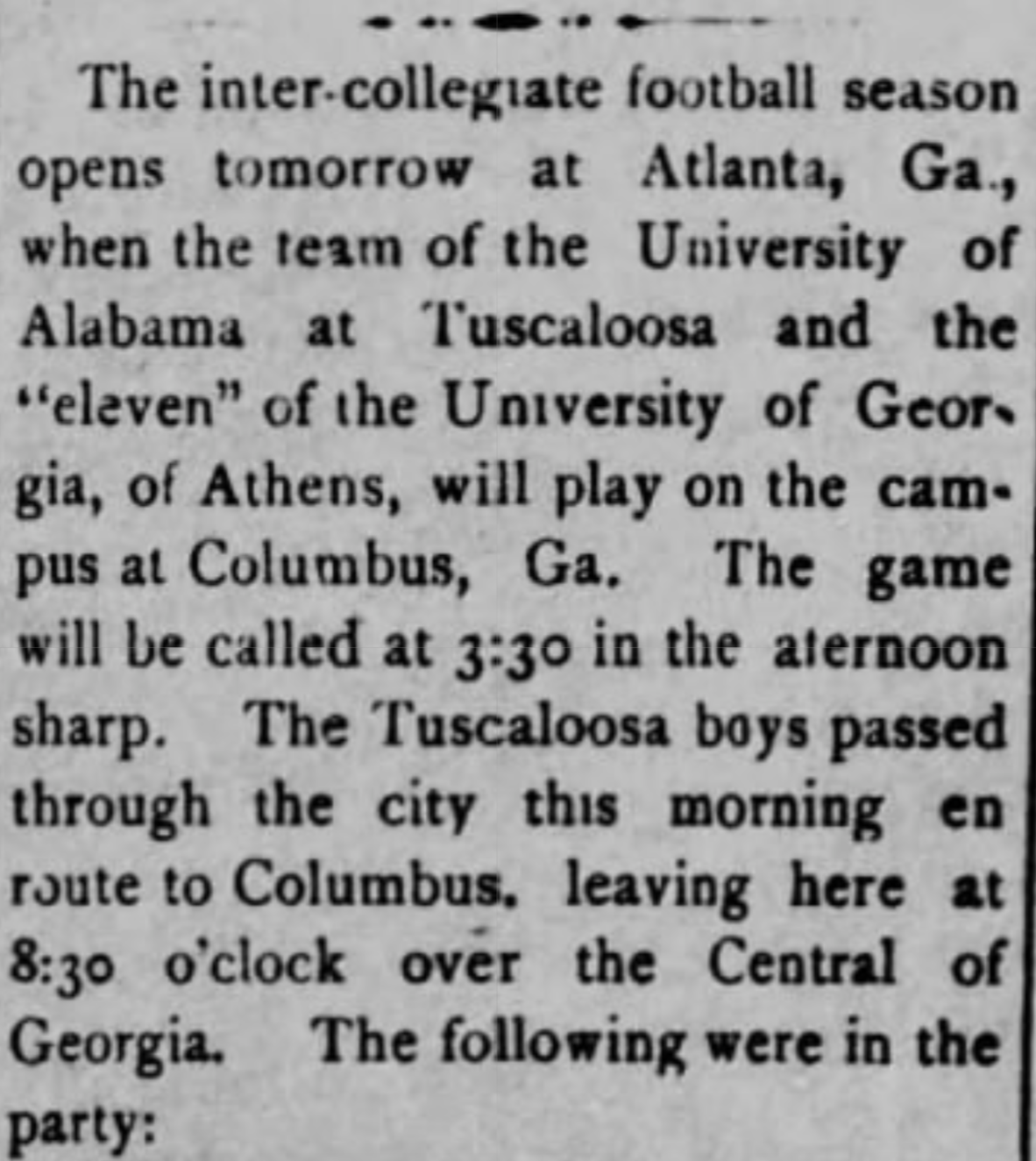
The game kicked off at 3:30 p.m. in front of 500 cheering fans and it seemed to be Alabama who captured the momentum early, as a blocked punt and recovery put the team from Tuscaloosa on the scoreboard first.
Georgia would regain their composure after the special teams breakdown, however, and score 18 unanswered points on the ground going into the half.
The second half would be marked by a ball-control offense on the part of the home team, who held the football for most of third and fourth quarters on their way to a 30-6 win over Alabama.
After coming off a successful campaign the previous year, the loss was a hard one to swallow for Alabama as it embarked on a stretch of three more games played over a little more than a week.
For those at home complaining about Bill O'Brien's play-calling for the Tide's current offense, it's worth noting that the 1895 Alabama squad would only score one more touchdown during the season. This came in a 12-6 loss in Baton Rouge to LSU, before Alabama ended its season with a crushing 48-0 loss to Auburn on the Quad in Tuscaloosa — just the fourth installment of what would become known as The Iron Bowl.
Back in the present, after the Alabama band buses passed me going the opposite direction on the interstate, I was reminded of just how far the game has come since those halcyon days absent of face masks, overpaid coaches and stadium lighting.
Still, the ghosts of those gridiron forefathers can be seen on college campuses across the southeast. They come in the form of statues, names on buildings and can be seen in the hearts of every cheering fan who buys a ticket for a Saturday ballgame.
And while Alabama is a consensus underdog in Saturday's SEC title bout with Georgia, much like the 1895 team, it's worth appreciating how long this rivalry has persisted.
After all, it’s important we never forget the names, places and memories that make such a peculiar obsession possible.
Have a news tip or suggestion on how I can improve Tuscaloosa Patch? Maybe you're interested in having your business become one of the latest sponsors for Tuscaloosa Patch? Email all inquiries to me at ryan.phillips@patch.com
Get more local news delivered straight to your inbox. Sign up for free Patch newsletters and alerts.