Community Corner
The Ghosts Of Bloody Tuesday: Remembering 'Tuscaloosa's Freedom Summer'
Thursday marks the 58th Anniversary of Blood Tuesday, so we set out to build the most in-depth historical narrative of the event to date.


EDITOR'S NOTE: This story is dedicated to my friend Ulysses Lavender, without whom this story would not have been possible and to the memory of the late Bill Buchanan, who loved Tuscaloosa history and was instrumental in the development of the Tuscaloosa Civil Rights Trail.
TUSCALOOSA, AL — An unnamed Tuscaloosa Police officer had an uneasy feeling in his gut the morning of June 9, 1964 as he sat in his squad car.
Just after 8 a.m. on what would have otherwise been a quiet summer day, the officer was parked near First African Baptist Church in downtown Tuscaloosa on what is now Stillman Boulevard.
Find out what's happening in Tuscaloosafor free with the latest updates from Patch.
Click here to subscribe to our free daily newsletter and breaking news alerts.
Even his colleagues, some of whom stood talking with others outside of their patrol cars, were reportedly relaxed.
Find out what's happening in Tuscaloosafor free with the latest updates from Patch.
It's unclear exactly how this particular officer viewed the situation unfolding in front of him or what role he would eventually play later that day as he watched small groups of two and three — primarily Black teenagers — make their way down city sidewalks and into the historic church.
Still, he could sense something was off.
"Something bad is gonna happen today, I just know it is," he told a newspaper reporter that Tuesday prior to the violence. "I have never been involved in anything like this."
The Tuscaloosa News correspondent covering the events that day wrote about the early-morning mood as nothing out of the ordinary, with demonstrators heard laughing and chatting inside the church and on its steps facing out to the street.
The tranquility would be short-lived, though.
At day's end, nearly 100 people — including close to two-dozen juveniles — sat behind bars in the Tuscaloosa County Jail. Meanwhile, across town, dozens of others were treated at Druid City Hospital for injuries sustained in the racially-fueled mayhem that is still referred to today in Tuscaloosa as "Bloody Tuesday."
Thursday marks the 58th anniversary of the pivotal event, which saw peaceful demonstrators and marchers attacked by local police amid their protests of segregated accommodations in the newly-opened Tuscaloosa County Courthouse.
In an effort to preserve history and bring the story of Bloody Tuesday into sharper focus, Tuscaloosa Patch set out to build the most in-depth narrative on the subject to date, in order to provide a timeline of that fateful day and the events that followed ... all of which had a profound impact not just on our local history in Tuscaloosa, but the Civil Rights Movement as a whole.
THE BUILD UP ![]()
Martin Luther King Jr. speaks at First African Baptist Church in Tuscaloosa in March 1964 (Photo provided with permission from the Tuscaloosa Civil Rights History and Reconciliation Foundation)

The morning of April 12, 1964 was a cold and rainy one as area and state officials gathered for the dedication of the new Tuscaloosa County Courthouse.
The highly-anticipated event was also attended by Alabama Governor George Wallace and a large contingency of locals hoping to snag an autograph or glimpse of the short, pink-faced segregationist.
The unfavorable elements resulted in the day's festivities being moved indoors to the second-floor courtroom of Judge W.C. Warren. According to newspaper accounts, two adjoining courtrooms were filled to capacity as a public address system echoed the sounds of the ceremony to the hundreds in attendance.
In an account published in the Tuscaloosa News, the controversial governor referred to the new courthouse as "a temple of justice which personifies and typifies the spirit of the people who live in Tuscaloosa County," before going on to call Tuscaloosa his second home.
As a side note: Wallace also teased the possibility of moving the state capitol to Tuscaloosa, which was the birthplace of his wife and the first woman to serve as governor of Alabama, Lurleen B. Wallace.
"Alabama has moved forward," he told the excitable crowd made up primarily of White citizens, before touting his administration's efforts on the state's business climate and public education.
Looking back on that same moment in time, Danny Steele — whose family name graces the historic Van Hoose & Steele Funeral Home on Stillman Boulevard — provided a stark contrast with his view of the oppressive atmosphere in segregation-era Alabama.
Memories like having to use the side window to place an order at Dairy Queen, not being allowed to sit at the lunch counter inside Woolworths in downtown Tuscaloosa and being barred from attending University of Alabama baseball games, which were played in a stadium within walking distance of his family's front yard.
Steele also remembered the bus boycotts and, during his interview with Patch, recited the first verse of the classic protest song "If You Miss Me at the Back of the Bus" by White folk singer Pete Seeger.
"If you miss me at the back of the bus, and you can't find me nowhere.
Come on up to the front of the bus, I'll be sittin' right there.
I'll be sittin' right there, I'll be sittin' right there.
Come on up to the front of the bus, I'll be sittin' right there.
"We would go downtown, just for the heck of it, no structured protest, and turn both water fountains on — the Black and White ones — and we would say 'we can't see any difference," he said with a laugh.
But George Wallace's focus during the courthouse dedication ceremony eventually turned to the proposed Civil Rights Act of 1964 — a landmark piece of legislation introduced by the late President John F. Kennedy and signed into law later that summer by President Lyndon B. Johnson that formally outlawed discrimination based on race, sex, religion, etc.
Wallace's words that day eventually proved somewhat prophetic, albeit likely not in the way he intended, as he exclaimed the Civil Rights Act of 1964 would result in "something that will compound every problem we have in this country, both for whites and blacks."
"If this bill passes in its present form there will be no need for new courthouses or even a capitol building in Alabama," Wallace told those gathered at the Tuscaloosa County Courthouse. "The people here will have no power or authority."
Apart from the populist political theater on display that dreary April morning, the seeds of discontent began to sprout amongst Tuscaloosa's Black population and its leaders, many of whom were under the impression that the brand new courthouse would feature racially-integrated accommodations.
Irene Byrd, who was a teenager at the time, recalled the empty promises made that the signs would come down, which came less than a year after Wallace attempted to buck the federal government's forced integration of the University of Alabama. The negative media attention focused on Tuscaloosa in 1963 no doubt dealt a black eye to the city's image, resulting in coverage of little else in local media relating to Civil Rights demonstrations after Wallace's ill-fated stand.
"They were already somewhat embarrassed by that and [Civil Rights protests in Tuscaloosa] just didn't get much news coverage after that," she said in an interview with Patch, describing the outside perception of the movement.
Instead, Tuscaloosa's Black community was met with the familiar signs in the courthouse pointing out segregated bathrooms and drinking fountains. And it would be this blatant act of dishonesty and institutional racism that spurred one young pastor to rally support and answer the call to action.

Theophilus Yelverton Rogers, Jr. was the first child born to T.Y. Rogers and his wife Hester in the Brewersville community of Sumter County sometime in 1935.
His upbringing was understandably less than modest, as his father worked as a laborer to support the family. Still, the son of T.Y. Rogers Sr. eventually had the means and credentials to leave home to attend school, earning his undergraduate degree from Alabama State College in Montgomery.
Rogers then apparently felt the call of the Lord to preach and worked to earn his divinity degree from Crozer Theological Seminary in Pennsylvania with the encouragement of an up-and-coming activist and firebrand preacher from Atlanta named Martin Luther King, Jr.
King was quite fond of Rogers, going so far as to employ the young preacher as an assistant pastor at the famous Dexter Avenue Baptist Church in Montgomery during the early days of his career. This is where he would become a lieutenant in the movement and a devoted follower of King.
"He was just like Martin Luther King," Danny Steele told Patch in an interview, as he remembered back to his teenage years and involvement in the local fight for equality. "If you couldn't see him, but heard him speak, you would think he was Martin Luther King. He was so dynamic."
And it would be King who ultimately recommended Rogers to become the head pastor at First African Baptist Church in Tuscaloosa in January 1964. King even attended a service at the church and spoke to a packed house as the 28-year-old Rogers was formally introduced in his new role in March 1964.
Steele then made it a point to explain why church leaders, particularly head pastors, were the primary spokespeople for the local movement.
"Almost every minister in town supported [the Tuscaloosa Citizens for Action Committee] and the reason the ministers were in charge is they were self-employed," he said. "My mother was a teacher and when the school superintendent found out I was demonstrating, he called her in and threatened her job."
Once installed as pastor in Tuscaloosa, Reverend T.Y. Rogers made sure to waste no time hitting the ground running, as he quickly became the executive director of the Tuscaloosa Citizens for Action Committee that year and, along with others, set in motion the course of events that would become known as "Tuscaloosa's Freedom Summer."
But it was no doubt the continued segregation of courthouse accommodations that truly sparked the turbulent events that would come to define Tuscaloosa in 1964 — coming two days short of a year since Wallace's failed "Stand In The Schoolhouse Door" at the University of Alabama and less than a month before the Civil Rights Act of 1964 was signed into law.
THE BATTLE OF TUSCALOOSA
Around 9:15 a.m. on the morning of June 9, 1964, the aforementioned Tuscaloosa Police officer's patrol car radio crackled out a call from headquarters ordering all units to report to back to pick up additional personnel and riot gear.
Most importantly, though, the officers were told they would also receive "last-minute instructions," according to one contemporary account in the Tuscaloosa News. It remains unclear to this day exactly what those instructions were, but police returned to the church with a visibly militarized presence, sporting police batons, fire hoses, tear gas and mustard oil.
The situation was rapidly deteriorating.
Black journalist Sylvester Leaks — reporting for the Nation of Islam's publication "Muhammed Speaks" — provided some of the most unfiltered and illuminating accounts of Bloody Tuesday, detailing topics such as clandestine surveillance of outsiders by local police and the wiretapping of certain phone booths in Tuscaloosa.
It was also Leaks who chronicled the demonstrations that had been going on with increasing regularity following the courthouse debacle in April.
In a somewhat militant tone, Leaks exclaimed that the Black community in Tuscaloosa was ready and willing to do what was needed to rid itself of oppression and humiliation.
"One leaves here convinced that Tuscaloosa will not be another Birmingham," Leaks wrote, mentioning the ongoing racial tensions and violence in Alabama's largest city. "The Negroes are armed and prepared to meet violence with violence. Their homes, churches ... must be protected."
While Leak's account could have been intended to serve several purposes, locals speaking to Patch recalled a much more peaceful attitude at large in the community.
However, in a fascinating and overlooked instance that deserves a story all its own, leaders in the Black community, led by the late Joe Mallisham, did indeed form armed groups — known as "The Defenders" — that provided protection to those in the Black community, in addition to the members of the White community who lent their support in the fight for equality and were threatened as a result.
But on Tuesday, June 9, 1964, as the authorities armed themselves to the teeth, the jovial sounds of singing and clapping could be heard from First African Baptist Church. Organized by Rogers, the church that day was filled with excitement and anticipation ahead of a planned march and demonstration in protest of the courthouse's accommodations.
As celebrated Civil Rights foot soldier Maxie Thomas recalled during a past video interview for the Tuscaloosa Civil Rights Trail, the end goal was for the marchers to make it downtown, where they planned to enter Whites-only bathrooms and drink from Whites-only water fountains in the new county courthouse.
Byrd, who was one of between 500 and 600 people in attendance at the church that day, told Patch the event served as a kind of "pep rally" for the day's larger public demonstration. Only 16 years old at the time and one of many socially-aware teenagers, Byrd became involved in the cause by way of her boyfriend and future husband, who was a close lieutenant for Rogers.
"He thought the Reverend T.Y. Rogers was sent from heaven and he was a member of church," she said. "[My boyfriend] was out of town in New York, so me and one of his classmates went up [to the church] that morning and we had been prepared for everything on that Tuesday morning ... it was sort of like a pep rally to go and do what we had to do. Being a 16 year old and bright eyed, I was maybe a little bit fearless. We were ready to go, but maybe that is a characteristic of being young."
The unnamed Tuscaloosa News correspondent in the field that day said Rogers delivered an inspirational speech to those gathered, with the crowd breaking into "freedom songs" — of which the journalist noted the tempo built up for "what seemed like hours."
"The group started shouting, singing, clapping their hands and stomping their feet," the reporter wrote. "Their singing could be heard a block or more away."
Former Tuscaloosa City Councilman Harrison Taylor was one of the many teenage foot soldiers on hand and told me last February about the overall tone inside the church that morning.
"They could have had alligators around that church and we were still going to march," he said.
Meanwhile, as the excitement inside reached its crescendo, patrol cars began to pull up and park along the streets surrounding the church. This time, the much-larger contingency was made up of both city and county police officers, firefighters, state officials and FBI agents.
Then, the doors to the church swung open and the showdown began.
Several contemporary newspaper accounts described the tone in the community on that Tuesday, mentioning that many on both sides expected an inevitable violent confrontation following the steady build up of tensions over the previous months.
Tuscaloosa Police Chief W.M. "Bill" Marable was considered the tip of the spear by city officials opposed to public demonstrations and was out at the church that morning when peaceful protestors — led at the very front by Rogers — began to slowly file out of the church and out into the street.
Credited with designing the uniform patch still worn by the Tuscaloosa Police Department and securing the department's first polygraph machine, Marable was named police chief in 1962.
Despite the abject failure that awaited Marable and his officers that day, it's worth noting that he would go on to hire the department's first two Black officers in each of the years that followed the events of Bloody Tuesday.
And it was indeed Marable, surrounded by officers, who was the first man to approach Rogers from the opposite end of the block.
In what is easily one of the most important moments in the city's history, the two met face-to-face in front of Van Hoose & Steele Funeral Home. Along the street, Steele and Byrd both remembered the scowling faces of deputized citizens who wielded clubs and various other impromptu weapons.
"Most of the people who were there were citizens," Byrd told Patch. "They were empowered to help keep the negroes in line. They knew they were prepared to do what they did. And, of course, it was made out [in the press] like the negroes were unruly."
The Tuscaloosa News reported that Marable was the first to speak when he and Rogers met, as he reminded the reverend of the city's recent ban on large-scale public demonstrations.
"You have heard my orders that you will not be allowed to march," the police chief is reported to have said. "Do you intend to march anyways?"
In response, Rogers nodded and replied with a simple "Yes."
To this day, the few seconds that followed remain something of a mystery as all hell broke loose out in the street.
What is known, however, thanks to surviving newspaper accounts and eyewitness testimony gathered by Patch, is that Marable informed Rogers he was under arrest and grabbed him by his coat before shoving him toward a patrol car that had been called for the sole purpose of taking the young pastor to jail.
Byrd then remembered the scene as armed police and deputized citizens began their push to disperse the crowd, which resulted in hundreds of people seeking refuge in the church. But as many demonstrators clamored over one another for shelter, police clad in riot gear and armed with clubs and electric cattle prods began their offensive and violently worked to hasten the retreat.
As she attempted to flee the chaos, Byrd felt a sharp jolt in her side from a cattle prod.
At the same time, amidst the commotion in the street shrouded by thick clouds of tear gas, some marchers fell to the pavement as the police line pushed forward, while others could be seen bleeding from head and face injuries delivered by the business end of a wooden night stick.
Steele then recalled the heart-wrenching sight of his friend James Gee — affectionately referred to as "Tick" — who suffered from polio in his right leg.
"I felt the effects of the tear gas, my eyes were burning, nose was running, but I didn't get hit with a billy club," he told Patch. "One guy, a friend of mine named James Gee, and my brother and I were trying to get to the funeral home when this short deputy stops us. So James cursed him."
In the moments that followed, Steele thought back to when he and his brother were forced inside their family's funeral home, while Tick was left outside.
"They knocked all his teeth out with a billy club," Steele said, his voice heavy with emotion.
While the violence on the street was unlike anything felt by Tuscaloosa before or since, it reportedly took less than five minutes for the crowd to be pushed from the street and forced back in the church.
Still, the worst was yet to come.
The Tuscaloosa News reporter witnessing the violence intensify wrote that many demonstrators first gathered in the foyer of the church, shouting "We want freedom, come and get us, we want to go to jail." Other demonstrators could also be seen hanging from first and second story windows shouting similar protests.
It's worth noting that this attitude on the part of the peaceful demonstrators would prove to be far from a bluff, especially when considering Rogers the previous night had instructed those gathered to "Bring your toothbrush and your toothpaste ... We are going to stay there in jail until we get ready to come out."
Byrd and Steele — both teenagers on Bloody Tuesday — were far from bashful about their beliefs and said fear never crossed their minds, even during the most intense moments that day. While Steele was forced into his family's business after the fighting on the street subsided, Byrd was seeking shelter with hundreds of others in the church.
Contemporary accounts of what happened next also differ, as White-owned publications painted the demonstrators as antagonists. Indeed, on the front page of the Tuscaloosa News the next day, a photo of a broken stained-glass window was featured that implied it had been shattered by one of the demonstrators.
"The coverage made us look like we were mean or that we were rebels," Byrd said. "[The demonstrators] didn't shoot one window out, but the police shot out the majority of those beautiful stained glass windows. They demolished the church that day."
The scene was a brutal and heartbreaking one, recalled late Tuscaloosa businessman and pastor Thomas Linton in an interview with Alabama Public Radio in 2013. Linton's barbershop, now a stop on the Tuscaloosa Civil Rights Trail, was a central hub for activism during the Civil Rights Movement and provided a safe space for anyone in need.
"It was a bad day for Tuscaloosa,” Linton said. “I never saw a church attacked before.”
Click here or on the video link below to learn about the history of Linton's barbershop and the role it occupied in Tuscaloosa's Black community during the Civil Rights Movement.
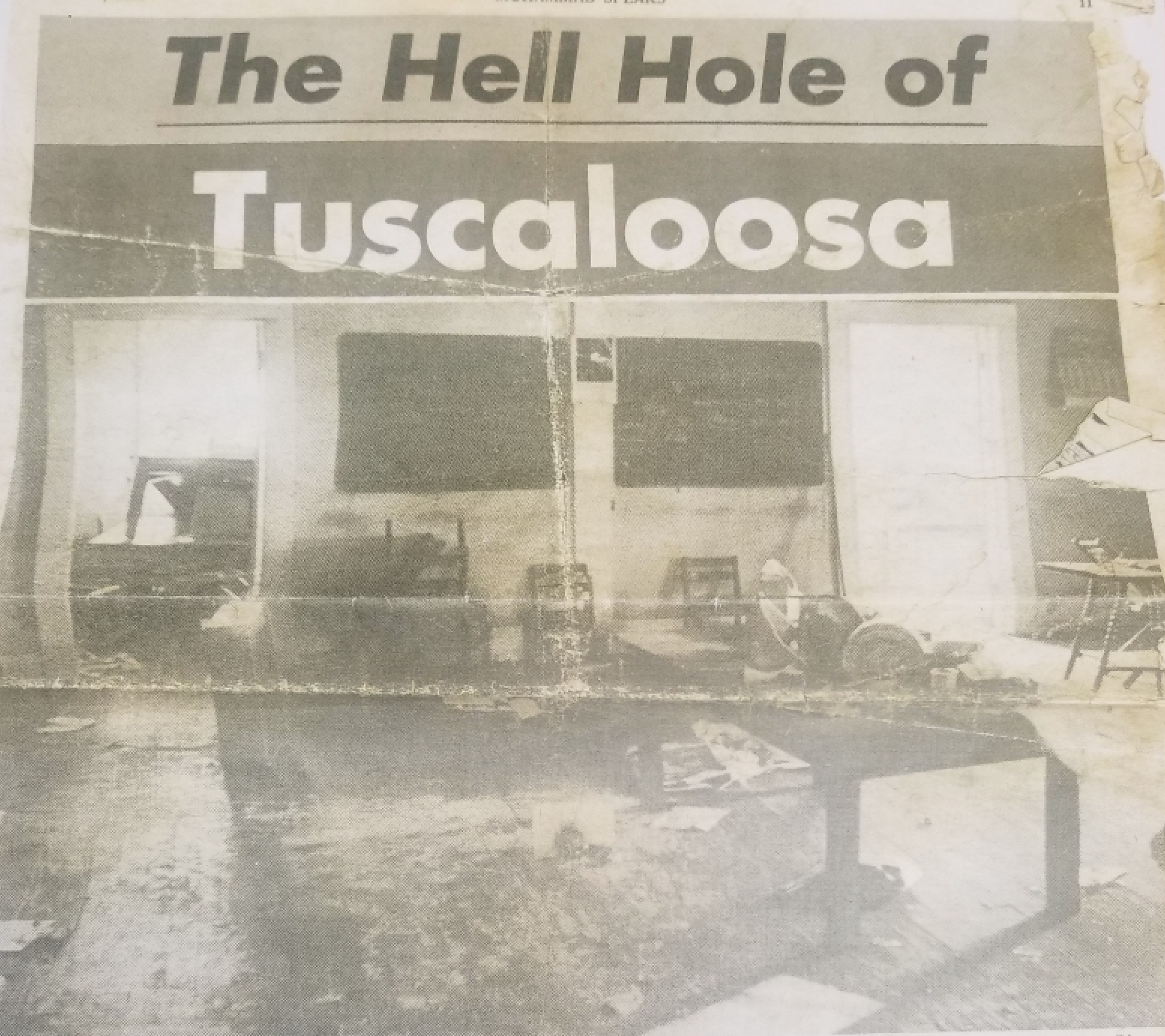
But as many ran through the streets to Linton's barbershop or their nearby homes, Byrd and others hid in a room in the church referred to as "The Hell Hole."
"I ran and tried to hide, I tried to cover my face," she said. "I had never experienced tear gas before. Many of us were forced into that area. I don't even know how long we were in there. I couldn't tell you to this day. But I know I didn't die. At some point in time, the police forced us out and told us to go home. "
It was all over in less than an hour. All told, 33 people were injured and required medical attention, while another 94 were jailed. The historic First African Baptist Church, a victim of tear gas canisters and fire hoses, sustained untold damage.
Of those arrested, some were never formally charged with a crime but held behind bars anyways — in a cohort of fellow demonstrators that included more than two dozen juveniles who were eventually released to the custody of their parents.
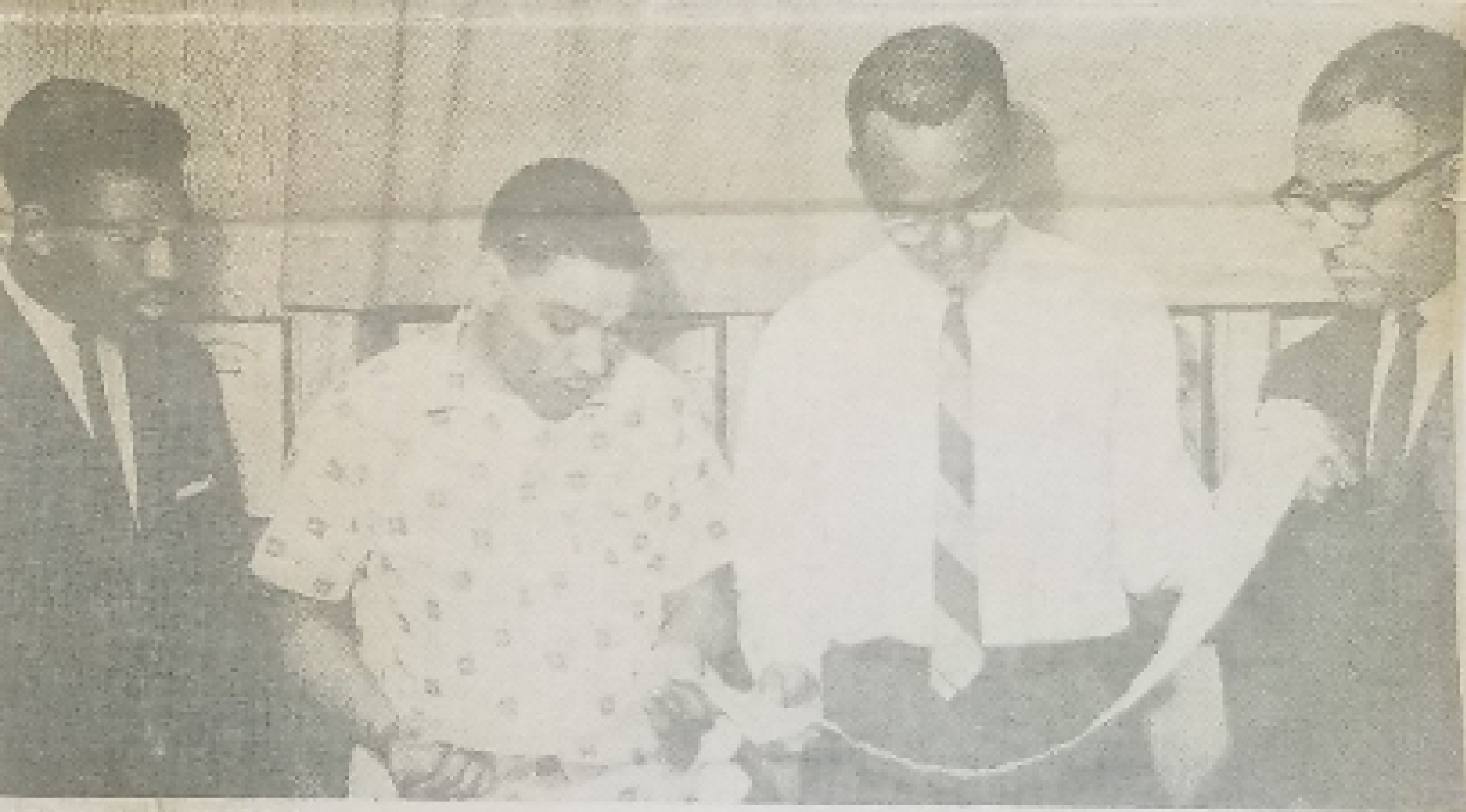
In the aftermath, Sylvester Leaks reported on the toll taken by violence in the Nation of Islam's publication "Muhammed Speaks." The coverage included a photo of Tuscaloosa civil rights icon and foot soldier Maxie Thomas sporting a white bandage over his injured right eye after being struck with a club.
Another photo depicted the swollen face of a young woman, who Leaks said was hit in the face with a kind of improvised explosive device or potentially a tear gas canister, resulting in her hair having to be cut and her eyes swelling shut.
While there were no deaths as a result of Bloody Tuesday, the events of that day are remembered today as a final act of desperation on the part of segregationists hell bent on holding on to power, despite the looming passage of legislation that would change the course of the entire country.
THE AFTERMATH
Few events in Tuscaloosa's history have been as easily forgotten as Bloody Tuesday. The occasion is absent in Alabama history textbooks and, in the present day, is relegated mostly to a small iron historical marker and accompanying visual display outside of the church.
But while the story of Bloody Tuesday is easily overlooked with the passing of time, the days and weeks that followed have been left mostly to fade into obscurity.
For instance, in the wake of the violence, city leaders were vocal in their criticism of Rogers, on whom they squarely placed blame. It's no secret that these Tuscaloosa elected officials and others in positions of power were adamantly opposed to integration, so it should come as no surprise that their finger-pointing did not age well.
"I no longer consider the Rev. Rogers a responsible leader of the Negro population in Tuscaloosa," Tuscaloosa Mayor George Van Tassel said in the days that followed Bloody Tuesday. "In fact, I consider his leadership irresponsible."
The fight was far from over for either side, though.
Indeed, in the immediate aftermath of the violence, the Tuscaloosa Citizens for Action Committee took their fight to the courtroom, pleading with a federal judge to block local police from interfering in future peaceful demonstrations. The request ultimately fell on deaf ears, as the judge opted to continue the hearing in early July.
What's more, less than two weeks after Bloody Tuesday, a federal judge refused to take jurisdiction of the cases of those arrested on Bloody Tuesday, referring them back to Tuscaloosa Municipal Court.
But when considering the lack of action by the federal court to step in when it came to police interference in protests, the same federal judge in Birmingham opted against handing down any ruling, due to the passage of the Civil Rights Act of 1964 just four days prior.
The wait-and-see approach by the federal court would yield little to no formal reprieve for the Black community in Tuscaloosa, but underscores yet another pitfall faced by those in a seemingly insurmountable struggle for equal rights.
Rev. T.Y. Rogers would go on to marry Byrd and her husband in one of the offices at First African Baptist Church and the road running alongside the church bears his name.
"I'll never forget him," Byrd said of Rogers. "He was a really funny, articulate, and smart man."
Rogers saw his life tragically cut short on March 26, 1971 when he was killed in a traffic accident while visiting Atlanta. He was 36 years old.
His funeral was presided over by Rev. Ralph David Abernathy — a towering icon of the Civil Rights Movement and then-president of the Southern Christian Leadership Conference. Rogers was buried beneath a modest headstone alongside his family in rural Sumter County.
The legacy of T.Y. Rogers will no doubt be remembered for generations to come, but for folks like Byrd and Steele, there has only been sparse outreach from Tuscaloosa-area institutions when it comes to reconciliation.
"We have never received any reconciliatory remarks," Byrd told Patch. "Tuscaloosa Mayor Walt Maddox did send a video and spoke on it officially, so I was proud of him for that. But we want to celebrate and elevate that day. Had it been publicized and treated fairly, it might have even overshadowed Selma."
History is a funny thing, Byrd told me, explaining the age-old adage concerning what happens to those who fail to remember their history. A student of history herself who wrote a book detailing the history of First African Baptist Church, she stressed the need to keep the memory of Bloody Tuesday alive for future generations to remember and learn from.
"I don't know what's going on now in the world, but I see it and feel it and I think about how this nation is changing and the things happening that are not friendly," Byrd said. "Freedom is not always free and we just have to stay diligent. If you don't stand up and speak out, they will kill you and say you enjoyed it."
Have a news tip or suggestion on how I can improve Tuscaloosa Patch? Maybe you're interested in having your business become one of the latest sponsors for Tuscaloosa Patch? Email all inquiries to me at ryan.phillips@patch.com
Get more local news delivered straight to your inbox. Sign up for free Patch newsletters and alerts.