Crime & Safety
The Killing Of John Awtrey: Tuscaloosa County's First Line-Of-Duty Police Death
Patch takes a deep dive into local history on the anniversary of the first line-of-duty law enforcement death in Tuscaloosa County.


Editor's Note: This story includes depictions of violence and strong language with racial overtones. Reader discretion is advised.
TUSCALOOSA, AL — January 24 is a date that goes largely unnoticed in Tuscaloosa County, apart from the folks at the Tuscaloosa County Sheriff's Office.
Click here to subscribe to our free daily newsletter and breaking news alerts.
Find out what's happening in Tuscaloosafor free with the latest updates from Patch.
It's a solemn day of reflection for the handful of locals and old-timers who remember the stories and one easily lost in the static of today's fast-moving news cycle.
An unimportant anniversary on its face, Monday represented 134 years since Tuscaloosa County Sheriff's Deputy John Manning Awtrey was gunned down while serving an arrest warrant in the southern part of the county. His murder marked the first law enforcement death in the line of duty in Tuscaloosa's history.
Find out what's happening in Tuscaloosafor free with the latest updates from Patch.
Since little has been documented about the 53-year-old deputy at present, Tuscaloosa Patch set out to tell a more complete story of who Awtrey was and how he met his untimely end as the county observes the anniversary of his death.
The Man Behind The Badge
![]()
John Manning Awtrey and his wife, Lizzie in 1880 (Tuscaloosa County Sheriff's Office)

While debate persists over the spelling of his surname (Autrie, Awtrey, Autrey), John Manning Awtrey was born in Resaca, Georgia — a small town in Henry County near the Tennessee border — on July 15, 1834. According to family records, his middle name was in honor of his paternal grandfather, while his mother likely died during childbirth or as a result of complications shortly thereafter.
John grew up in the hills of north Georgia, also in nearby Murray County, and would marry Margaret Elizabeth "Lizzie" Stewart in 1853. Nuptials would be followed by the birth of the couple's first daughter, Francis, in 1856, followed by a son, Joseph Alexander, in 1858.
Alabama Homestead Records show in 1859, the young couple would go west after purchasing 240 acres in Tuscaloosa County, Alabama. While it serves as no indication of his politics, it's at least worth pointing out that Awtrey was not among the names of Tuscaloosa County slaveowners during the 1860 census, prior to the outbreak of the American Civil War.
War would come, nonetheless, for Awtrey and the rest of the young nation in 1861. The Alabama Civil War Muster, which provides a roster of Alabama men who enlisted, shows Awtrey served in G Company of the 50th Alabama Infantry — a unit that saw its heaviest fighting in north Mississippi and Tennessee, particularly at the Battle of Shiloh.
Little is known of his time during the war and, by all accounts, he returned to his land in Tuscaloosa County. John and Lizzie would have five more children following the war — two sons and three daughters.
In looking for steady work after the war, it was during this time that he found his calling as a lawman, joining the sheriff's office sometime around 1878. Apart from being described in the Eutaw Mirror newspaper as "greatly popular" in the community he served, even less is known about his law enforcement service than his time during the Civil War.
Alabama was a hard place during the post-war Reconstruction Era. Violence and mob rule were commonplace, as Union occupation gave way to Jim Crow terrorism with the approach of the 20th century. Apart from speculation, though, Autrey was indeed a Tuscaloosa County deputy during at least one high-profile lynching in the area.
Andy Burke, a 22-year-old Black man, was arrested in July 1884 after a young white girl accused him of strangling her before being frightened off. He was later identified as a suspect and was quietly jailed after a large-scale manhunt. However, word would spread quickly around town and a lynch mob broke into the Old Tuscaloosa Jail and dragged Burke to a nearby tree to be hanged.
It was a violent scene devoid of due process and one where lawmen not only stood by, but likely participated in the unnecessarily-cathartic, racially-charged execution.
It's unclear and will likely never be known if Awtrey was involved with that lynch mob, but the context underscores the brutality of the day. Life was cheap and, for those who lived by violence, they so often met their end by the same fortune.
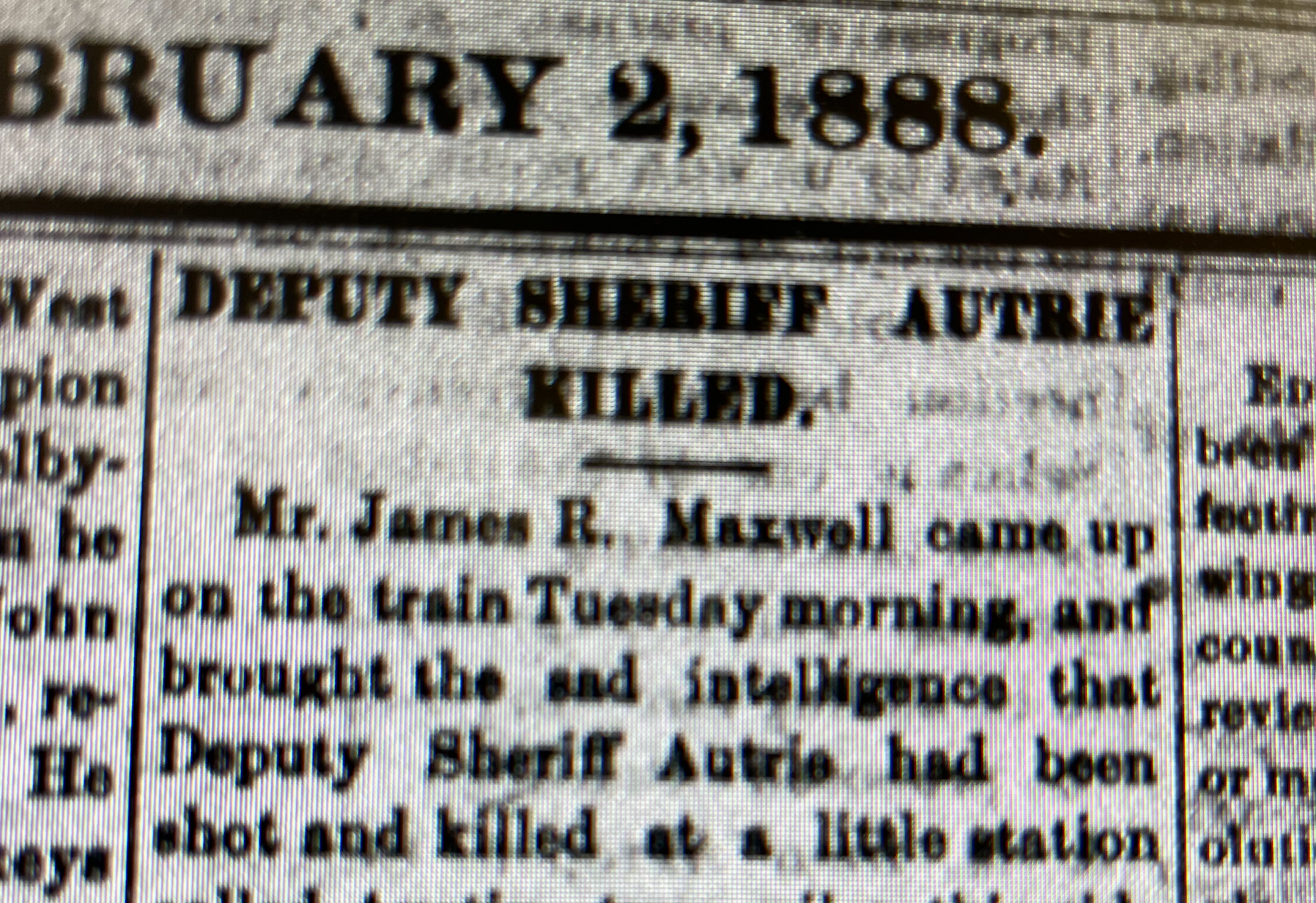
Jan. 24, 1888![]()
The headline from the Tuskaloosa Gazette describing the killing of John Manning Awtrey (Tuscaloosa Public Library Archives)
Jim Seams was a Black man who lived in the Austin community, roughly two miles from Hulls in the southern part of Tuscaloosa County. Few, if any, other details are known about the man, apart from the color of his skin and the conflicting events leading to his death.
Newspaper reports from the time paint two different pictures of what happened that Tuesday morning. While The Eutaw Mirror asserts that Seams was wanted for "some trivial offense," the Tuskaloosa Gazette insisted he had an outstanding warrant for "assault with intent to murder."
On the orders of Tuscaloosa County Sheriff J.O. Prude, deputies John Awtrey and Arthur Carpenter rode to the Austin community to carry out the seemingly routine arrest warrant where Seams was known to stay.
Accounts vary of what happened next.
According to lore and the Tuscaloosa County Sheriff's Office on the anniversary of the incident, Seams was carrying firewood when he spotted the two lawmen and ran inside his home to retrieve a shotgun.
Conversely, reporting in the Eutaw newspaper said Awtrey spoke with Seams and allowed him to go into the house for his coat and hat for the cold horse ride (or walk) back to the local jail.
While it may never be known just who fired the first shot that day, different newspaper and historical accounts agree that Seams reappeared on the porch of his home with a double-barrel shotgun and shot Awtrey where he stood.
The 53-year-old lawman was likely dead before he hit the ground.
After his pistol failed to fire, Carpenter — standing nearby — then reportedly tussled with Seams, who was able to escape into the marshlands of southern Tuscaloosa County.
"The news of the killing of Mr. Autrey was broken to his family as gently as possible," the Tuskaloosa Gazette reported on Feb. 2, 1888. "It was a great shock to them and their grief was heartrending. The scene at the jail when his little children came home from the public school and heard the sad news of the killing of their father broken to them beggars description."
Awtrey would be buried in a family plot in the now-historic Greenwood Cemetery, which sits in the shadow of Bryant-Denny Stadium on the University of Alabama campus.
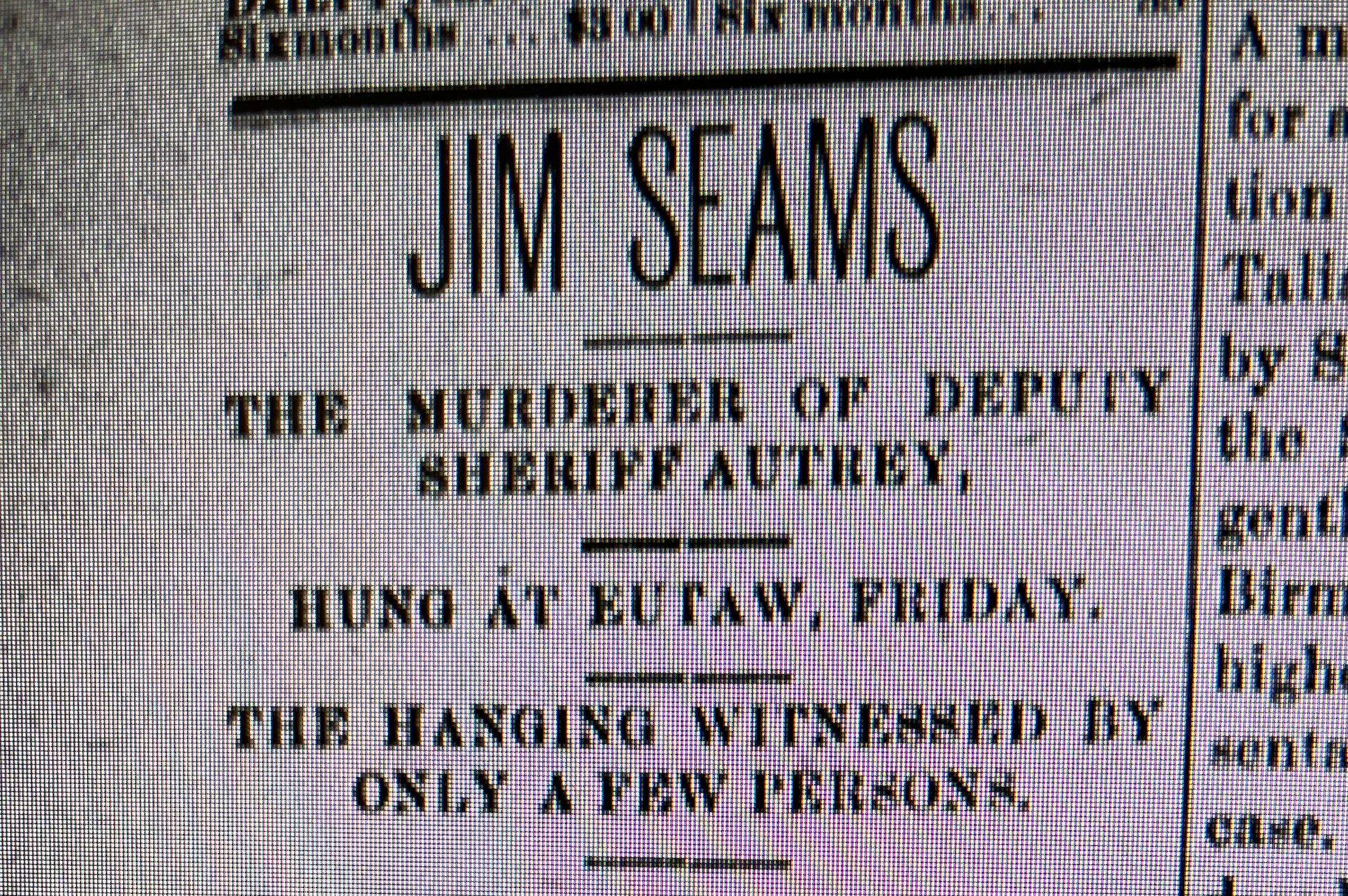
The Hanging of Jim Seams ![]()
A headline from a Tuskaloosa Gazette story about the execution of Jim Seams for the murder of the Tuscaloosa deputy (Tuscaloosa Public Library Archives)
While Black-on-White offenses, particularly those with any kind of perceived sexual component, were generally met in the Deep South with mob anger that often resulted in lynchings, the citizens of Tuscaloosa seemed to have a strong desire for due process in this particular case.
Indeed, numerous articles published in the immediate aftermath told of the biracial effort to bring Seams to justice in the hopes of avoiding a heinous public lynching.
"Several colored men from the city left on horseback to join in the pursuit," The Tuskaloosa Gazette noted. The paper, a more progressive publication when compared to its local peers, went on to say: "We do not mean by this to mob [Seams], but hold him and let the law take its course."
Seams was ultimately found seeking refuge in the cabin of a Black family and was transported without incident back to Tuscaloosa to await trial. Sheriff Prude, according to one newspaper report, paid a $250 reward out of his own pocket to an unnamed party who provided information leading the posse to Seams.
As for the other money Prude reportedly spent during the search effort, one newspaper article speculated the sheriff would likely be out $300 to $400, primarily due to the failure of Gov. Thomas Seay to offer anything in the way of reward money or financial assistance.
The local newspaper in Tuscaloosa was laudatory of the sheriff after the apprehension of Seams, writing "Mr. Prude has come square up to the scratch and has paid what he promised like a man. He has acted all the way through the matter in a way calculated to make friends, at the same time discharging his duties as an officer of the law in a conscientious manner."
It's worth noting, in the days and weeks leading up to a trial in Tuscaloosa County Circuit Court, Sheriff Prude had Seams moved to a jail in Birmingham, so as to quell the tempers of mobs who demanded lynching Seams as retribution for the killing of the deputy.
The fall 1888 Circuit Court term would see Seams convicted of murder, but an appeal to the Alabama Supreme Court would allow him to be granted a change of venue, with a second trial held shortly thereafter in Eutaw. His second trial produced the same result, however, with a judge handing down a death sentence by hanging.
The events of the hanging of Jim Seams were grim and well-documented.
At exactly 11:30 a.m. on Friday, Jan. 25, 1889, Seams was led to the gallows by a "Sheriff Cullen" and his deputies, along with some of his family, two newspaper reporters, a Black preacher, and the Greene County circuit clerk.
One report said Seams wore a brand new suit of clothes, paid for by Cullen.
As a quick side note: Sheriff Cullen is an interesting character all his own. A few years later in 1892, as one story passed down through history says, Cullen formed a secret posse to infiltrate a violent mob of about 50 men that had set out from neighboring Pickens County to take a Black man from a jail in Greene County. The sheriff was successful in thwarting the mob and rescuing the jail inmate, with the story becoming the stuff of law enforcement legend in west Alabama.
Cullen hadn't been made a hero yet, though, and on this day in 1889 he was tasked with overseeing a public execution. The Eutaw Mirror reported immediately following the hanging that Seams had requested the specific date and time for his execution, so his body could be shipped to his relatives on a local freight that would be passing through just after noon on January 25.
Unlike the jovial, carnival-like atmospheres openly documented during unlawful public lynchings of the time, the air was reportedly cold and somber that January day — a year and a day since Deputy John Awtrey was shot and killed.
Seams was described as pale but "perfectly steady." He spoke to those around him, including the Eutaw newspaper, about sending his body up on the train to his sister, "with as little concern as if arranging to send a package of goods."
The Tuskaloosa Gazette described Seams as turning his face up to the sky, with his "lips continually moving as though in prayer."
His last words, paraphrased, were reportedly that his sister had been good to him.
The crowd of between 200-300 people were notably silent when the trap sprang at 12:07 p.m.
Seams dangled for 19 minutes before his body was cut down and given to relatives.
"There was no excitement whatever," the Tuskaloosa Gazette reporter flatly stated.
Echoes Into The Present
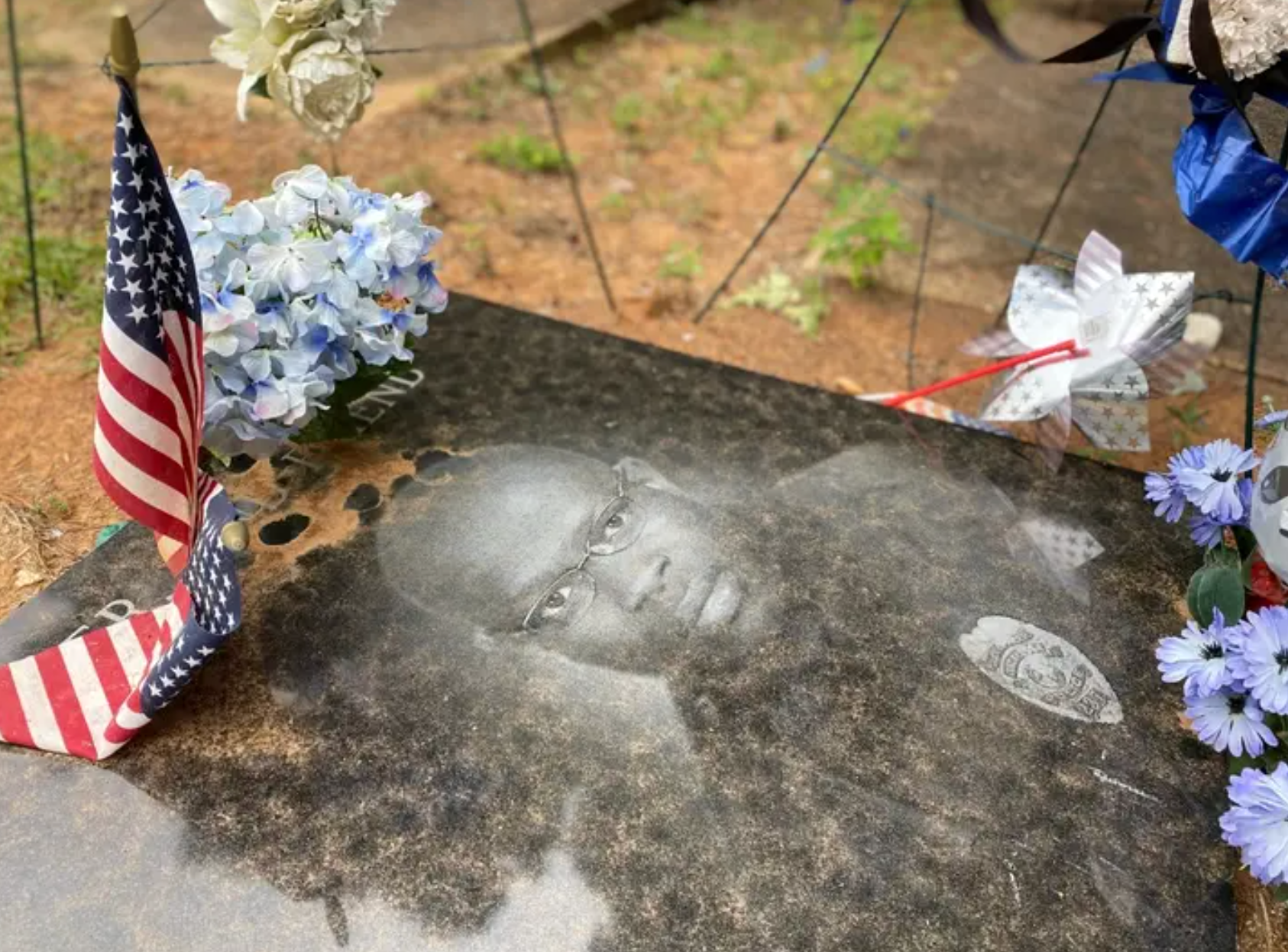
Later this week, the City of Tuscaloosa and other area law enforcement will honor the memory of fallen Tuscaloosa Police Investigator Dornell Cousette, who was shot and killed in the line of duty on Sept. 16, 2019.
Much in the same way that the death of Deputy John Manning Awtrey more than a century before sent waves of pain through the community, the death of Cousette stands as just the latest heartbreaking example of the sacrifices made by those in law enforcement.
It also underscores the dangers of the profession that have been unchanged with the passage of time, as both lawmen were shot and killed in what could only be described as impulsive acts of fear and brutality.
As previously stated, Awtrey was the first documented line-of-duty death in Tuscaloosa County's history and the fifth to date for the TCSO, while Cousette's murder stands as the most recent for Tuscaloosa County and the 12th to date for the Tuscaloosa Police Department.
As of the publication of this feature story, 598 Alabama law enforcement officers have died in the line of duty — 342 by gunfire, alone.
It's the hope of Tuscaloosa Patch that this story not only preserves our community's past, but honors a profession that so many of us take for granted every single day.
Have a news tip or suggestion on how I can improve Tuscaloosa Patch? Maybe you're interested in having your business become one of the latest sponsors for Tuscaloosa Patch? Email all inquiries to me at ryan.phillips@patch.com.
Get more local news delivered straight to your inbox. Sign up for free Patch newsletters and alerts.