Seasonal & Holidays
Chasing A Ghost: The Tragic Death And Haunting Legacy Of Clarence Cason
Thanks to archived newspaper articles and witness testimony, Patch learned more about the ghost who supposedly haunts one UA building.


TUSCALOOSA, AL — This story uses historical narrative provided by archived newspaper accounts and first person accounts, in an effort to best tell a story that spans nearly a century.
Click here to subscribe to our free Tuscaloosa Daily newsletter and breaking news alerts
May 7, 1935
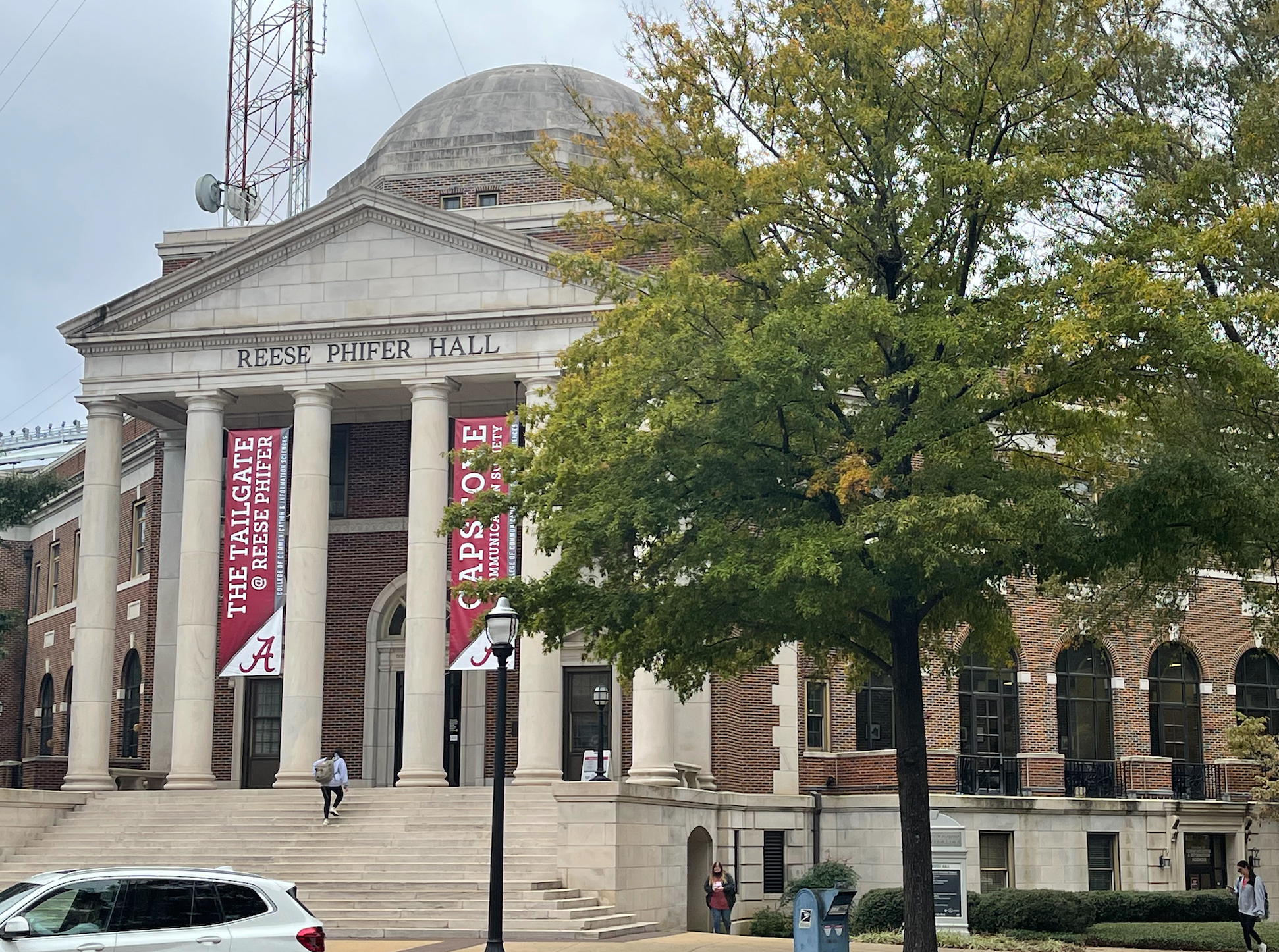
It was a mild spring Tuesday on the University of Alabama campus. Sporadic seasonal showers had moved out of the area and trees on the busy campus were full and green, budding with life. Sometime around 6 p.m., amid the bustle of students at the close of day, a thin-built professor with a part in his dark hair moved alone on the sidewalk and up the stairs into the old Union Building — known today as Reese Phifer Hall.
Find out what's happening in Tuscaloosafor free with the latest updates from Patch.
To an unwitting observer, Clarence Cason was living the dream. After being named the first head of the school's journalism department in 1928, he was set to have his first nonfiction book — "Ninety Degrees in the Shade" — released by his publishers the coming Saturday. Born in Ragland, Alabama in December 1898, he was a clean-shaven, inquisitive man as an adult.
Cason had been an honors student and class poet at Talladega High School, before enrolling at the University of Alabama, where he became a staffer for The Crimson White and The Corolla. Following graduation, he would volunteer for service in World War I and spend the war as an aerial machine gunnery instructor.
Find out what's happening in Tuscaloosafor free with the latest updates from Patch.
After returning home, Cason carved out successful stints as a journalist at several large newspapers, including work as a correspondent for The New York Times. He would return to academia, though, and use what he had learned in the newspaper business to pioneer new methods of teaching journalism to students.
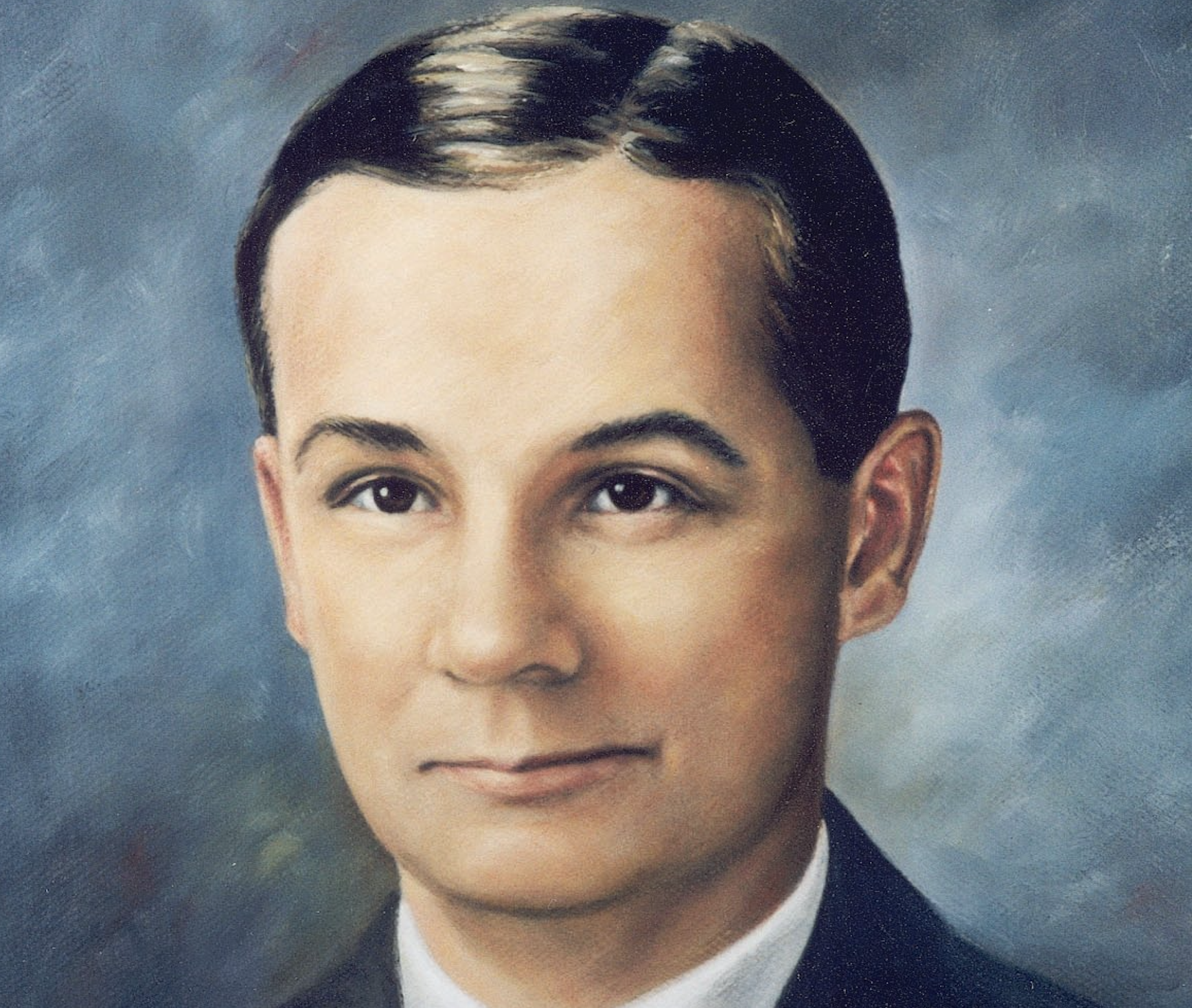
His intelligence and work ethic resulted in a living that paid well enough to even own a family automobile. However, it would be his book's unflinching and balanced critique of classism, race and social hierarchy in the Deep South that would go on to form the body of a best-seller and become part of a legacy that persists into the present.
“Ninety Degrees in the Shade” was Cason’s opus and serves as a lasting piece of nonfiction that likely would've kept his young family living comfortably for years to come, even apart from his academic pursuits.
But for reasons still debated to this day, Cason sat down at his desk in Office No. 11 that Tuesday evening, took a handgun from his pocket, put the barrel to the roof of his mouth and pulled the trigger.
He was 37 years old and left behind a wife and six-year-old daughter.
The tragic death of the promising author and head of the University of Alabama's Journalism Department was the top story in the Tuscaloosa News the following Wednesday, under the headline "Clarence Cason Ends Own Life With Pistol."
The news sent shockwaves through the community as few answers were provided as to why such a promising young mind would make such a decision. Cason's noon funeral service the day after his death was also covered by the local newspaper, before his body was boarded onto a train with his wife, daughter and mother as they embarked on a trip of more than 800 miles to a family burial plot in Galena, Illinois.
But almost a century after the night that Frisco liner started up the tracks of a Birmingham depot headed north, stories from current UA employees make the case that Clarence Cason never truly left Alabama.
To best contextualize Cason's story, however, Tuscaloosa Patch took a deep dive into archived accounts of his death, which remain the most illuminating pieces of information when seeking to understand not just who Clarence Cason was and how he viewed the world, but how the world saw him at the time of his death.
'A Superb Spirit'
The events of that May afternoon still remain murky in putting together the hours before and immediately following Cason's death. Fortunately, the loose ethics of newspapers at the time lent themselves to sensationalism. This resulted in many details of Cason's death being published that would otherwise be omitted by today's standards.
According to the front page newspaper story published on May 8, 1935, Cason's wife Louise began to worry the night of Cason's death, after she had driven by the old Union Building, honking her car horn. This was reportedly a customary practice, but on this Tuesday evening, Louise didn't see any glow from her husband's office window.
Thinking he was likely working late, as Cason was prone to do, she drove home and thought little of it at the time.
Patience would eventually give way to alarm, though, as the evening hours did not bring the return of her husband. Apart from the testimony of his publishers, it’s unclear if Cason had been battling mental illness or had threatened suicide before. However, the newspaper story mentions that Cason's wife noticed her husband's pistol missing before she began to fear the worst and contacted two neighbors for help. This can be interpreted in various ways, one being that she had previously feared her husband was capable of harming himself.
The two family friends — mentioned as Professor V.M. Smith and J.H. Newman — and Louise then set out to the Union Building at approximately 11 p.m. that night, where they found the promising young writer and professor with his "head slumped slightly on the shoulders and sitting upright in the chair at his office desk."
The Tuscaloosa News reporter assigned to the story wrote that a pistol was also found on the floor of Office No. 11. In an odd technique that has since been abandoned with modern day journalism ethics, the reporter wrote: "The comparatively small 35-6 bullet had passed through his head, struck the ceiling and fallen to the floor."
No suicide letter was found or mentioned and Cason's pockets held only a ring of keys and his handkerchief.
The following day, University President George H. Denny — whose name graces the stadium just a short walk from Reese Phifer Hall — publicly mourned the death, saying "We can assign no other reason for Professor Cason's action than ill health and depression."
Denny would go on to praise Cason as a beloved member of the faculty, a brilliant teacher and a leader in his field.
"While at the University, he has done excellent service and the institution suffers a real loss," the UA president said. "He had many friends and was universally admired as a gentleman and a scholar."
In the wake of her husband's death the following Wednesday, Louise was described by the Tuscaloosa News as "virtually prostrated."
But there was still the looming matter of Cason's book.
Later in the week, a follow-up story quoted the publishers of "Ninety Degrees in the Shade," who told the Tuscaloosa News that the University of North Carolina Press intended to move forward with the book's scheduled publication and release date, referring to it as "probably the best thing that we have published."
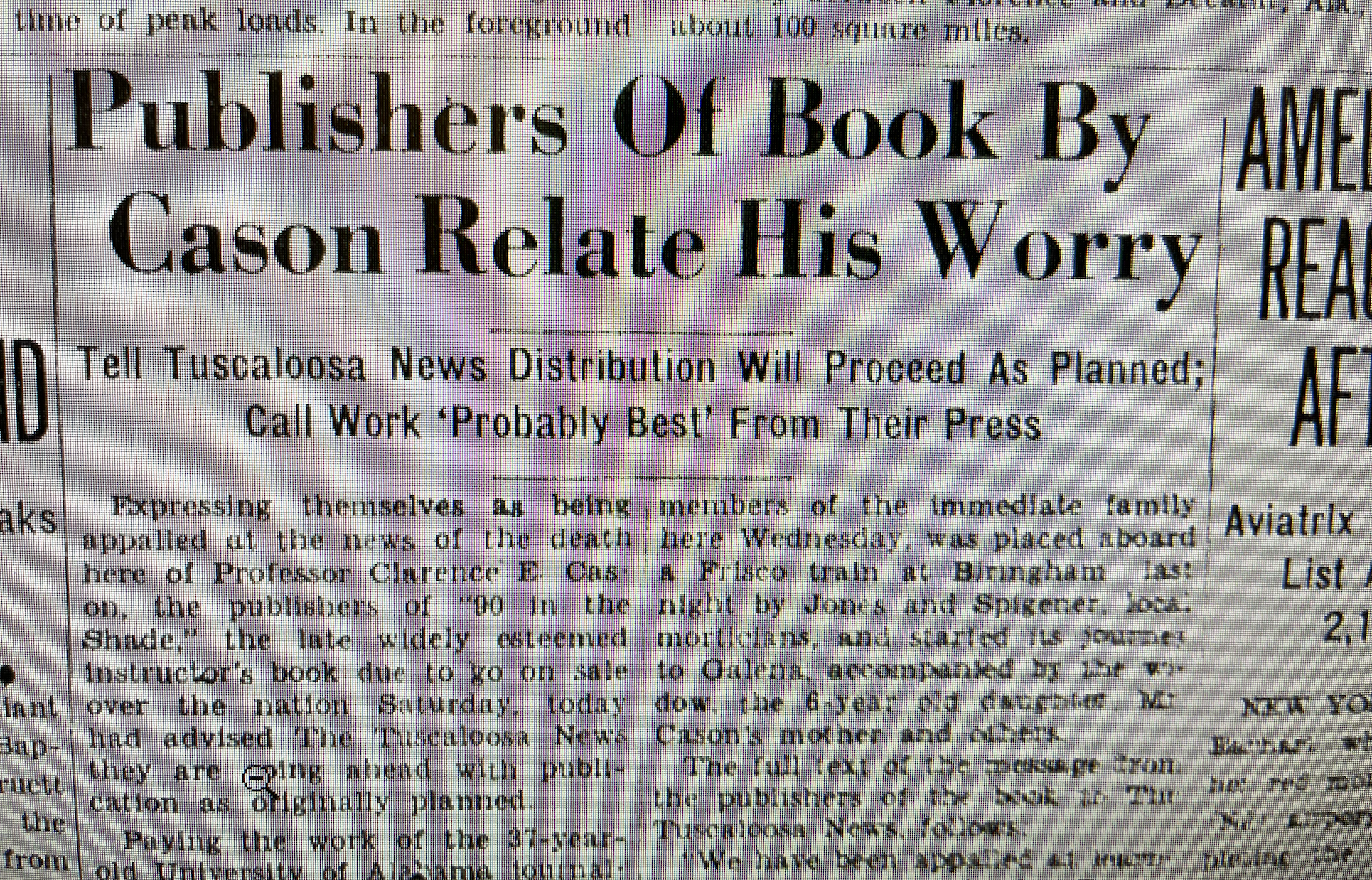
One of the editors, referred to as W.T. Couch, flatly attributed Cason's suicide to "temporary unbalance, caused by worry" ... a cold and sterile phrase, wrapped in context that is likely lost in the modern way of speaking.
However, in a formal statement to the paper, the publishers relayed recent communications with Cason, which expressed the author's worry over the potential for local criticism of the book upon its release.
Cason would be laid to rest in his wife's family plot the day before the book hit shelves. His funeral in Illinois was attended by a small collection of friends and colleagues, including those from the University of Wisconsin and the University of Minnesota — two institutions where Cason had worked and studied before taking the job at Alabama.
There was no mention found of any University of Alabama representatives at his funeral.
"We do not believe the book could have possibly harmed him in Tuscaloosa or in Alabama but on the contrary that it would have been received as the finest expression of a suburb spirit," the publishers said. "Needless to say, we would have delayed or cancelled publication if we had known the worry he expressed to us was any more than that which is frequently felt by authors before publishing a first book."
'An Incredible Feeling Of Calm'
The same floor where Cason tragically cut short his own life is now occupied by journalism faculty offices and normally abuzz with the voices of the students who vastly outnumber the few that roamed the building in the 1930s.
In the years since his death, Cason's image can be seen all around the inside of Reese Phifer Hall and his name graces the Clarence Cason Award for Nonfiction Writing. The award is presented annually to writers with a strong connection to Alabama, whose work has made an important contribution to the journalism and literature of the South.
Past recipients include, among others, Patch President Warren St. John, Gay Talese, Rick Bragg, and Edward O. Wilson.
But separate from academics and memorials, there's an unseen legacy left by Cason that lingers in Reese Phifer to this day.
Even as a graduate student, this reporter once walked the halls of the oddly-designed building and heard stories from students and faculty alike about weird goings-on during the quiet hours when few people would be in the building. These tales have included footsteps in empty hallways and faint voices calling out, with most attributing the occurrences to none other than Clarence Cason.
While never having experienced any of this high-strangeness for myself, I can recall an instance where one instructor told us a story about being saved from falling out of an open window by some unseen force.
This story was confirmed once again to me and clarified by someone who witnessed it, at least in part, but who has had experiences of her own in Reese Phifer.
Dr. Dianne Bragg told Patch she has never been fearful of ghosts or malevolent beings from the underworld. Rather, instead of full-body apparitions and destructive poltergeist activity, what she has experienced in Reese Phifer has been nothing short of positive ... if not a little weird.
She then remembered back to finishing her dissertation and seeking out the quiet of an empty Reese Phifer at 6 a.m. on a Sunday morning. From her office, she could hear the bells of Denny Chimes ring out over the Quad and, feeling overwhelmed in the moment, began to cry.
This reporter can confirm that Dr. Bragg’s office has a great view out to University Boulevard and the corner of The Quad. It has also served as a refuge and safe space for many students — including the author of this story nearly a decade ago.
But it would be Dr. Bragg who first sought the safety of her office that quiet morning.
Or so she thought.
"While I’m in the office, the copy machine in the next room goes off, as if someone walked by it," she said, referring to the copier's motion sensor. "I heard the door open and heard the copy machine come on. I thought 'who is here at 6 a.m. on a Sunday morning?' The door [to the building] was locked. I had my side door into the copy room and as I was reaching toward my door to open it, I heard [the other door] shut again. Then, I walk into the copy room and it shuts off."
Instead of being struck with terror, she calmly looked out into the hallway, expecting to see someone. But all was quiet — as empty and still as she had found it.
"All I can say, instead of scared, I had this incredible feeling of calm and it's almost like I thought to myself, 'that’s Clarence Cason' and I wasn’t alone," she said, on the verge of tears. "His spirit maybe looks for people who are struggling and doesn’t want them to make the choice he made. Maybe he felt hopeless and maybe Clarence doesn’t want people in Reese Phifer to feel that way."
Have a news tip or suggestion on how I can improve Tuscaloosa Patch? Maybe you're interested in having your business become one of the latest sponsors for Tuscaloosa Patch? Email all inquiries to me at ryan.phillips@patch.com
Get more local news delivered straight to your inbox. Sign up for free Patch newsletters and alerts.