Schools
UA Gives Facilities Update Ahead Of First Day Of Class
The University of Alabama will welcome back its students for the fall semester Wednesday amid a set of sweeping changes to promote safety


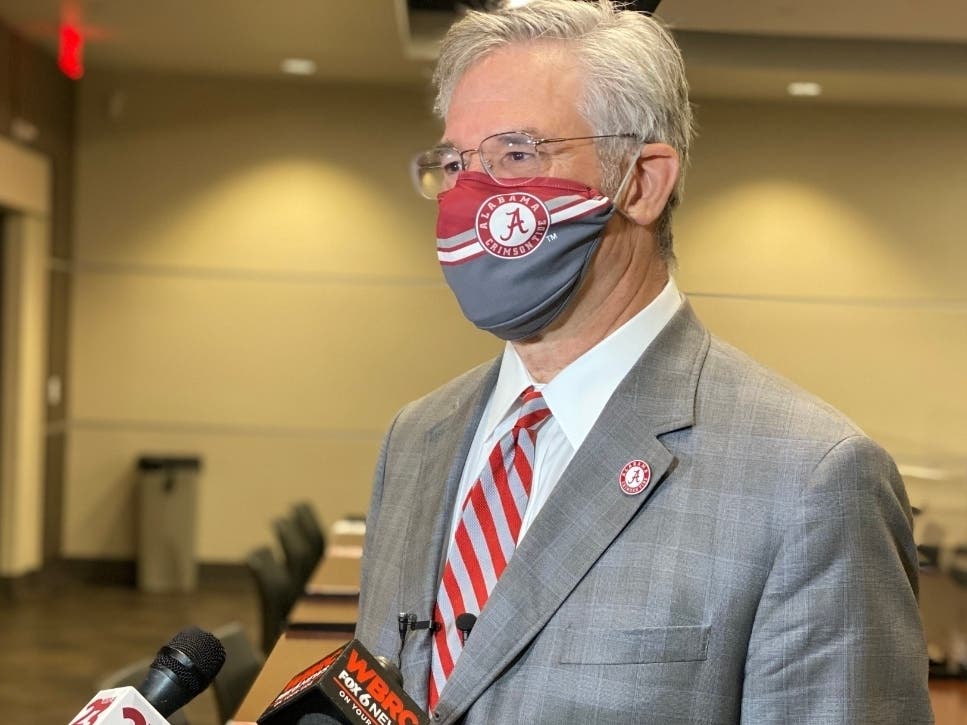
TUSCALOOSA, AL. — The fall semester is set to begin Wednesday at the University of Alabama, but the classrooms and lecture halls will have a distinctly different look. As students return to campus, the university has implemented sweeping changes to its facilities to both combat the spread of the novel coronavirus while also promoting an atmosphere that hopes to offer the best possible in-person educational experience
In a large lecture space in North Lawn Hall, red and white Xs resembling the Alabama state flag marked the appropriate distances between where each student will sit. In facing the front of the classroom, students will do so looking through a Plexiglas partition mounted to the front of each desk.
"We’ve done this with probably 20 large lecture halls to be able to increase that capacity and give students the experience they need," said Matt Fajack, UA vice president for the Division of Finance and Operations on Tuesday.
Find out what's happening in Tuscaloosafor free with the latest updates from Patch.
The update on Tuesday also coincided with the university announcing that as of Aug. 16, less than 1% of the more than 25,000 students tested for COVID-19 had tested positive.
Speaking to the challenges of handling a rapidly-changing situation, though, Fajack said keeping up with and reacting to the science has been a point of focus.
Find out what's happening in Tuscaloosafor free with the latest updates from Patch.
"It's staying up with the science and just getting things done," he commented. "Many students need a face-to-face learning experience and we have limited space."
The vast overhaul of campus facilities and offerings ahead of the fall semester has been a sizable financial and operational undertaking. Fajack told local media the university budgeted about $2.5 million for plexiglass, hand sanitizer, mask and sanitary wipes.
"We have another $1.8 million budgeted for our group that if you do think you have COVID or have exposure, it will do the notification, investigation and the tracing," he said.
Fajack then said the university had also increased the ventilation in all of the classrooms to create more air going through and hopefully decrease the potential for spreading the virus through the air. These changes also include increasing the humidity to 60%, as Fajack cited claims that a higher humidity can also combat further spreading.
"We’ve increased the airflow, doubled the airflow," he said. "It takes more energy, but does help protect people."
For students testing positive, the university has also secured quarantine space at two on-campus apartments — Bryce Lawn and the Highlands. Upperclassmen living in those apartments, Fajack said, have been moved to off-campus housing locations while the two on-campus apartments will be used for isolating students testing positive.
Testing was made a requirement for students ahead of the start of the semester through money allocated by Gov. Kay Ivey, but Fajack said faculty, staff and students who may have missed the testing window can get tested at Coleman Coliseum for free from Aug. 17-19 from 7 a.m. to 5 p.m.
The previous testing site through the GuideSafe platform was at the storm shelter on the east side of campus.
Fajack also applauded the contributions of the UAB Health System in developing UAB Healthcheck, which allows users to log symptoms and temperatures to then let them know if they are at risk. It also has a voluntary feature for tracking and tracing that tells users if they have been within six feet of someone testing positive for COVID-19 for 15 minutes or more each day.
Platforms like Healthcheck and GuideSafe will also prove effective tools in helping the university better understand the health of its student population moving forward, due to student testing numbers being reflected on their hometowns in numbers provided by the Alabama Department of Public Health, as opposed to their residence for school.
"We’re very confident in our plan," he said, reiterating the precautions taken. "We have hand sanitizer at the front door of all buildings, we've distributed two masks to all students and staff. Put masks in vending machines, put disposable wipes in rooms."
Apart from the changes implemented, Fajack also fielded questions concerning the possibility that a spike in cases could result in a pivot to an all-virtual learning format, as seen in recent days at the University of North Carolina.
"We have not defined any triggers for when we would or possibly could go to remote learning," he said. "I'm sure there is at some point, I don’t know what those points are right now. We will take each day and each report that comes in."
The large crowds seen on the Strip on Sunday were an added point of discussion, in the wake of Tuscaloosa receiving negative nationwide attention after the post-Bid Day influx on the entertainment district near campus resulted in a dozen mask citations being issued by the Tuscaloosa Police Department and the city making arrests for violations for the first time.
Fajack said the approach moving forward should be focused on using "behaviors that make sense."
"I think there is a small percentage of the population that is not taking it seriously," he said. "I think most of our students, faculty and staff take the self-responsibility to protect themselves and those around us and abide by the rules on campus and around campus."
Get more local news delivered straight to your inbox. Sign up for free Patch newsletters and alerts.