Health & Fitness
Free Tests? As COVID Surges, Rapid Results Cost Up To $300
Although state and federal rules require COVID tests to be free or covered by health insurance, people often have to pay hundreds upfront.

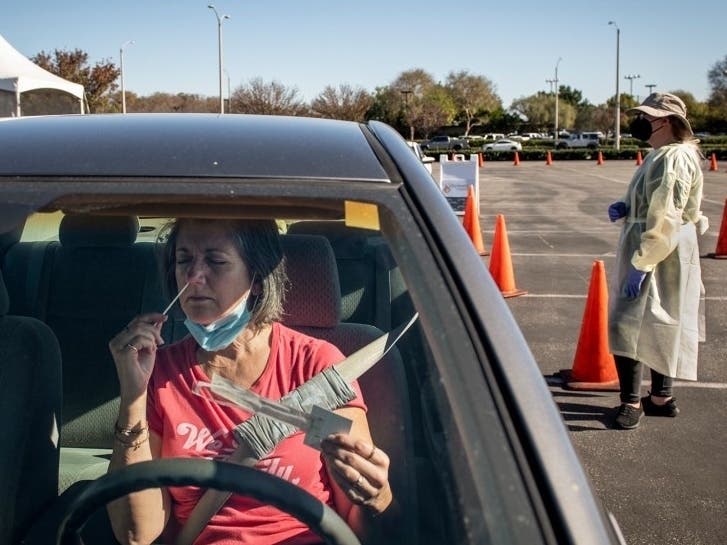
ACROSS CALIFORNIA —When Rebecca Santucci of Lakewood learned that her sister, Stacy, may have been exposed to COVID-19, she set out to look for a rapid test. She needed to know quickly whether their 88-year-old father was at risk.
Pharmacies had been wiped out of home test kits, and testing clinics were booked solid for at least two weeks. On Amazon, she found a set of two at-home tests for $38, but they wouldn’t arrive until next month. And anything that required waiting hours in line wouldn’t work for her sister, who has Down syndrome and anxiety.
Eventually she found a slot for a rapid antigen test at a private drive-thru clinic on the city of Lakewood’s website. But it was five days after Stacy learned of her potential exposure.
The price tag for the test: $129.
Find out what's happening in Across Californiafor free with the latest updates from Patch.
“We ended up paying the money but it killed me to do it,” Rebecca said. Stacy tested negative, so at least they finally got some peace of mind.
With the explosion of the highly transmissible omicron variant, more Californians find themselves seeking tests wherever they can find them. State and local testing sites offer free COVID-19 tests but they are swamped, forcing people to seek private pop-up clinics.
Find out what's happening in Across Californiafor free with the latest updates from Patch.
Quick results often come with hefty upfront costs: Some clinics charge nearly $300 for a rapid PCR test.
Although state and federal regulations require COVID tests to be free or covered by health insurance, people often have to pay upfront, and the amount is unaffordable for many Californians.
Those who can’t afford to pay will often have to wait hours in line at local and state free testing sites, and then sometimes wait days for the lab results.
“There is a requirement that testing be free, but there is no requirement of how fast those test results need to be returned,” said Shira Shafir, a UCLA professor of epidemiology. “With this omicron surge, some people are again waiting four to five days for those lab results and at that point those results are essentially useless.”
Adding to the demand for quick results is that certain places demand proof of testing within a time frame of 24 to 72 hours. People need them to visit nursing and senior homes, return to daycare programs or board flights to Hawaii or overseas.
Pop-up sites at California’s international airports charge upfront. At San Francisco International Airport, a rapid test is $275. At Los Angeles International Airport, a rapid PCR test with results in one hour costs $199. According to one LAX provider, Clarity Mobile Venture, debit or credit card payments are required, although a receipt is provided for insurance reimbursement. At San Diego International Airport, the cost is $135 to $165, and at Long Beach Airport, a test with 1.5-hour results costs $250.
At the Lakewood clinic where Santucci went, costs range from $129 for a rapid antigen test with one-hour results to $299 for a PCR test with two-hour results. The clinic also advertises a free standard PCR test with results in two or more days.
“With rapid tests, what people may be paying for is the guarantee of quick results,” said Shafir. “The test site is not always pitching it that way.”
PCR and antigen tests are both used to diagnose COVID-19; antigen tests can yield faster results but PCR tests are more sensitive to detecting the virus so they are considered more accurate.
Health experts say getting results quickly is vital to protecting people and avoiding long quarantines, but rapid tests have long been in short supply.
Save your receipts
Californians have an array of places where they can be tested: a hodgepodge of pharmacies, community clinics, government mass-testing sites and private pop-up sites. Many of these are free, but they are booked for weeks. Some pop-up testing sites charge upfront, creating confusion as to why, since testing is supposed to be free.
At most pharmacies and doctor offices, providers do not charge people directly. Instead, they collect insurance information so they can be paid. But some private testing clinics charge individuals, who are then responsible for seeking reimbursement from an insurer. Claims can be filed online or sent to the insurer by mail.
But it’s not always a guarantee that they’ll get their money back.
Stacy Santucci is covered by Medicare, which covers people with disabilities. Rebecca said she did not receive a receipt after her sister’s test, but she had an email confirmation from the testing provider, Covid Clinic. When Rebecca called her sister’s Medicare plan, she was advised to print the email and send it in by snail mail, but there was no assurance she’d be reimbursed because the printed email might not suffice.
Experts recommend checking receipts for extra service charges, such as a fee for expedited results.
Charging an extra fee for rapid results is deceptive, said state Sen. Richard Pan, a Democrat from Sacramento, who last year authored a bill, SB 510, that clarified rules around free testing. The law, which went into effect Jan. 1, codifies federal rules into state law, requiring insurance companies to cover testing without any cost sharing such as copays or deductibles.
Pan said his office is looking into cases of providers who are tacking on extra charges to a test — they’ll provide a procedure code for the test itself that patients can then submit to their insurer for repayment, but they won’t provide a reimbursement code for the mysterious extra charge.
“Trying to splice the bill in a way that continues to have a cost to the patient is certainly not in the spirit of the law,” Pan said.
The law also doesn’t address the issue of having to pay upfront. The challenge is that new test sites don’t usually have existing relationships with insurers, so instead they charge the individual, Pan said.
“They (testing clinics) just want to get paid, to them it doesn’t matter where that payment comes from,” Shafir said.
It’s been a pattern throughout the pandemic that those with less resources are less likely to access testing.
Upfront costs and long lines can deter people from getting tested and worsen health disparities, experts say. People without insurance don’t have the option to seek reimbursement. And testing requires free time or a flexible job, and sometimes the physical ability to stand in line or car ownership.
SEE ALSO: