Weather
Hilary Arrives In SoCal; Threatening Flash Floods, A Tornado & Thunder
There were over 7,500 boots on the ground, including dozens of water rescue teams and high-water vehicles, in anticipation of the storm.



For the latest updates on Tropical Storm Hilary, see: 'Hurriquake,' Record Rain, Mudslides, And Floods: Hilary Slams CA
CALIFORNIA — Tropical Storm Hilary moved into Southern California at 5 p.m. Sunday as communities braced for an evening gauntlet of rain, thunderstorms, and high winds hammering the region.
The storm was expected to peak by 9 p.m. across the Southland, and flooding was reported in San Bernardino, Los Angeles, Orange, and San Diego counties Sunday night while flash flood warnings extended from Los Angeles to the Inland Empire. The storm forced school districts to cancel classes for hundreds of thousands of children Monday in Los Angeles, San Diego and Redlands. Wind gusts of 64 miles per hour were recorded in the San Gabriel Mountains, and authorities warned of downed trees and potentially downed electric wires across the Southland as powerful wind gusts tore through the region.
Find out what's happening in Across Californiafor free with the latest updates from Patch.
The National Weather Service issued a tornado warning for the San Diego region throughout the afternoon Sunday.
The storm made landfall along Mexico's Baja California coast earlier Sunday as concerns mounted over what could be deadly flash flooding in the border city of Tijuana, Southern California, and places as far north as Idaho that rarely get such heavy rain.
Find out what's happening in Across Californiafor free with the latest updates from Patch.
Hilary hit the coast in a sparsely populated area about 150 miles south of Ensenada, Mexico. The storm has already caused flooding along the length of the Baja peninsula, and torrential rains threatened mudslide-prone Tijuana, where improvised houses cling to hillsides just south of the U.S. border. One person drowned Saturday in the Mexican town of Santa Rosalia when a vehicle was swept away in an overflowing stream.
“Rainfall flooding has been the biggest killer in tropical storms and hurricanes in the United States in the past 10 years and you don’t want to become a statistic,” Hurricane Center Director Michael Brennan said in an online briefing from Miami.
State and local leaders hosted a briefing at 4 p.m. Sunday in Los Angeles, where school district superintendent Alberto Carvalho announced all schools would close Monday out of an abundance of caution.
"The peak of this storm will take place in the middle of the night, depriving us of our ability to inspect schools or determine access to schools to be safe," Carvalho said. "There is no way we can compromise the safety of a single child, or an employee."
The National Weather Service said the storm was largely tracking as expected through mid-afternoon, picking up speed to 20 knots as it continued north, with the center located just north of the Mexican border shortly after 4 p.m. Forecasters said the faster speed could mean an earlier — but stronger — peak.
"Because of the faster speeds of the motion of the storm, it means the storm has less time to weaken by the time it gets here," said Lisa Phillips, a meteorologist with NWS Los Angeles. "It also means the peak of the rainfall could be earlier. Right now, we're looking at the peak somewhere from now until 9 p.m. ... for the L.A. Basin."
With at least an inch of rain falling over the basin by 4 p.m., forecasters expected at least a couple more inches before the end of the night, including locally-heavy downpours and potential thunderstorms embedded in the rainbands. Wind speeds were expected to hit 30 to 50 mph in the coasts and valleys, with speeds of 50 to 60 mph possible in the mountains.
Related: San Diego County Declares Local Emergency Due To Tropical Storm Hilary
In a news briefing earlier in the afternoon, the NWS joined leaders in San Diego County to provide updates on the timeline for the storm's arrival in SoCal.
"We expect landfall through San Diego County this afternoon between 2 and 6 o'clock," said Alex Tardy, a senior meteorologist with the National Weather Service. "That's when we expect our biggest impacts, from high winds, from heavy rainfall, and from the major swell that's moving up along the coast."
Tardy said while different parts of San Diego County will see varying impacts, but noted at least 1 to 3 inches would be possible anywhere in the county over a 12-hour period, along with tropical-storm-force winds at 40 mph, with gusts hitting 60 mph.
"We've already seen 3 to 4 inches of rain at Mount Laguna for example — they're going to triple that," Tardy said. "In the coastal areas, the wind directions are coming from the north, and they're going to pick up as the eye center moves into San Diego County this afternoon."
Tardy urged residents to brace for a historic weather event and to take seriously any warnings issued throughout the day.
"1939 was the last tropical storm strength system that moved into Long Beach," he said. "After that, [in] 1997, Nora moved through the Imperial Valley. This is an event that hasn't happened before in terms of having a tropical storm, that kind of energy, taking a direct hit into San Diego County."
Related: Flash Flood Warning Issued For LA, Long Beach, Glendale
Authorities warned residents to plan for the worst, with flash flooding expected in mountain and desert areas, as well as landslides, mudslides, and dangerous to locally catastrophic flooding anticipated late Sunday and early Monday. Other concerns included power outages and impassable streets.
"As soon as Tropical Storm Hilary's path became clear, my administration took immediate action to prepare. At my direction, FEMA deployed to California federal personnel and supplies that can be surged to impacted communities. The U.S. Coast Guard pre-positioned aircraft to allow for rapid response and search-and-rescue efforts. My administration also deployed federal personnel to Nevada to ensure the state has additional support, and we will continue to coordinate with California, Nevada, and Arizona on any resources they might need," President Joe Biden announced.
"My administration stands ready to provide additional assistance as requested," Biden added. I urge people to take this storm seriously and listen to state and local officials.
The impact of the storm was expected to peak Sunday afternoon and evening, with rain tapering off through Monday for most areas. Hilary was forecast to drop the majority of its accumulation during the day Sunday in San Diego and Riverside counties, as well as Palm Springs, while in Los Angeles, most of the rainfall was projected to occur overnight, according to the National Weather Service.
.png)
Hilary peaked Friday as a Category 4 hurricane with 145 mph winds but by early Sunday it had weakened to Category 1, and it was downgraded to a tropical storm by around 9 a.m. Sunday off the coast of Baja California.
Nevertheless, forecasters said "catastrophic and life-threatening" flooding is likely across a broad region of the southwestern U.S.
Riverside County was under an unprecedented tropical storm warning Sunday, a warning that extended to coastal areas of San Diego County, while Los Angeles and Orange counties were under the first-ever tropical storm watch.
Related: Hilary Barrels Toward Inland Empire; Residents Asked to Stay Indoors
Gov. Gavin Newsom signed an emergency proclamation, was in touch with the White House, and directed the deployment of over 7,500 boots on the ground, including dozens of water rescue teams and high-water vehicles.
The Federal Emergency Management Agency said it was coordinating with California officials to provide support as needed. FEMA pre-positioned supplies at March Air Reserve Base in Riverside, and a FEMA Incident Management Assistance Team deployed to the California Office of Emergency Services and is prepared to aid with any requests for federal assistance.
Los Angeles Mayor Karen Bass activated the city's Emergency Operations Center at Level 2 — one level short of the most critical status.
"We asked Angelinos to stay inside today,'' Bass said. "The timing of this could become earlier. We know that storms are moving fast so it could change. So please stay at home.''
An evacuation order was issued Sunday morning for the Mias zone in the Apple/El Dorado burn scar, north of Banning and near the Morongo Reservation, according to the Riverside County Emergency Management Department. The San Bernardino County sheriff issued evacuation warnings for several mountain and foothill communities ahead of the storm.
Residents of Catalina Island were advised to leave as a precaution. Voluntary evacuations were in place in Silverado and Williams canyons, which compose part of the Bond Fire burn scar.
Elizabeth Adams, a meteorologist at the National Weather Service San Diego office, said rain could fall up to 3 inches an hour across Southern California's mountains and deserts, from late Sunday morning into the afternoon. The intense rainfall during those hours could cause widespread and life-threatening flash floods. Some areas in the mountain and deserts could see 10-12 inches total, while the coastal region was expected to get up to 2 inches total.
Winds could reach 50 mph in San Diego and up to 70 mph in the mountains.
Large swells generated by Hilary will affect portions of Baja California Peninsula and Southern California over the next few days. The swells are likely to cause life-threatening surf and rip current conditions.
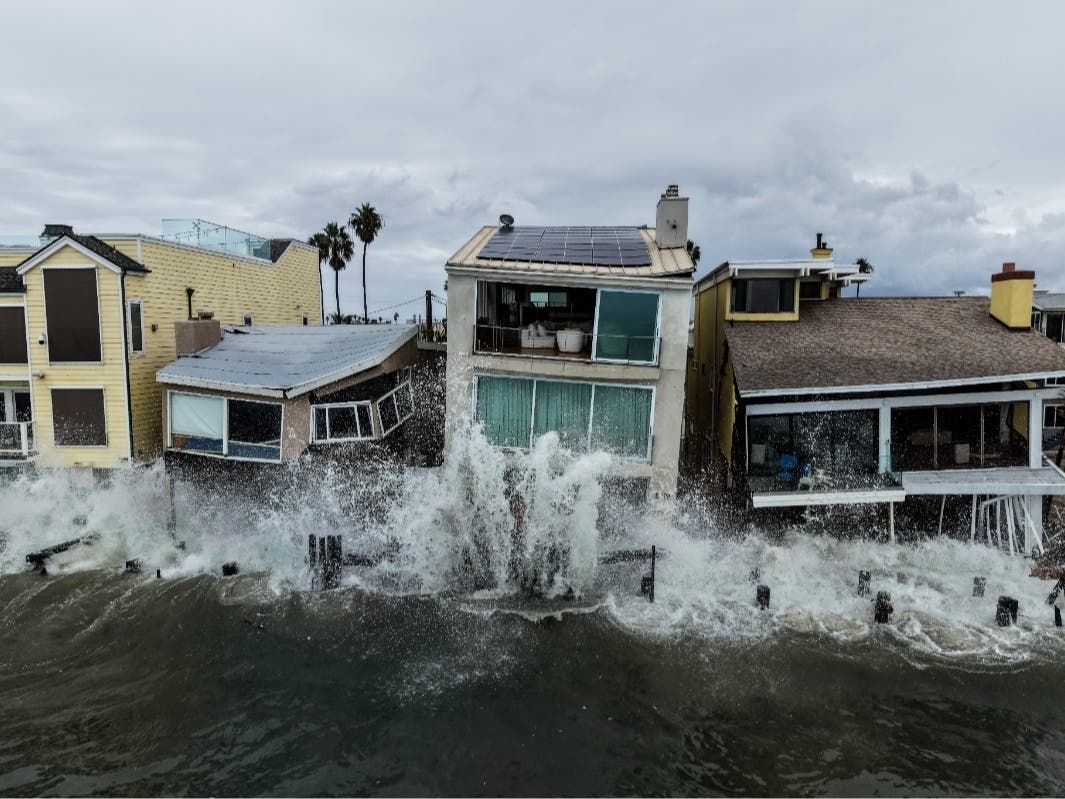
Forecasters said surf of 4-7 feet is possible at southeast- and south-facing beaches. From Long Beach to Orange County, cities deployed bulldozers to build berms on beaches to protect coastal properties, and sandbags were being provided for residents to protect their properties.
The National Weather Service warned residents to secure porches, carports and unanchored mobile homes in coastal and valley locations.
The North County Transit District announced mid-day Sunday that COASTER train service was temporarily suspended until further notice due to the storm. Amtrak and Metrolink have both reduced their service for Sunday in San Diego County.
Los Angeles County officials said all county parks, buildings and facilities would be closed Sunday and Monday.
Magic Mountain and Hurricane Harbor, and Knott's Berry Farm and Knott's Soak City were closed Sunday due to the storm. Disneyland announced it would close at 10 p.m. and California Adventure was set to close at 9 p.m. Universal Studios and Universal CityWalk remained open Sunday morning. All attractions that were still open Sunday said they were closely monitoring the storm.
Hilary is expected to remain in the Southland through Monday morning, likely clearing out by early afternoon, with scattered thunderstorms possible Tuesday.
A tropical storm has not made landfall in California since 1939.
Meteorologists warned that despite weakening, the storm remained treacherous, and could dump up to 10 inches — a year's worth of rain for some areas — in southern California and southern Nevada.
The U.S. hurricane center posted tropical storm and potential flood warnings for Southern California from the Pacific coast to interior mountains and deserts as far north as eastern Oregon and Idaho.
Western states could be hit with once-in-a-century rains, with a good chance Hilary could break all-time records as the wettest known tropical cyclone to douse Nevada, Oregon and Idaho. Hilary was expected to remain a tropical storm into central Nevada early Monday before dissipating.
City News Service contributed to this story.
The Associated Press contributed to this story.
Get more local news delivered straight to your inbox. Sign up for free Patch newsletters and alerts.