Politics & Government
See Which CA Counties Had The Biggest Population Gains, Losses, Over The Last 5 Years
Population growth has slowed in California, but the state is not experiencing a mass exodus. Not even close.



California is not experiencing a "mass exodus," but it is experiencing a slow rate of population growth, federal and state figures show.
The latest batch of U.S. population data for the years 2020 to 2025 was released in June by the Census Bureau, and the figures confirm sluggish growth in California — but with important caveats, including variances by county.
California's Population Picture: A County-By-County Look
Find out what's happening in Across Californiafor free with the latest updates from Patch.
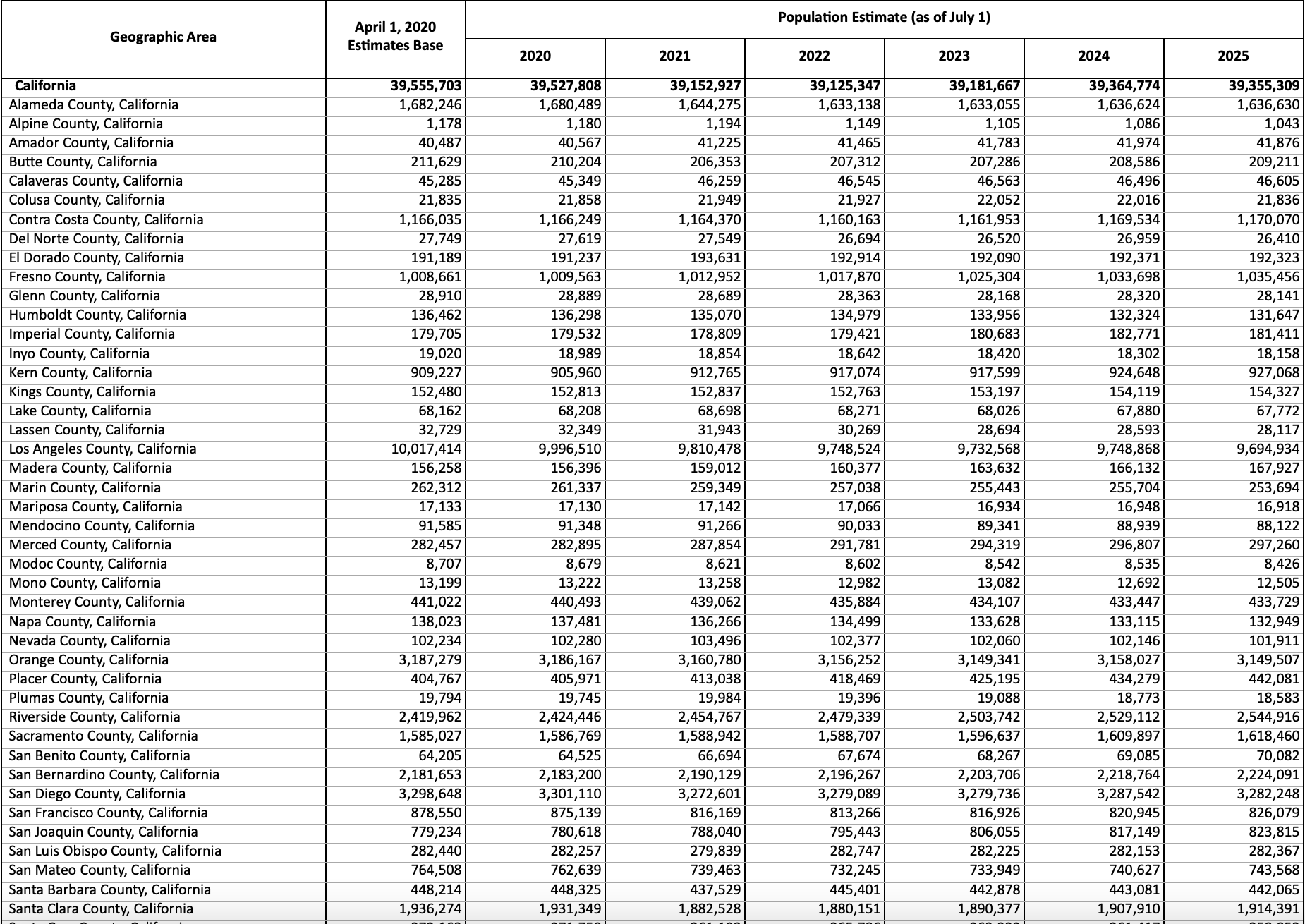
The Golden State's total population was estimated at 39,527,808 on July 1, 2020, compared to 39,355,309, on July 1, 2025, a net decrease of 172,499 people, according to Census Bureau data.
The drop is largely attributed to a decline in immigration and birth rates, according to the data, but the state's population figures are as diverse as its landscape (click on a county below to see its population gains or losses).
Find out what's happening in Across Californiafor free with the latest updates from Patch.
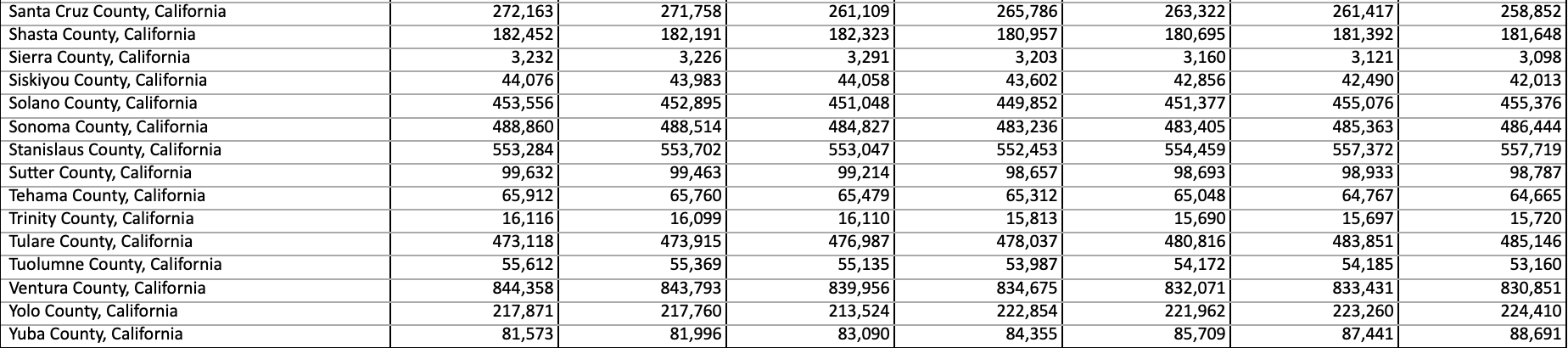
California counties that saw growth of 5% or greater over the five-year period included Placer (+9%), San Benito, (+9%), Yuba (+8%), Madera (+7%), San Joaquin (+6%), Merced (+5%), and Riverside (+5%).
Conversely, counties that saw population dips of 5% or more included Lassen (-13%), Alpine (-12%), Plumas (-6%), San Francisco (-6%), Mono (-5%), and Santa Cruz (-5%). Out-of-state migration, aging populations, and job losses are cited as key factors behind the drops in counties with the biggest losses.
Patch reached out to the California Department of Finance for comment about the latest Census Bureau data. H.D. Palmer, Deputy Director for External Affairs, said there are differences in timing and data sources between the state and federal agencies' calculations, resulting in nuances between population totals, but the variances are small.
For example, for the year ending July 1, 2025, California Department of Finance estimates showed .05% statewide population growth compared to a .02% decrease reported by the Census Bureau for the same period.
"That works out to about a 0.07-percentage point difference — or, approximately 28,000 people," Palmer said.
"We’d also note that California isn’t alone in slowing growth rates: Based on the [Census] Bureau's estimates, all but a handful of states experienced lower growth rates in 2024-25 than they did in 2023-24," Palmer continued. "So taken together, all of these data clearly don’t support the notion that people are leaving California 'en masse.'"
Here are population figures for each of California's 58 counties for the period 2020 to 2025 (Source: U.S. Census Bureau 2026):
Summary
With over 39 million people, California is the nation’s most populous state. Texas is a near second at over 31 million people, and Florida a distant third at just over 23 million.
The California Department of Finance currently projects that the state’s population will reach 39.7 million in 2030, and 40.5 million by 2040.
Population numbers have consequences. The state lost a congressional seat after the 2020 census and it could lose more after the 2030 census. Congressional seats dictate California's legislative voting power in the U.S. House of Representatives and directly influences the outcome of presidential elections through the Electoral College.
The number of seats also determines how many constituents each representative must serve, which can impact local services and overall responsiveness.
But population numbers extend beyond politics. Housing, infrastructure, jobs, the environment, and education are all impacted by population expansions and declines.
California has been the most populous state in the nation since the early 1960s, so the balancing acts will continue.
Get more local news delivered straight to your inbox. Sign up for free Patch newsletters and alerts.