Schools
Future Scientists Show Off Their Know-How
Sumac Elementary students participate in a science fair that kicks off their L-STEM program for next year.


students demonstrated homegrown science projects during their annual science fair on Wednesday.
Though not graded, all students–grades two through five–were required to perform a science experiment at home and showcase their project at the event, said Carol Martino, Sumac principal.
“The students were all given handouts with guidelines and instructional information for conducting an experimentiment,” said Martino. Families were encouraged to participate with their children on the activity, she said.
Find out what's happening in Agoura Hillsfor free with the latest updates from Patch.
At the fair, parents and teachers judged the projects based on a list of criteria and chose four winners in each grade.
“I am so impressed with the effort that all of the children put into this,” said Martino, “It is evident that our kids really love science, which is fantastic, because that is going to be our focus when we start our program next year.”
Find out what's happening in Agoura Hillsfor free with the latest updates from Patch.
Martino said she was als0 pleased with the high level of family participation.
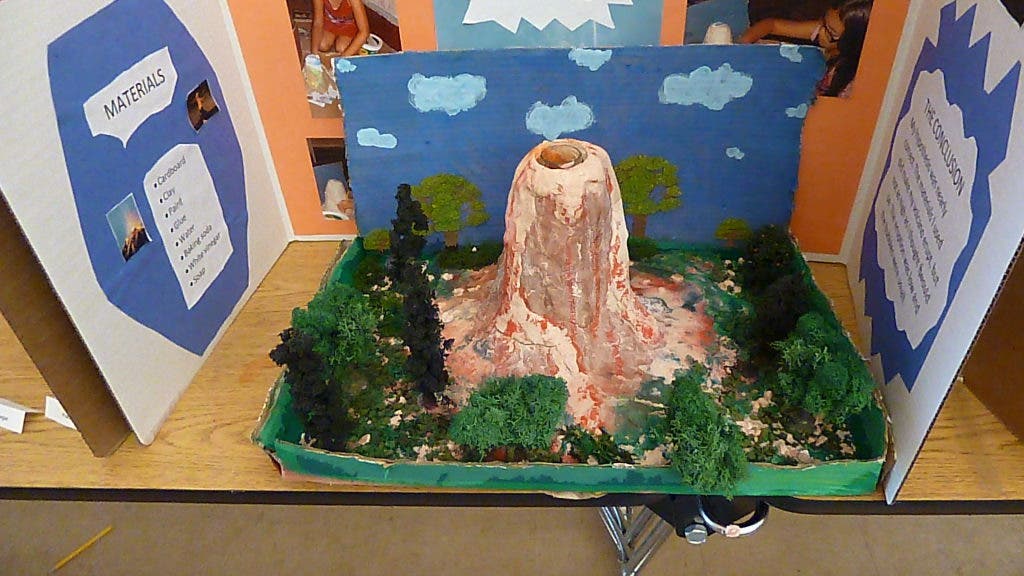
Experiments ranged from which gum blows the biggest bubbles to what kind of Mentos produces the biggest geyser when dropped into a bottle of soda to what best gets the smell of garlic off of your hands. Some students studied the best conditions for liquefaction, how to build a solar oven, how to make batteries out of lemons, and the ever-popular, how to build a working volcano.
“I think this is a great way for our students to showcase their creativity and really encourages kids at any level to excel in science,” said Tracie Madden, fourth grade teacher and Sumac L-STEM academy webmaster.
Kindergarten and first grade classes did their science projects as a class. The students in Journey’s pre-K program, taught by Patch’s April Teacher of the Month , created architectural structures.
Austin Schwartz, a second-grader, came up with the idea for his science experiment with his father. “We were on this long drive and Austin said, ‘Why don’t we grow something?’” said Austin’s mom, Lisa Schwartz. “They were already planting things in our garden, so Austin and his dad decided to see if planting with fertilizer really is better. It was such a fun project for my husband and my son to do together.”
“My hypothesis was that the plants would grow faster with the fertilizer, and my conclusion was that I was right,” said the second grader.
Mrs. Adelstein, the fourth and fifth grade science teacher, judged the second grade entries. “I am so impressed with the work of the students. They are creative and they’re thinking and they’re exploring. It is very hard to judge these projects, because it is obvious that all the children put a lot of hard work and thought into these projects. I’m so happy to see such an enthusiasm for science,” she said.
