Politics & Government
Residents Protest New Water Meter Readers
Homeowners share health, security concerns about new devices that transmit water usage data.


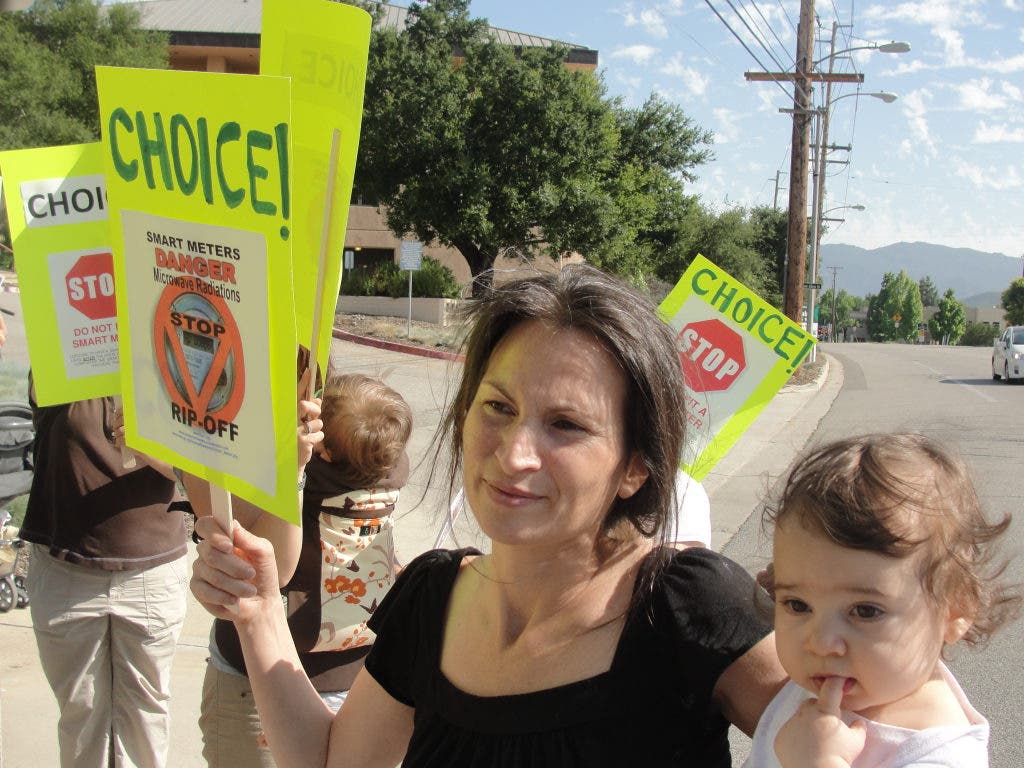


About a dozen residents with concerns about "smart" water meters, also known as automatic meter readers, protested Tuesday outside Las Virgenes Municipal Water District's headquarters.
The protesters, who lined up along Las Virgenes Road while hoisting signs, claimed that the devices that record and transmit water usage data pose a health hazard and put homeowners at risk for privacy invasion by hackers.
District officials disputed their contentions, claiming that the meter readers emit minimal radio frequency levels and do not transmit sensitive information other than the meter's serial number and its reading.
Find out what's happening in Agoura Hillsfor free with the latest updates from Patch.
There are two kinds of automatic meter reading devices that are installed on traditional water meters: the ones that transmit data to the district every 20 minutes, and those that send a signal to an employee who drives by in a truck every 60 days and queries the device.
Local water meters, some of which have been in operation for 50 years, are installed underground in the public right of way.
Find out what's happening in Agoura Hillsfor free with the latest updates from Patch.
Water meters without automatic meter readers must be read in person by a district employee every 60 days, said Jeff Reinhardt, a water district spokesman.
There are currently 4,700 automatic meter readers installed throughout the water district in neighborhoods including Monte Nido, Old Agoura, the Las Virgenes Road area and unincorporated Chatsworth as part of a five-year installation plan that began in 2010.
The goal is to have 21,000 of them in place, Reinhardt said.
Having easier access to water usage data gives the district the ability to tell homeowners when and how they're using the most water, in order to improve conservation, he said. The new, automatic devices also reduce the need for manpower, he added.
But some residents believe that the water district should respect a homeowner's decision to refuse a "smart" meter.
"I think that people should have a choice as to what they want on their property," said Manuela Saul, one of the protest organizers. "I pay my fair share of property taxes and income taxes."
Saul expressed concern that the automatic meter readers could be emitting harmful radio-frequency waves. Some in the protest carried signs that read "smart meters are cancer meters."
Reinhardt said that each automatic meter reader emits 250 milowatts, which is a quarter of a microwatt. A Southern California Edison smart meter designed to record and transmit electricity data emits 40 microwatts and a cellphone by the ear generates 5,000 microwatts, according to the energy company.
Water district board member Barry Steinhardt said based on the information he has received from staffers, the emission from automatic meter readers is minimal.
"It is not causing any type of harm whatsoever," he said, adding that there is a considerable distance between the public right of way, where automatic meter readers are installed underground, and homes.
But Calabasas resident Mary Hubbard said it's not just the automatic meter readers acting alone that could do damage; it's a combination with other radio frequency-emitting devices such as Internet routers and cellphone towers.
"You start to get a cumulative effect," she said.
Saul also worried that the transmitted data could be tapped by hackers, exposing personal information, but Reinhardt said the only information an automatic meter reader transmits is a water meter's serial number and its reading.
Carlos Reyes, director of resource conservation and public outreach for the water district, said there is currently no direction from the board of directors to diverge from its five-year roll-out of automatic meter readers.
Saul said she would prefer an all-out ban of the meter readers, but could live with the choice of opting out of having one installed.
"Even if it's the lowest dosage of [radio frequency waves] it's still my choice," said Saul.
Get more local news delivered straight to your inbox. Sign up for free Patch newsletters and alerts.
