Schools
Maya Lin Students Meet the Real Maya Lin
Renowned designer advises fifth graders in Alameda on academics, creativity, and finding voice


Forty 5th-grade students sit around a small woman who is dressed casually in jeans, a button-down shirt, a loose cardigan, and clogs. She talks of environmental activism, creativity, and the importance of finding an artistic voice. And although the students are only 10 and 11 years old, they are mesmerized by her words and her presence.
The artist is Maya Lin, the American designer, architect, and writer best known for creating the Vietnam Veterans Memorial as a 21-year-old Yale undergrad. Over the last 30 years, her work has expanded to include interactive memorials and installations dedicated to a wide range of very complex modern-day issues, including environmentalism, civil rights, feminism, and history.
The students are 5th graders from Maya Lin School, a magnet school in the Alameda Unified School District (AUSD) that emphasizes arts integration, inquiry-based learning, and professional collaboration. The class went to visit their school’s namesake at the David Brower Center in Berkeley, where she currently has an exhibit.
Find out what's happening in Alamedafor free with the latest updates from Patch.
“Study Everything”
Working with Dana Adams, a teacher-librarian at Maya Lin School, and 5th grade teachers Janet McNamee and Sarah Cruz, the children had developed and honed a list of questions for the artist, including, “Who taught you art?”, “How do you express through art?” and “What motivates and inspires you to do art?”
Find out what's happening in Alamedafor free with the latest updates from Patch.
“Our students put thought into creating interesting questions that would elicit sophisticated answers,” Adams says. “The way they worked collaboratively on thoughtful open-ended questions is a demonstration of the Common Core standards and a high level of thinking.”
Lin, who received two degrees from Yale University (a Bachelor of Arts degree in 1981 and a Master of Architecture in 1986), counseled the 5thgraders to take a broad approach to their schoolwork.
“Study everything,” Lin said. “Don’t narrow yourself right away to one field or to the arts. When you’re young, it’s really great to experiment with everything. That being said, art is an amazingly hard and easy language at the same time. And you want to explore it and not worry. You want to have fun with it.”
“You Know Who You Are”
The Maya Lin School program is based on the work of Project Zero, a research consortium at Harvard University that investigates a wide variety of topics related to cognition, including the nature of intelligence, creativity, ethics, and learning. Maya Lin’s curriculum includes both “arts integration” (meaning art lessons and exploration are woven into all of the curricula) and “inquiry-based learning” (in which studies start with questions or problems, rather than a statement of facts).
“We believe that art is an academic subject,” says Constance Moore, the MOCHA artist-in-residence at the school. “It provides as much of a way to understand the world and your place in it as any other subject.”
Adds Judy Goodwin, principal of Maya Lin School, “Art builds confidence and mental muscles that for some children are challenging to develop through reading and math. Students use what they learn about themselves creating art to improve their performance in other subjects. Art provides a means for children to develop a self-expression.”
Lin was eloquent as she told the children how she got her start as an artist. With a mother who was a poet and a father who was a ceramist, she was exposed to art and keen on creating it from an early age, she said. She also confided how growing up “surrounded by woods” shaped her passion for waking people up to the environment around them and the need to save it and the species that depend on it.
“I wanted to become a veterinarian first, then a field zoologist,” she says. “I really wanted to do something with animals. The funny thing is, after all this, I’m still working with nature and the environment. In the end, you know who you are and what you want to do. My parents asked only one thing of me and that was to give back. “
“What Is Missing”
Lin invited the children to participate in her current project, “What is Missing,” a global multimedia collaboration that focuses on the loss of species and habitat around the world. Her interactive website features videos, audio recordings, photos, and text that evoke our vanishing natural world. She asked the children to interview their grandparents about what they believe has diminished or disappeared in the natural world or even what has changed for the better.
“The children were entranced by what she was saying,” says Betsy Weiss, a Maya Lin School literacy teacher. “To see these students meet her and have reverence for her was so powerful. She was amazing with them.”
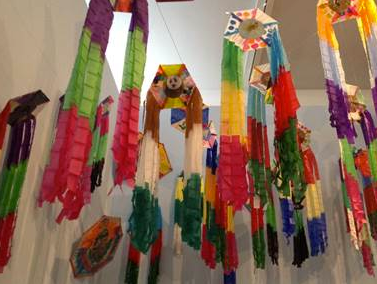
To study the work of Maya Lin, the children had already been working with Moore, Adams, and Spanish teacher Sarah Zegarra to create traditional Guatemalan barriletes (kites) memorializing endangered species, people, and habitats. “Some students chose to do earth as a whole,” Zegarra says, “while others focused on specific species, such as the panda bear or the sea turtle.” These kites are on display as part of the Oakland Museum of Art’s 20th anniversary Day of the Dead exhibit through January 4, 2015.
Although the material presented in “What is Missing” is hauntingly sad, Maya Lin is hopeful about the future. When one student asked what she believes the world will look like in five or ten years, Lin responded, “I’m hoping we’ll start really moving on climate change. We have the tools, the technology, and the UN report says that spending money to turn climate change around could boost the economy.” (She was speaking about the IPCC’s report to the UN Climate Summit in September).
“There’s hope we can turn this around tomorrow,” she told the children. “We could put a huge dent in climate change. I’m actually hopeful… But it’s not going to come from keeping your fingers crossed. We all have to act.”
“Nature comes back, if you give it a chance,” she added later.
Studio Habits of Mind
Part of Maya Lin’s artistic process is doing research on a topic before starting to create. She often looks at old maps, studies the culture and history of a site, talks to experts, and reads widely about an issue before her idea for the piece itself forms in her mind and she begins her preliminary sketches or models. “Just like you, I’m a student,” she said. “I read as much as I can about the subject.”
That process parallels the “Studio Habits of Mind” that Maya Lin students practice during their school day. Those eight habits (which include developing craft, engaging, and observing) help “students increase their metacognitive abilities about their work,” Goodwin explains.
Perhaps one of the most provocative questions the students asked was, “How does art make you feel?” Maya Lin answered it beautifully: “Miserable, traumatized, angry, tired. It’s really hard. But there’s nothing more satisfying than when you have finished the project and you know it is done.”
“Art is a reflection of our times,” she said. “But it’s also a reflection of you as an individual. And you have to find your voice. The most important thing is, in art you have to find your voice.”
—Information, photo submitted by Alameda Unified School District
Get more local news delivered straight to your inbox. Sign up for free Patch newsletters and alerts.