Sports
Oakland Raiders Chaplain Adam Ybarra
The founder of Alameda's Bridge Point Church talks about his roots and his work as a pastor and chaplain.


The first time Adam Ybarra stepped up to a pulpit, he knew he was destined to be there.
He read just one verse. Ybarra recalled that pivotal moment in his youth: “At that time, in my mind, even though no one else knew it, I was a preacher. It was as if God said this is why I created you.”
Today, Adam Ybarra, 46, is the chaplain to the Oakland Raiders and the pastor of Bridge Point Church in Alameda. He is a respected authority on working with at-risk youth, a husband, and a father. But at that turning point in his life, Ybarra was none of those things — yet.
Find out what's happening in Alamedafor free with the latest updates from Patch.
Where were you born and raised? I grew up on the east side of San Jose — the rough part in a single-parent home. My mom and dad were divorced when I was five. My mom was young when she had the four of us. She had her first child when she was 15.
When I was five, I remember the last argument my mom and dad had. I could hear the commotion and then my dad leaving. I went to bed just crying my heart out. I didn’t know what to do. It wasn’t a religious home, so there wasn’t any praying or anything like that. It had a profound effect on me. I knew I wanted to be a dad — a good dad — and that I would never do anything like that.
Find out what's happening in Alamedafor free with the latest updates from Patch.
It sounds like you had a rough childhood. The folks around us were in and out of prison. They sold drugs. At a young age, I saw guns, heroin. You’re just around it. It was the norm.
You go to school and you see one aspect of life. Then you come home and that’s reality.
I would see families like the Kennedys or The Brady Bunch on TV. That was the social construct. Then you look at yourself and you’re not like that. So you think you’re just not blessed.
How did you go from that kind of childhood to where you are today? We weren’t a religious family. When I was 15, my mom goes to church and comes home and says “I just met Jesus Christ.” I was floored. At that time, we were on welfare and my mom would tithe. I didn’t know what that meant at first and when I realized it meant she gave the church money, I thought that she was really off.
But I began to see my mom change. She became a lot more solid as a person. And that was the seed.
Did you become a Christian then? No. At the age of 15, I was selling drugs. I was arrested when I was 17 for having a quarter-pound of weed and a gun. By the time I was 18, I wasn’t selling any more. I was trying to change but I was still smoking a lot of weed and partying. I didn’t like me. The substance was a way to cope.
When I was 19, my brothers, who had started going to church, needed a sound person for their gospel band. They were going to Denver to play. So I went along to help. And for the very first time in my life, I saw a group of young people who were genuine. No one was drinking or doing anything. It was then — November 23, 1984-— I said, "God, if you’re real, come into my life." Then I felt this sense of love. I knew.
How did becoming a Christian affect you? I didn’t need to use substance any more. That, to me, was huge.
Order started to happen. For instance, I was never big into cleaning my room. I looked around and said, what kind of pig lives in here? I started cleaning up.
I went to people that I used to be part of a gang with or girls I used to go out with and I’d bring them to church. I didn’t think of it as winning souls. I just found something that I wanted them to check out. I don’t like to be preached to. And to this day, a lot of people don’t know I’m a preacher. They think, "This dude is cool.” The Bible says they will know you by your fruits. Hopefully they see something in you.
I just loved being in the church. If the church needed painting, I was there. I started becoming passionate about the Bible. God just grabbed my heart. I started seeing the beauty of serving people, serving God. Whatever I could do.
Eventually, I went to Northern California Bible College.
Talk a bit about your work with youth. In 1996, I founded the Tenacious Group. I created a curriculum that’s being taught all around the country in high schools, juvenile hall, and maximum security prisons.
What is the curriculum? It’s called RESH 180. RESH is an acronym for Raising Expectations, Standards and Honor. When I was a youth pastor, I would go into a school. Because of the separation of church and state, I’d only get to speak to the Bible club. There would be eight people there and we had to bring pizza to get those eight to come! I wanted to reach the 2,000 kids who attended the school.
One day, I got a call from a buddy of mine who was working with at-risk students in San Jose, He asked me if I wanted a job, and could I bring an example of a curriculum I could teach? I brought him a binder of principles I pulled out of Scripture. He looked at it and said, “I don’t know how you did it, but you condensed three personal development curriculums into one.” So I went and bought a book on how to put a curriculum together.
In 1999, they gave me 33 students at a school that was the last chance for students who were one decision away from juvenile hall. The class was mandatory. So I have these kids who hate school from 3 to 5 in the afternoon. What that compelled me to do was make every lesson visual. The next year, RESH 180 was used in all the continuation schools in San Jose. Now people are using RESH in all different parts of the country.
How did you become the chaplain for the Oakland Raiders? I was at a mall.
I never get that at the mall! I was at the mall and I met [Raiders running back] Napoleon Kaufman. We became friends. One day [in 1999] he called me and asked if I would like to be the team chaplain for the Oakland Raiders. It was just like that. One moment, I’m the young adult pastor at an incredible church (Cathedral of Faith in San Jose), then I’m the chaplain for a NFL team.
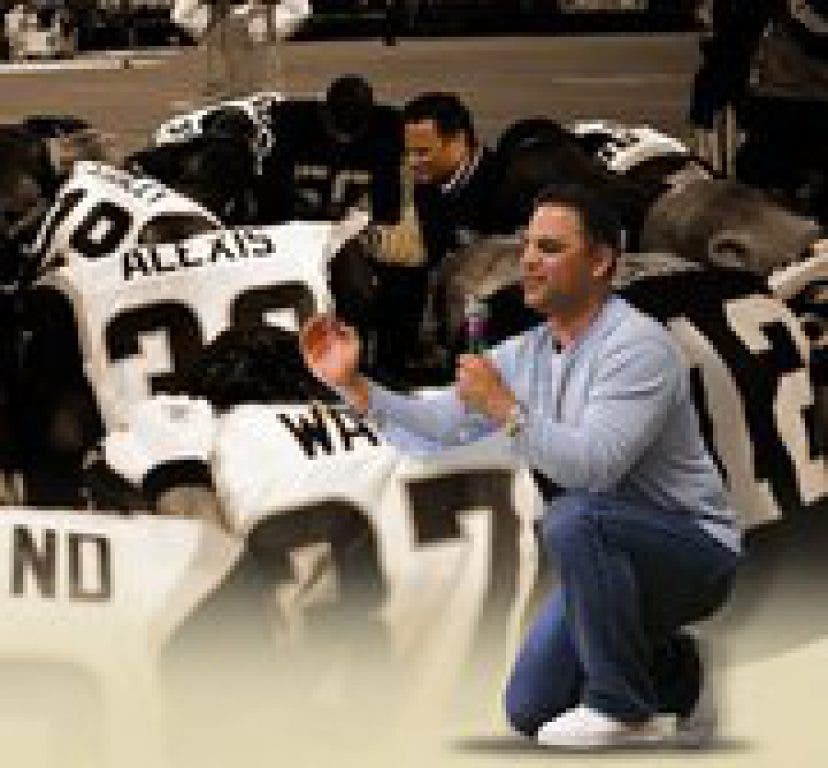
What are your job responsibilities as the team chaplain? I travel with the team. I’ve been to every game. We have service the night before the game. The players can’t go to church on Sunday, so this is their church. I bring a projector and a sound system on the plane. I default to my youth pastor mode because these are young guys — average age is about 25 — and they’re so drilled all week. They just seem older because they’re big and they have a lot of money. We’ll sing and then we’ll share. Then we play trivia games. For that moment, they’re not in this billion-dollar industry. They’re just having fun. Then I give a 20-minute talk.
We also have couples Bible study during the week. I do one-on-one counseling. I marry couples and baptize.
Do you pray for the Raiders to win? Absolutely! When we lose, they say I didn’t pray hard enough.
Seriously, there are some terrible statistics about what happens to many players after their NFL careers are over. The length of the average NFL player’s career is 3.6 years. According to the NFL, 78 percet of players wind up bankrupt, divorced or unemployed. Sometimes all three. When I first read that, I thought someone was exaggerating. After 10 years, I think the numbers might be a little higher.
How do you help players plan for life after the NFL? That to me comes through relationships. Some guys won’t listen because life is good. They’re playing a game they love. They’re making tons of money and everybody loves them. They’re living in a dream world.
I just ask God to give me the wisdom to help guys get away from the helmet for just 10 seconds. I’m not trying to get them away from the game. But I’m trying to help them make connections that will help them post-NFL. I say, “Look, let me help you build a network right now. If you have a passion for Peet’s, let me connect you with the president of Peet’s.”
With so much going on in your life, why did you start a church too? As I traveled around the country with the Raiders, I’d meet these guys who went to foreign cities and just started churches. They fascinated me. How did they do it? Little did I know that God was stirring this in me. Bridge Point started April 2010. It’s a church plant, so basically it’s starting from scratch.
Why in Alameda? One of my favorite writers is Norman Vincent Peale. He talked about how to discern the voice of God and how to make good decisions. Obviously you want to read the Bible and pray and talk to godly people. But he also said, don’t discount logic.
Logic said Alameda. For the last 10 years, I’ve been going to a place called Alameda for six months of the year. (Ybarra and his family moved to Alameda in September 2010.)
How did you choose the West End? Other than the and on Park Street, I’d never been anywhere else in Alameda. Then I thought, I don’t know anyone here in Alameda outside of the Raiders. How am I going to start a church? So I asked the mayor and the chief of police for a few minutes of their time. [Former Police chief] Walt Tibbets invited me on a tour of Alameda. He took me to the Naval base — I’d never been there — and he started telling me about the demographics. I have a real heart for the . Then he took me to . I said, this is where I want to be. Right here.
How big is your congregation? About 57 adults and 18 young people. Everyone from doctors to homeless people. It’s an incredible thing to see. There’s something about worshiping in a place with somebody who is radically different from you. We need each other.