Neighbor News
Stages of a Team Managing Group Dynamics in a Decision Environment
Leadership and Decision

Abstract
Reflection is so extremely important when working within teams. Looking back at past projects to keep from making the same mistakes in the future is needed. Being within a professional environment and creating a cohesive team that works well together members will need to know what role they play within the collaborating. Leaders within groups may use the Cog’s Ladder as a way to know the different behaviors and personalities that may show up while working together. Knowing the stages of group collaboration from norming to forming and when you must arrive at each stage to complete a project.
Introduction
Find out what's happening in Alamedafor free with the latest updates from Patch.
While attending University of Phoenix it was normal for students to work within teams. This method of team collaboration was meant to help students learn how to perform the dynamics of group collaboration and cohesiveness. Attending the University of Phoenix was extremely a learning experience for me considering one of their fundamental beliefs is cultural diversity and working within group. They are also a University that focuses on leadership and structure. “All groups need leadership. Without leadership, a group may be nothing more than a collection of individuals, lacking the coordination and motivation to achieve a common goal. Quite simply, “there are no successful groups without leaders….Leaders lead because groups demand it and rely on leaders to satisfy needs” (Engleberg & Wynn, 2010).
In each and every class we had to work within group and for me the first group exercise was a bit difficult considering the team members where of different ages, and each and every one of us had uniquely different life styles along with different work schedules. My first class at University of Phoenix campus was Gen/101 Skills for Life Learning I. This class taught students about the formation of team building, APA formatting, researching for essay writing, and presentations something that would be used in each and every class. I will discuss some of the issues that I ran into and how I worked through all aspects of team dynamics and the observation of group collaboration, leadership, and the stages of Cog’s Ladder.
Find out what's happening in Alamedafor free with the latest updates from Patch.
Thesis Statement
I worked in groups but never really put emphasis on collaboration and working together and picking up the slack of lager within the group. My first group consisted of 4-5 members whom were of all diverse ages and genders. Finding out whom the leaders where and the followers were was bit much, because all of us had some form of taking on the initiative except for maybe 1 or 2 whom did not.
Stages of a Team
How Cog’s Ladder Influenced Group Collaboration
While at the University of Phoenix we did not use the Cog’s Ladder but we used other forms of information concerning group dynamics which included the stages of group dynamics that where very similar. I remember being a new student on campus and not really knowing what to expect from the scholastic program. What I did know is this we had to work in groups in class weather we liked one another or not, the work by no means was easy, and weekly we would have an individual paper due, group paper, and a power point. My second teacher Mr. Wielder stated to the entire class, “ Look to the left of you and then to the right of you two out of three of you will not complete your degree program here at University of Phoenix” (Wielder, 2007).
The first class group dynamics was far from easy, because I did not have a clue on what group dynamics was. I worked in groups but never really put emphasis on collaboration and working together, and picking up the slack of lager within the group. My first group consisted of 4-5 members whom were of all diverse ages and genders. Finding out whom the leaders where and the followers was a bit much because all of us had some form of taking the initiative within us except for maybe 1 or 2 whom did not.
Our very first project was based solely off research and delivery (presentation). Even though we did not use the Cog’s Ladder we still as a group went through Cog’s Ladder stages.
Provide an example for each stage/step
Polite: This portion of the Cog’s Ladder within my class group dynamics was basically the introduction of team members. Usually when you first meet people you are polite and humble.
Why We Are Here: Establishing why we have formed is evident within the assignment that was given by the instructor. We also formed as a group within UOP to accomplish one single goal a degree and knowledge.
Power: This stage of forming shows who will take the initiative within the group to get the needed work and assignments done in a timely manner, and whom will not. Our group showed evidence of who was willing to do the needed work and take the initiative which showed members who were the leaders within the group.
Cooperation: Our group was excellent when it came to cooperation however we did have incident when one member dropped the class due to personal issues.
Espirit: This would be a way of unification and oneness within team bonding. This stage bring upon group forming and collaboration with one another. In the group everyone has introduced each other and has familiarity with associate team member. “A group will have reached the Esprit stage when its members develop the kind of rapport that brings a sense of closeness, comradeship and mutual trust. At this stage, the members enjoy working together and are willing to extend themselves for their colleagues. The need for structure declines and is replaced by an air of informality based on positive regard for each of the other team members” (HDP, 2014).
Stages of a Team
My team in this first series of classes was successful by actually going through the motions of group dynamics.
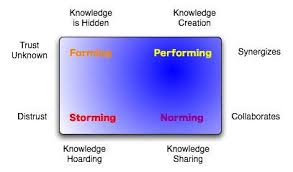
Norming: Within this stage each team member was able to meet and exchange needed contact information on an online group form that UOP gives to each team member to ensure that we all have proper contact information just in case an emergency surfaces.
Storming: There was the best of times and the worst of time and let the challenge arise. The storming portion of the group dynamics is the worst. This stage of the dynamics I truly hated, because you actually find out who plays what role within the group. From leaders, workers, to followers, and also those who take the initiative. You also find out who will not do their work. Communication is key! The most valuable form of communication is face-to-face. The next most valuable is by phone or videoconference, but with a caveat: Those technologies become less effective as more people participate in the call or conference (Pentland, 2012). We got through this stage, but not with ease.
Performing: Now let the good times roll. I love the performing stage which means we are actually accomplishing something and things are getting done. Our group made it through this stage not necessarily with ease, but we were able to make it through. The performing portion was the assignments did come with ease, but getting there was the difficult part. Once our group started doing the work and performing we were able to work out the kinks.
Forming: When the group is forming you know who plays what role in the group, and the group has established titles and positions. Forming is what you call the cooling down period, and all work is compiled together. This is the merging portion of group dynamics.
Positive and Negative Group Collaboration
Within our group collaboration the negative collaboration came when we lost a team member. When you work in teams and you lose a team member it causes other team members to have to pick up the slack of the lost team member. The set back by us doing this time management and leadership pulling the weight of other team member. “Leaders must focus on both task and non-task elements. A team that has a strong bond or camaraderie also needs task issues to be successful, and best-laid plans are of no use if a team cannot communicate or get along. Bottom line, both task and non-task elements are equally important and must be paid attention to if a team is to be successful” (CSU Global, 2014). The positive aspect of the group collaboration was we all had say and inputting within the requested assignments. Each member contributed to the task with room to grow.
Conclusion
Group dynamics, group collaboration, and Cog’s Ladder are all forms of team building and development. Within each group completion of stages should be acquired in order to complete task. Excellent groups work through the required stages to make sure completion is achievable. University of Phoenix did teach me the value of working within groups and how group process can help organizations be more successful. Weather groups use the Cog’s Ladder to help finding out what vital role each member plays is decisive. The Cog’s Ladder is not always used, but is needed when finding out the strengths and weaknesses of the team and team player.
References
Decision Theory in a Global Marketplace. (2014). In Module 4: Managing Group Dynamics in a Decision Environment. Greenwood Village, CO: CSU Global.
Engleberg, I., & Wynn, D. (2010). Working in groups: Communication principles and strategies (5th ed.). Boston: Allyn & Bacon.
PETLAND, A. (2012). Harvard Business Review. In The New Science of Building Great Teams. BOSTON: Harvard Business Review.
INNOVATORS IN. DEVELOPING HUMAN POTENTIAL to DELIVER HIGH PERFORMANCE. (2014). In STAGES OF TEAM DEVELOPMENT: COG’ S LADDER. Evergreen Consulting Home.
=