Schools
50 Years Since Start of Free Speech Movement: Cal Students Stage Sit-In
A noon rally was held Wednesday in Sproul Plaza to mark 50 years since the movement's catalyst.


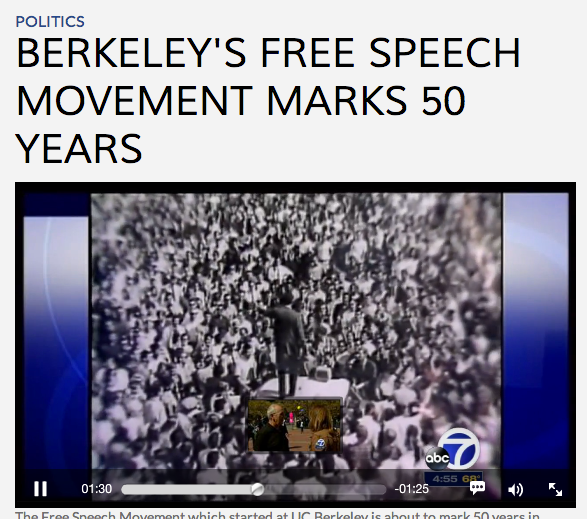
As a large rally was held today to celebrate the 50th anniversary of the Free Speech Movement on the University of California at Berkeley campus, a group of students who say they still face curbs on their speech on campus launched a sit-in of their own. In the last 50 years, the university has come to appreciate the historical significance of the series of massive protests in late 1964 demanding the school lift a ban on on-campus political activity. While they were disruptive at the time, the school is now commemorating those protests with numerous events throughout the school year. The Free Speech Movement changed the way college students engaged with their universities and influenced college activism nationwide, contributing to student movements that eventually led to huge protests against the Vietnam War.
A noon rally was held Wednesday in Sproul Plaza to mark 50 years since the movement’s catalyst -- a spontaneous sit-in involving thousands of students who surrounded a police car for 32 hours after a former graduate student was arrested. Jack Weinberg, the former student who was arrested for refusing to show his identification to campus police and remained in the immobile car the whole time, spoke at today’s rally, along with fellow organizers Lynne Hollander Savio, Bettina Aptheker and Jackie Goldberg.
A student group called the Cal Progressive Alliance participated in today’s rally and the school invited one of the students to speak there. Once it was over, however, they broke away to form their own protest over what they call the increasing privatization of school resources and militarization of the police force. They marched to the Architects and Engineers Building, where about 15 students went inside for a sit-in, one of the protesters said. Alison McDonald was outside of the building at about 3 p.m., where she said a larger group had gathered to show support for the students refusing to leave inside.
Find out what's happening in Albanyfor free with the latest updates from Patch.
She said that not as much has changed since the Free Speech Movement took hold in 1964 as the students would like. While on-campus political activity is no longer banned, she said that police intimidation can make it difficult for students to effectively organize.
Find out what's happening in Albanyfor free with the latest updates from Patch.
“We’re facing the reality of being silenced by the university,” McDonald said. The students inside distributed a list of demands, mainly involving the Gill Tract, 6.3 acres of university-owned land in Albany slated for development but also used for agricultural research that was the site of Occupy the Farm demonstrations in 2012. They are demanding that development of the land be halted immediately and for the development firm, Capital Projects, to provide documents about the development.
The students also expressed concerns about a planned satellite research facility in Richmond that is slated to be under construction next year. They are demanding that Capital Projects make documents related to the Richmond Bay Campus available and work with other branches of the university to address concerns from Richmond residents. The students are also demanding a meeting with university Chancellor Nicholas Dirks, who they say backed out of a promised meeting with them in May. McDonald said the students planned to remain there until satisfied that their demands had been addressed.
Events commemorating the anniversary of the Free Speech Movement are planned throughout the coming months, including panel discussions, film screenings, lectures, exhibits and other performances and presentations. A full calendar of events is available at http://events.berkeley.edu/index.php/calendar/sn/fsm.html
—By Bay City News
Get more local news delivered straight to your inbox. Sign up for free Patch newsletters and alerts.