Schools
After 9/11: How One Boy Spoke for His Entire Community
Mohammad-Amir Aghaee reflects on his Sept. 11 experiences at Albany Middle School.
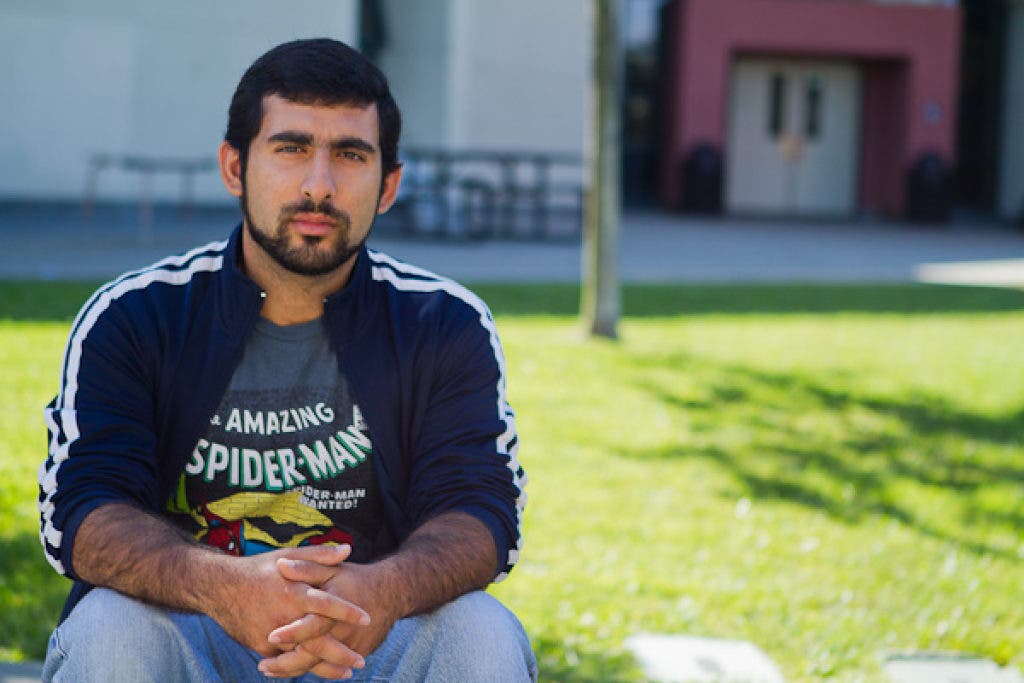
In January 2001, when Mohammad-Amir Aghaee was 13, he visited the World Trade Center with his dad.
As Aghaee stood at the bottom of the twin towers looking up, he thought, "This doesn’t look tall at all. This is hella short."
Eight months later, on the morning of Sept. 11, Aghaee was asleep when his father burst into his room.
Find out what's happening in Albanyfor free with the latest updates from Patch.
"Come down stairs, come down stairs," his father shouted. "They hit the World Trade Center!"
Aghaee rushed to his family’s living room, just in time to see United Airlines Flight 175 smash into the south tower on live television.
Find out what's happening in Albanyfor free with the latest updates from Patch.
When the TV cameras zoomed out and showed the burning World Trade Center against New York City’s skyline, Aghaee realized he had been wrong about the twin towers' size eight months earlier.
“Damn it. They do look tall,” he remembers thinking.
AWAY FROM THE AYATOLLAH
Aghaee is a Persian American. His parents fled from Iran to the United States in 1986 to escape the Iran-Iraq War. (The war spanned from 1980 to 1988, claiming more than 1 million Iranian and Iraqi lives.)
In 2001, his family lived in ; his mother studied electrical engineering and computer science at UC Berkeley. Aghaee attended and graduated from in 2006.
Aghaee is now a 23-year-old graduate student studying entomology at UC Davis. When I visited him several months ago at Davis, he was frantically recapturing escaped insects in his laboratory.
I recently met Aghaee at an Asian tea shop in the Pacific East Mall to hear his 9/11 story.
FROM "ALADDIN" TO "BIN LADEN"
Prior to Sept. 11, Aghaee said being a Muslim in America was like being invisible. When he told non-Muslims of his faith, some thought he was like Aladdin.
After the towers fell, Aghaee said, people became aware of his religion.
"After 9/11, it became like, 'What are you?'" said Aghaee of the curiosity and suspicion surrounding Muslim Americans. "It was like the aliens had landed: 'Are they here in peace or are they going to kill us?'"
ONE BOY REPRESENTING AN ENTIRE COMMUNITY
Aghaee got his chance to explain the difference between al-Qaida and his religion when the Albany Middle School faculty asked him and two other Middle Eastern students, Moustafa Hussein and Negien Mirzai, to represent Islam and Middle Easterners to each eighth grade history class. They were to give a brief history of Islam, explain how the Quran condemns terrorism and answer questions students had about Muslims and the Middle East.
Aghaee, who had no previous public speaking experience, said he remembers being nerve wracked by the presentation’s responsibilities.
"I had been lumped with all the other Muslim people, (as if) we’re all one monolith," said Aghaee. "So suddenly, I’m speaking for the entire Muslim community."
But he, along with the other two students, accepted the middle school’s offer. Aghaee, being the leader of the group, spent two weeks rehearsing his 30-minute speech in front of a mirror each night before the presentation.
AS THE BOMBS FELL
Aghaee’s tour of eighth grade history classes began in early October 2001, just as American troops entered Afghanistan.
Like a student performing a school play, Aghaee’s heart would beat wildly with stage fright before each presentation. Once he started speaking, his heart would calm down to a steady rhythm.
"Making those presentations was like jumping off a cliff," said Aghaee. "But with a parachute."
Robert Pressnall, an Albany Middle School English and history teacher who retired last year, said the school made the right decision to have Muslim students represent Islam instead of Muslim adults.
"At this age, teens are pushing away from adults. They're pushing away from me and they're pushing away from their parents," said Pressnall. "So, to have another kid come in, that is the most powerful thing you can do."
WHY DO THEY HATE US?
The most challenging part of the presentation, said Aghaee, was the question-and-answer session. His classmates asked complex questions, such as: Why is there conflict between al-Qaida and the United States?
Aghaee said he provided answers beyond President Bush’s they-hate-us-because-we-are-free mantra. He told his classmates about U.S. support for authoritarian Middle Eastern regimes, U.S. troops stationed in Saudi Arabia, and U.S. support for Israel as some of the reasons behind al-Qaida's attack.
Sometimes Aghaee’s teachers would elaborate on a topic.
"I remember Mr. Pressnall expanded on puppet regimes," said Aghaee of Pressnall, who is a Vietnam veteran. "He explained to the class how the U.S. funds puppet regimes by relating his Vietnam War experience, how the U.S. was propping up Ngo Dinh Diem." (Diem was the president of Vietnam until he lost U.S. support. He was assassinated in a CIA-backed military coup in 1963.)
FEAR AND WAR
In the weeks following 9/11, Aghaee feared the government would detain his family in internment camps, like Japanese Americans during World War II. To demonstrate his patriotism, Aghaee banged the war drums with the hawks. He recalled a conversation he had with a friend when the United States invaded Afghanistan.
His friend said, "Yeah! They killed a Taliban."
Aghaee replied, "Yeah dude, rock on!"
Looking back, Aghaee said he could also have differentiated himself from al-Qaida and the Taliban by espousing his belief in democracy. He said the recent overthrow of Egyptian president Hosni Mubarak has provided a democratic alternative to al-Qaida’s violent ideology for Middle Eastern political change.
But the fear of being called a terrorist by the government and his peers caused Afghaee to be swept up by the war frenzy following 9/11.
"When people are afraid, they just want to know who to point their finger at," said Aghaee.
CHILDREN OF SEPT. 11
Ten years later, many of Aghaee’s eighth grade classmates have only a vague recollection of his presentation. But his speech had a profound effect on a few students.
“That was definitely one of the first times I really ever came in contact with the Muslim world,” said Natasha Best, an eighth grade classmate of Aghaee and a recent graduate of UC San Diego. “And I think, later on in my life, it made me more interested to study it. My major was political science-international relations, so a lot of my study in school has been around that.”
Looking back, Aghaee said he appreciated being part of history with his classmates.
“Thirteen-year-olds usually don’t give a crap about anything, but here was history happening,” said Aghaee. “And here were their fellow students trying to explain to them what was going on, trying to make sense of the world for them.”
See more portraits of those whose lives were changed on Sept. 11 on the Huffington Post here.
Everybody makes mistakes ... ! If there's something in this article you think should be corrected, or if something else is amiss, call editor Emilie Raguso at 510-459-8325 or email her at emilier@patch.com.