Business & Tech
Albany Garden to Table: An Edible Initiative of a Different Kind
If you're an avid Albany edible gardener interested in teaming up with local businesses, or a local restaurateur, this may be just your ticket.

Would you like to see your plump, homegrown organic radishes blush crimson on a bed of sea salt in a sweet little restaurant? Interested in sharing your extra lemons with locally owned businesses?
Community organizer and is creating a new program that may be perfect for you.
Albany Garden to Table, a fledgling Albany Edible Initiative, hopes to provide independent, locally owned restaurants and other institutions in the city with organic produce, courtesy of backyard gardens.
Find out what's happening in Albanyfor free with the latest updates from Patch.
Participating growers would drop produce off at the city's weekly vegetable swap; there is no cost to be involved.
Reil, who works full-time as a publisher, formed Albany Edible Initiatives as part of to connect and build on community food-related efforts. The , a proposed Albany Community Farm, garden work parties and alternative planning for the Gill Tract and Albany Meadows are on its current roster.
Find out what's happening in Albanyfor free with the latest updates from Patch.
Albany Garden to Table is unique, however, in its plan to connect community gardeners and restaurant owners. It represents, as Reil put it, “a very different model and way of thinking.”
The program will begin with restaurants, and will later look at expanding to food banks.
“I am starting with restaurants because I want to make an immediate impact on the economics in town, and I also feel restaurants are a forgotten element in this type of community activism,” Reil said.
Context comes from the Transition movement’s idea that economic breakdown will follow peak oil—when, followers believe, global oil production will reach its maximum and then forever dwindle. Rising oil prices and decreasing availability, the movement predicts, will impact economic sectors reliant on inexpensive oil and force us to meet many needs on a very local level.
The idea is that community members should work together to sustainably produce and share goods now, because one day we’ll have no other choice.
Locally owned businesses are not seen as something outside this framework, and a goal of Albany Edible Initiatives is to support them. “They are our neighbors,” Reil said. “We need to work together and keep the money in the community.”
The program encourages gardeners to become “edible growers,” as Reil calls them, and grow a little extra to drop off at the Albany Garden Swap for collection and delivery.
Albany-grown produce of any kind is welcome, though it must be organic—no pesticides or synthetic fertilizers—and harvested within 24 hours of delivery. Growers are not expected to provide specific items or quantities because they’re collectively supplementing restaurants with local, seasonal produce and not supplying them with every fruit and vegetable they need.
Soon there will be guidelines for sharing preserved and pickled items—and eggs.
There’s no cost to restaurants.
“I am asking restaurants for low-total gift certificates if they feel the project was successful,” Reil said, adding, “I would give them to the best growers at the end of the season.”
How the relationship will ultimately work—including in-kind sharing to growers—is a matter of time and natural development. “I want this to be self-creating and work for the participants,” he said.
At this point, though, only one restaurant is on board, and four are interested.
No problem. Reil plans to pilot the program with that restaurant and community-minded gardeners on his own block, himself included—whose gardens he referred to collectively as “a farm.” The hope is that other restaurants will want to join when they see the benefits.
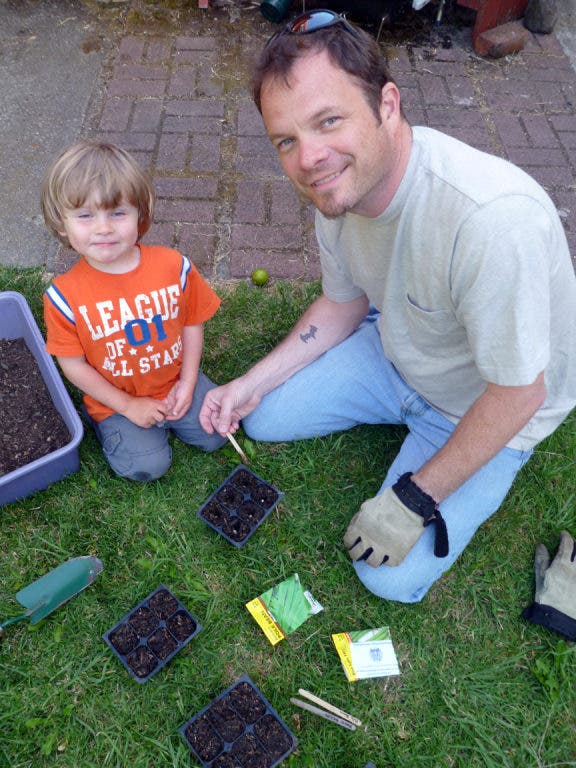
Running the program will be a team effort, thanks to volunteers, and Reil said his key role will be to “aggressively garden.” Cashel, his almost 3-year-old son, likes to grow things, too, so Reil will have some in-house assistance while training the next generation of edible grower.
Albany Garden to Table “brings the food full-circle and keeps the economic loop within the community,” according to Reil, which is something you may want to think about if you believe challenging times are ahead of us.
Interesting in taking part? Contact Doug Reil at halfreal@sbcglobal.net.
Everybody makes mistakes ... ! If there's something in this article you think should be corrected, or if something else is amiss, call editor Emilie Raguso at 510-459-8325 or email her at emilier@patch.com.