Schools
Albany High's Iron Teacher
Albany High teacher Darren McNally strives to be an Ironman triathlete.
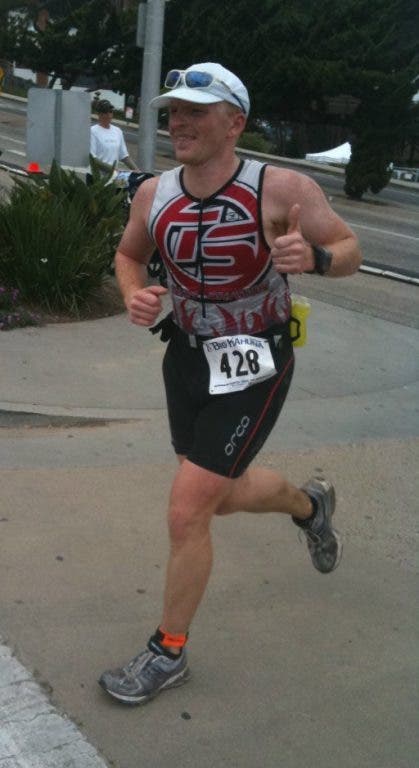


Darren McNally, a chemistry and AP environmental science teacher at , will be racing his first Ironman triathlon at Penticon, Canada, on Aug. 28.
The Ironman consists of a 2.4-mile swim, a 112-mile bike and a 26.2-mile run.
Arrion Azini, an Albany High student, said McNally, age 28 and 5 feet 11 inches tall, resembles a Roman gladiator. He has muscular arms for swimming, thick legs for cycling and flat abs for running.
Find out what's happening in Albanyfor free with the latest updates from Patch.
I sat down with McNally at on Solano to discuss his Ironman training.
THE START
Find out what's happening in Albanyfor free with the latest updates from Patch.
“I discovered training makes me happier, improves my mood and relieves stress,” said McNally. “Which surprised me because I did not think I would be one of those people who enjoys working out. Turns out I am.”
McNally said he was surprised because he grew up as a chubby kid, so he always thought sports were reserved for lean and muscular people. He said he lived a sedentary life from elementary school through college.
After he graduated from UC Santa Cruz in 2004, McNally wanted to end his unhealthy college lifestyle of staying up late, drinking beer and eating pizzas. He was overweight at 215 pounds.
He also wanted to take on a new challenge.
“I felt like I had been doing academic stuff my whole life,” said McNally. “I wanted to try something physical and the Olympic distance triathlon (1.5 kilometer swim, 40 kilometer bike ride, 10 kilometer run) seemed like a good challenge.”
He originally planned to finish only one triathlon, but he got hooked on the endorphins, neurotransmitters that induce positive feelings after strenuous exercise.
“In times where my training has fallen off, I tend to get depressed and sad,” said McNally.
As a result of his training, his weight dropped to 175 pounds.
After finishing his first race at Wildflower, a popular Central Californian triathlon, in 2006, McNally completed six half-Ironman triathlons (1.2-mile swim, 56-mile bike, 13.1-mile run) from 2007 to 2010, and the 2007 Escape from Alcatraz triathlon, where he swam 1.5 miles across the San Francisco Bay.
WHY?
George Mallory, a British mountaineer from the 1920s, was once asked why he wanted to scale Mt. Everest.
According to legend, Mallory famously answered, “Because it’s there.”
McNally has an attitude similar to Mallory's.
“I want to see if I can train myself for that," said McNally, in reference to the Ironman event. "It really is just as simple as that, to see if I can.”
His goal is to finish the Ironman between 11 and 12 hours, faster than the average Ironman Canada finish time of 12 hours and 5 minutes for 25- to 29-year-old men.
FORGING THE IRONMAN
McNally said the most challenging part of the Ironman isn’t the race itself, but the training.
“The race is one day, but you really have to train for it. It’s almost like having a second job for three to four months,” he said.
McNally specifically chose Ironman Canada so his peak training period, where he does 100-mile bike rides and 20-mile runs, would occur during the summer. His longest workout is six hours of biking followed by two and a half hours of running.
McNally still has to balance his Ironman training with his summer job as a biological researcher at Lawrence Berkeley National Laboratory. He often runs at 6 a.m. before leaving for work.
THE 15-MINUTE RULE
Sometimes the most challenging part of a workout isn't pushing the mind and body to their limits, but overcoming the lethargy of sitting in front of a computer and surfing Facebook. To insure he completes his training, McNally devised the 15-minute rule.
"I tell myself, 'O.K., this might suck, but just go work out for 15 minutes and, if you want to stop and come home, then stop and come home,'" said McNally. "And I find 95 percent of the time, I end up finishing the workout."
Paul Kinney, McNally’s personal coach, said McNally trains diligently, asks intelligent questions and provides detailed feedback after a workout.
“He really engages with his training because I told him from day one that everything that he does now impacts what happens in the future,” said Kinney. “So he makes sure his training is moving forward as efficiently as possible, so we are not wasting any time.”
AN IRONMAN WITH A HEART
McNally said the biggest downside of his Ironman training is that he sees his girlfriend, Ginger Sevilla, less often.
“There is a joke about tri-widows, which are wives who never seen their husbands because they’re always off training,” said McNally.
But Sevilla, a triathlete herself who finished the Big Kahuna Half Ironman last year at Santa Cruz with McNally, said she supports his training.
“We don’t have a kid, we don’t have a dog, we don’t have anything that he needs to be home to take care of,” said Sevilla. “So he can pretty much take whatever time he wants to go train.”
FERROUS SAPIEN
McNally said he treats his Ironman training as a science experiment. He tries to understand the casual relationships between nutrition, workouts and race performance.
Nutrition became especially important to him because he "bonked" during his first half-Ironman at Wildflower in 2007. Bonking is when the body runs out of glycogen, a type of energy storage in the body, and a bonked person moves as slow as a zombie, he said.
Since his bonk, McNally said, he has learned a lot about metabolic chemistry and sports nutrition.
“Being a science person, you are always like, ‘Why does this happen? How did that happen?’” said McNally. “So I had questions about why certain things happen. ‘Why does nutrition work this way? Why do you have to eat this instead of this?’”
McNally said he will burn 11,000 calories in the Ironman. He plans to fuel himself with Snickers bars, his favorite exercise food.
STRIKING THE IRON
“Overall, he’s doing a very good job with his training leading up to Ironman Canada. He’s not going to have any problems finishing the event,” said coach Kinney.
McNally’s major concern is the scheduling. He said he had to register for Ironman Canada one year in advance due to the race’s popularity. He thought he would have enough time to finish the Ironman before school starts, but the first day of school is Aug. 24, four days before Ironman Canada.
He will attend the first day of school before flying to Canada with his girlfriend on Aug. 25, race the Ironman on the Aug. 28, and be back teaching two days later.
The average recovery time from an Ironman is one month, but McNally said teaching molar mass and population dynamics to teenagers may well be harder than 140.6 miles of swimming, cycling and running.
Everybody makes mistakes ... ! If there's something in this article you think should be corrected, or if something else is amiss, call editor Emilie Raguso at 510-459-8325 or email her at emilier@patch.com.