Business & Tech
Albany Recyclables Ride a Roller Coaster
Albany Patch visited the Davis Street Transfer Station, the second stop in local recyclables' journey to reuse.


This is of three-part series on recycling in Albany. See parts and .
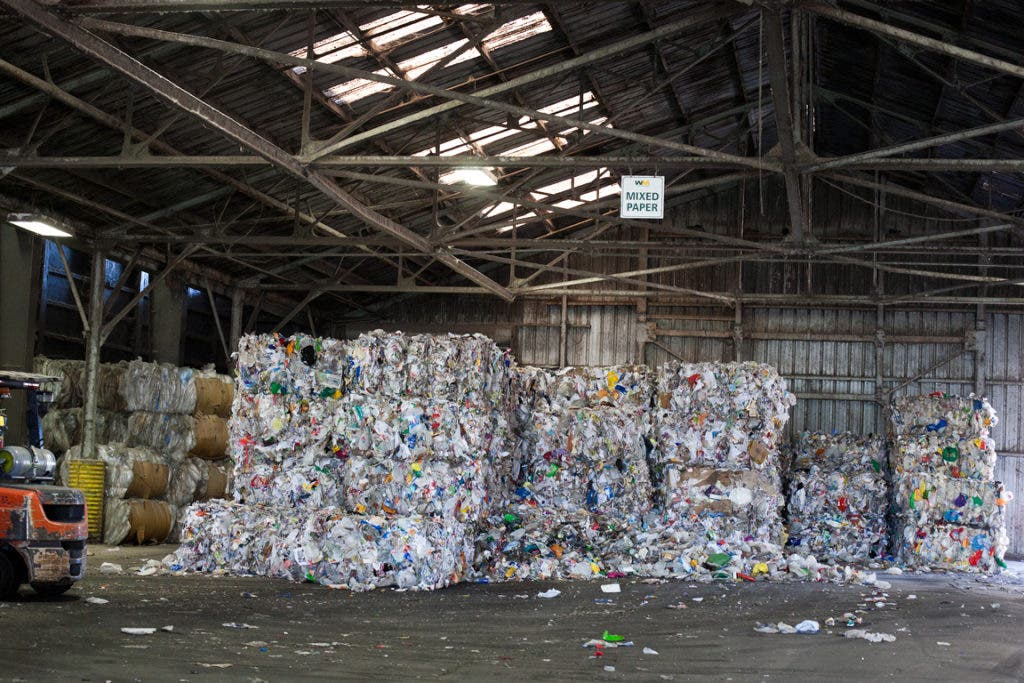
The smell of garbage as we enter the Davis Street Transfer Station is unmistakable and overwhelming. But one man’s trash is another man’s treasure, and Waste Management has invested $15 million in equipment to extract the marketable goods from what looks – and smells – like a garbage heap.
Upon arrival at the station, truck drivers weigh their loads before dumping them into huge piles outside a hangar-sized warehouse. Inside stands the Materials Recovery Facility, or “MRF” (pronounced “merf”), the machine that sorts the mixed glass, paper, plastics and metals into separate piles.
Find out what's happening in Albanyfor free with the latest updates from Patch.
Here, dust swims in the air, never settling, and the whirring conveyor belts, blowers, shifters, shakers and sorters make normal conversation impossible. Albany’s recyclables bounce, jiggle and ride through a Rube Goldberg-esque roller coaster that separates paper by blowing fans, glass by shifting slanted screens, and two types of plastics by optical sorting, since light bounces off various plastics differently.
Workers standing along either side of the conveyor belt grab non-recyclables from the fast-moving mix and put them aside or toss them down a garbage chute. (The morning Albany Patch visited, a small tree stump lay to one side.) After the bouncing and shaking have segregated the materials and brought all of one type together, these piles are compressed into bales. Those are sold to buyers, most of them in China, to be remade into new products.
Find out what's happening in Albanyfor free with the latest updates from Patch.
The truckloads are weighed to track the total from each city that would otherwise wind up in the landfill. Each truck picks up from a single city. Some trucks collect from single-family residences, while others collect from businesses. Still others handle waste from multi-family dwellings, where trucks that lift and shake out a dumpster’s contents are needed.
The state set a goal of 50 percent diversion from landfills in 1989 with AB 8939; that same year Alameda County passed Measure D, which named a diversion goal of 75 percent.
These figures are based on a hypothetical amount of waste per capita, according to Rebecca Jewell, recycling program manager at the Davis Street Transfer Station. Cities in Alameda County regularly divert between 63 and 70 percent, said Jewell.
There’s a real advantage to single-stream recycling, Jewell said, because “more people participate, and we [Waste Management] enter the market with more volume from more households.”
Next stop: All aboard the slow boat to China, where much of our paper and most of our plastic goes.
Everybody makes mistakes ... ! If there's something in this article you think should be corrected, or if something else is amiss, call editor Emilie Raguso at 510-459-8325 or email her at emilier@patch.com.