By Julia Chang Frank
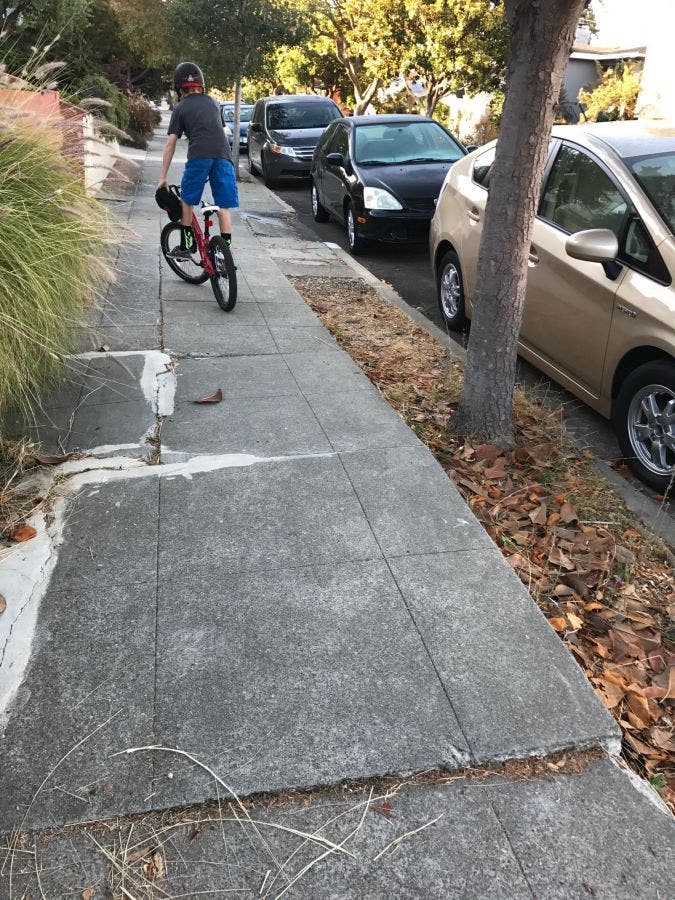
When Bryan Marten picked out a scooter for his daughter’s Christmas present, he thought about Albany’s sidewalks. He decided on the kind with bigger wheels, so she could better negotiate the cracks along her route to Marin elementary each day.
A few months later, Marten’s daughter was scooting home when her wheels hit a buckled slab of sidewalk on Portland Avenue. She fell on her outstretched hand and broke her wrist, taking months to fully recover.
Find out what's happening in Albanyfor free with the latest updates from Patch.
“She’s sworn off her scooter,” said Marten of his daughter who is now in middle school.
Albany’s sidewalks were hazardous for Gail Smith, owner of Toy Go Round, too. Smith was walking on Solano Avenue to her store when she tripped on a broken sidewalk. She hit the underside of her chin so hard that two of her teeth shattered. The fall cost Smith years of pain and over $30,000 in dental bills.
Find out what's happening in Albanyfor free with the latest updates from Patch.
A recent City survey identified 158 severely damaged sidewalk locations. And Albany Strollers & Rollers, a nonprofit advocating for P1, found that more than one-third of Albany’s 600 blocks are cracked or uneven.
Existing City code requires property owners to fix sidewalks fronting their lot. But the Public Works department only receives around 30 permit applications for sidewalk repairs each year.
Homeowners may not realize they’re responsible for sidewalk repairs. Or perhaps it’s just a low priority.
Janet Seltzer, who lives on a corner where three Camphor trees have uplifted the sidewalk, explains her reluctance: “To repair this would likely cost about $10,000. It is unfair that I should be asked to shoulder this burden when I had no say in the decision to plant these trees many years ago.”
And that’s the conundrum.
Sidewalks are public property. But owners are liable for fixing sidewalks fronting their property and any injuries caused by their disrepair.
This is a legacy of the “classic wild west town,” according to Preston Jordan, campaign manager for P1. “Over a hundred years ago, sidewalks were often made of wood and part of the commercial building fronting the street.” Businesses were incentivized to maintain sidewalks to attract customers.
But incentives aren’t aligned in residential areas where a few property owners pay and the majority benefits from smoother sidewalks. Oakland and San Francisco manage this by taking on sidewalk repairs and billing property owners, placing tax liens on properties if owners fail to pay.
Albany has left sidewalk repairs in the hands of property owners and has yet to place a tax lien on a property. Enforcement “is a time-consuming process,” said Nicole Almaguer, City Clerk of Albany. And compared to neighboring cities, Albany’s staff resources are spare.
Proponents of P1 argue that requiring property owners to fix broken sidewalks is inherently unfair since most damage is caused by City trees, and individual repair costs range from $1,000 to over $10,000. By taking advantage of economies of scale, proponents estimate that a citywide repair effort could halve that cost.
If passed, a typical Albany parcel would be taxed $38.65 annually (adjusted for inflation) for ten years. Property owners would remain liable for sidewalk-caused injuries and subsequent repairs.
Though no formal argument was filed against the measure, an East Bay Times editorial opposed P1, arguing that Albany property owners pay high enough taxes.
Julie Legrand, who recently spent $5,000 fixing the sidewalk in front of her Albany home, considers P1, “A huge bargain.” Legrand is a mother of twins and pushes her double stroller along Albany’s uneven sidewalks daily. She supports P1 because it, “improves everyone’s property value. No brainer!”
“Albany is awesome because of its walkability,” says supporter Kellie Lund.
In fact, Albany ranks sixth among Walk Score’s top ten best cities in California.19 Realtors often feature Albany’s high walk score in promotional brochures. Proponents contend that repairs are needed to preserve Albany’s walkability and improve safety.
Broken sidewalks can be particularly unsafe for vulnerable populations. Last year, Los Angeles – a city not known for its walkability -- agreed to make more than $1 billion in sidewalk repairs to settle an Americans Disability Act lawsuit.
“I do not drive. I am a handicapped senior who walks,” said Albany resident Mutka Vie. “Every day on the street I see dozens like myself, wheeling walkers or carefully negotiating with canes. Who can look up to see the birds and the sky? There are too many hazards on the ground under our feet.”
P1 is endorsed unanimously by Albany’s City Council and School Board members.