Health & Fitness
Open letter from a Bulb resident to visitors,
Open letter from a Bulb resident to visitors.

Open letter from a Bulb resident to visitors,
At some point (maybe tomorrow, maybe this week, maybe not for years), the Albany Bulb will come up as a subject of discussion before some political body, and that body will raise a question. That question might be, “Is this really the best use for the land?” or "Can this situation with the homeless continue to be tolerated?” Or it might be a question in which a drastic change is already presumed like, "What is the best way to develop the Albany Landfill?”
Whatever the question is, it will likely be raised by people who have very little to do with what goes on at the Bulb day to day. Their understanding of this place will be framed largely by filed reports, brief tours, and statistics. Because of this, the political body will be at risk of making mistakes. Mistakes that could do a lot of harm although they may be made with the best of intentions.
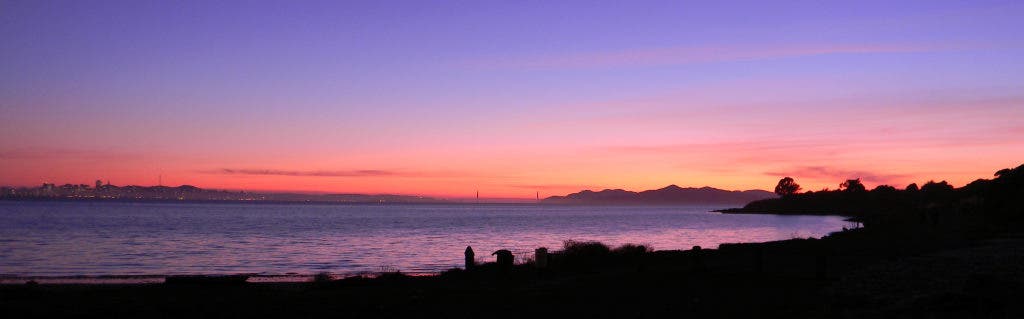
As a Bulb visitor your understanding of this place will be framed differently. You will have walked here, heard the waves, and witnessed the unique beauty. You will have looked across the water at the skyline of San Francisco, seen how small the towers look, and felt how far away the noise and bustle seems. You will have, in common with those of us who live here, an appreciation of this place as an escape, as an alternative. And this is very important.
You will have passed by our camps, seen our tarps set against the rain, and glimpsed jugs of water placed near our tents. You will have seen we deal directly with the same daily challenges others deal with at a distance through the intermediaries of property owned, bills paid, rent spent. You will have seen evidence of our needs and how we meet them. This is also very important.
These things are important because they will allow you to speak out in the event that the politicians make the mistake of characterizing us—the Albany Bulb residents—as weak, passive, and inhuman. They might say we have no choice but to be out here, that this is where we landed after falling through regrettable but sadly inevitable cracks. Or they might say we have been too lazy, too slow, too stupid, or too weak-willed and that, in some sense, we have painted ourselves into a corner by making bad decision after bad decision. They might make decisions on our behalf to ‘save’ us. Or they might make decisions as if we were merely annoyances or obstacles.
You will be able to say that this place has many fine qualities, and that it is possible many of us want to live here because of these qualities, and not because nowhere else will have us. You will be able to say that we are not negligent or lax; rather, we deal with our needs directly in ways many would find difficult. By saying these things, you may be able to help the politicians understand that we are human beings. You can help them understand that we, like everyone, reside in a complex interplay between social and personal dimensions, not relegated to one or the other in order to suit whatever narrative is expedient and easy on the conscience for those making the distinction. You can help them understand that we are not agentless statistics, we are not summed up neatly by a term like ‘homeless’, we are not without intelligence, and we are not without voices.
We are not without voices.
Even if the politicians become convinced of our humanity, they may yet make another mistake: the mistake of thinking they can put themselves in our shoes. They may think they already know how to treat us humanely, because they’ll assume that we want the same things they want. Their decisions will not account for the particulars of our experiences—both of this place and of our lives here— which are very different from theirs, and even from yours. So hopefully in addition to giving your own account of us, you will join us in demanding our right to give an account of ourselves, and in demanding that our perspectives play a critical role in shaping decisions about the future of this place we call home.
It may seem this is asking a lot of you, and it is. But you are not being asked to do our work for us. Of course we will try to be heard. But you must know that political processes tend to operate in such a way that important voices like ours are often not heard, or listened to, or understood, even though they may be loud, and strong, and articulate. The walls of the political structure can be very thick when approached from certain angles. You, on the other hand, may come from a direction from which it is easier to get through.
In asking for your support the hope is to appeal not only to your awareness of our humanity, and not only to your appreciation of our unique and essential perspective, but also to your own selfinterest. You will have felt the special qualities of this place. It would be beautiful even if we were not here. It would be symbolically powerful even if we were not here. But we add something.
This landfill is made from the shattered remnants of buildings and structures that not so long ago were whole and standing, framed in concrete and steel, expected and intended to last. Now, through the concrete, the grasses make their way. Eucalyptus, acacias, and palm trees drive their roots down through the cracks. Waves constantly erode the shoreline and wash out the edge of the road. And here and there, in sections leveled and cleared of rebar, our tents are hidden away. We live around, and with, and in the rubble. Live. Not merely survive. Can you see how hopeful this is?
The Bulb is not utopia. It is not free from strife, and chaos, and cruelty, but neither is anywhere else. It is flawed, but it isn’t broken and it shouldn’t be treated that way. We too are flawed. But we are not broken. So when the politicians start asking their questions and making their decisions, you can help ensure that we are not treated that way.
Enjoy The Bulb. It is yours as much as it is ours or anybody’s.
Bulb resident 2013