Politics & Government
Column: Pass the Frozen Peas, Please
Fun fact: The U.S. Department of Agriculture spent several years in Albany perfecting the freezing process. Albany Patch welcomes guest columns and letters to the editor via email at albany@patch.com.

OK, I have a confession to make. When the Occupy the Farm “farmers” were bothering us, we all sang the praises of our backyard gardens and fresh produce. Except that my garden has been fallow for a few years now. Personally, I could live on frozen vegetables. For me they are comfort food.
When I was in middle and high school I lived in Anchorage, AK. If I had been forced to live on fresh produce I would have starved. What fresh produce? Anchorage’s summers, while blessed with long days, are on cool side and are best for producing monster cabbages. Vegetables came frozen, and the milk I drank was powdered.
After high school I worked in the local public health hospital that served the native Alaskan Inuit (Eskimo) people. I remember one male teenager in particular who was from a remote Arctic village. It was winter, and his mother would come to the hospital ward in her spectacular hand-stitched sealskin parka (still the most beautiful garment I’ve ever seen). She would talk to her son in their Inuit dialect and then leave him with a small white cardboard box.
Find out what's happening in Albanyfor free with the latest updates from Patch.
After his mother left, he would open the box and wander around the ward as he nibbled the contents—frozen blueberries she had bought in a supermarket. For him, frozen blueberries were comfort food. They grew wild on the tundra, ripened late in autumn, and were naturally preserved when winter set in.
I was far from the first person to note that the Inuits preserved food by freezing. According to the American Chemical Society (ACS), in the 1920s:
Find out what's happening in Albanyfor free with the latest updates from Patch.
An astute naturalist employed by the United States government was the first to take particular notice of how the Eskimos prepared their frozen fish.
On duty in the Arctic, Clarence Birdseye watched in fascination as the Arctic ice and the bitter Arctic wind froze the fresh fish almost instantly. More importantly, Birdseye found that when these frozen fish were later thawed, cooked and eaten, their taste was remarkably similar to the original fresh food.
Recognizing that this ‘flash,’ or practically instantaneous, freezing had commercial potential, Birdseye left his government job and formed Birdseye Seafoods, Inc. in 1924.
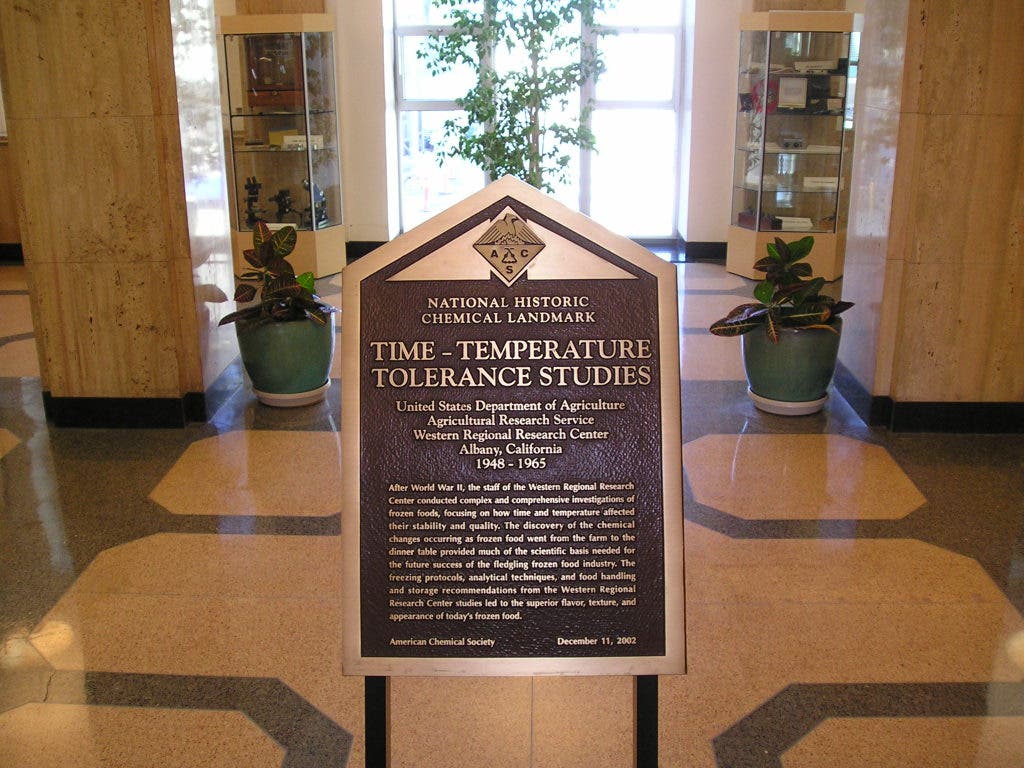
Unfortunately, early frozen food products, developed around the time of World War II, were so unappetizing that the U.S. Department of Agriculture spent several years perfecting the freezing process. The site of this research is one of only five sites in California important enough to be designated by the American Chemical Society as a National Chemical Historical Landmark. It is right here in Albany, at the .
Frozen vegetables have been a fantastic success story. For California farmers, they provided a huge new market. Consumers in states that lack California’s mild winters could still enjoy nutritious vegetables in the dead of winter. Gone were the canned vegetables that had lost their flavor or were preserved in excessively salty and acidic solutions. With refrigeration and freezing came a dramatic drop in food borne illness from improperly canned foods.
As the 20th century ended, says the ACS, there were 40 million freezers and 120 million refrigerators in American homes. Over 2 million people were employed by 550 major frozen food producers, and there was a warehouse capacity of 3 billion cubic feet, with more than 8 billion pounds of frozen foods in storage. One-quarter of all U.S. food exports are frozen foods, with a value of some $5 billion.
So next time you need a midnight snack, you could open the freezer and go for some Ben and Jerry’s Cherry Garcia ice cream at 240 calories per half cup. Or you could grab that package of frozen sweet peas, measure 2/3 of a cup in a bowl and pop it in the microwave. Season with pepper and some grated Parmesan cheese. That’s only about 80 calories—one-third of the calories in the ice cream.
Think of it this way: To bring the number of fat calories in the peas (zero) up to the level of the ice cream, you’d have to slather on more than tablespoon of butter. To get the sugar calories up to the ice cream level, you’d have to pour on more than four teaspoons of sugar.
Before sitting down to write this article, I hadn’t eaten high-fat premium ice cream in months. I’ve lost my taste for it. It’s like eating grease. Ugh—and now I have stomachache, too. Next time, pass the frozen peas, please.
For more on Albany’s National Chemical Historical Landmark, click here.
Albany Patch welcomes guest columns and letters to the editor via email at albany@patch.com.