Politics & Government
Gill Tract: Radiation Safety (Via UC Berkeley's Office of Environment, Health & Safety)
UC Berkeley's Office of Environment, Health & Safety posted this list of frequently asked questions regarding radiation at the Gill Tract.


See this list of answers to frequently asked questions posted on UC Berkeley's Office of Environment, Health & Safety website here.
1. What is the current status of and surrounding university property in terms of any possibility of radioactive contamination? Also, when was the last monitoring conducted, who conducted it, and which governmental organizations reviewed and approved the findings?
As of November 10, 2009, the Radiological Health Branch of the California Department of Public Health (CDPH) removed Gill Tract from UC Berkeley's radioactive materials license, authorizing the location for unrestricted use. CDPH did so based on their review of the results of a comprehensive radiation survey (i.e., monitoring report) that found no evidence of contamination. That survey was conducted by Bartlett Services, Inc. and was documented in a report dated September 8, 2009 (Gill Tract Final Status Survey Report (Reference 1), 101 pages).
Find out what's happening in Albanyfor free with the latest updates from Patch.
It should be noted that although the CDPH's radiation control regulations and program are under the oversight of the federal Nuclear Regulatory Commission (NRC), CDPH is typically more stringent than the NRC. The demolition debris from the former buildings at Gill Tract presents an example. While NRC allows licensees to use specific criteria to determine when that type of debris must be disposed of as radioactive waste, CDPH requires all such debris to either be sent to a licensed radioactive waste disposal site or shown to be indistinguishable from background levels (see answer to Question 2 for discussion of background level).
2. The report from Bartlett Services states that there were no levels of radioactivity found in excess of “naturally occurring background”? What does that mean?
Find out what's happening in Albanyfor free with the latest updates from Patch.
We live in a universe that naturally generates both radiation and substances that spontaneously give off radiation (radioactive materials). On the average, inhabitants of the US receive a radiation dose of 310 mrem each year due to radiation that comes from the sun and deep space plus from the radiation given off by the radioactive materials that are naturally and always present in the soil, in the air, inside our bodies, etc (Reference 2).
Levels of natural radiation and radioactivity vary from location to location, but there is no location on earth where the naturally occurring background radiation (or amount of natural radioactive material) is zero. This is why reports often make statements such as "...there were no levels found in excess of naturally occurring background" when discussing the amount of radiation measured or the concentration of radioactive material present (Reference 3).
3. The report states that exposure now would contribute an annual dose of 1 mrem. What does that mean and what is that equivalent to?
Documentation submitted to CDPH states that if a family moved to the Gill Tract site and raised crops and livestock for family consumption they would receive a dose of less than 1 mrem in a year due any residual radioactivity above natural background levels on site.
For details of the exposure paths included in calculating this hypothetical annual dose, search for "Resident Farmer Scenario" here.
Note that this 1 mrem in a year is a hypothetical dose, since – consistent with historical records of where radioactive materials were used at Gill Tract – soil sampling performed in accordance with the CDPH-approved sampling plan detected no activity above natural background levels.
For comparison, during a year, the average radiation dose to US inhabitants from natural radiation is 310 mrem (ranging from about 100 mrem to 1000 mrem, depending on location (Reference 4)). A typical radiation dose due to a roundtrip flight across the US would be 4 mrem.
4. When were radioactive materials introduced to the site? Which radioactive materials were used? Where, exactly, were they used and stored? What were they used for? When did usage stop?
In 2008, prior to UC Berkeley notifying CDPH that it would be requesting permission to proceed with the steps required for removal of Gill Tract from the campus radioactive materials license, ERS Solutions, Inc. conducted and documented a Radiological Historical Use Assessment1 of Gill Tract. The records show the use of radioactive materials for research purposes at the site beginning in 1988 and ending in 1997. The Radiological Historical Use Assessment notes that a variety of radioactive materials were used at the site (Table 5-1 on Page 9), but given the amount of time since the last use, only residual tritium (~12 year half-life) and carbon 14 (5,730-year half-life) could possibly be present as of 2008.
5. The 2009 Final Status Survey Report indicates that during the initial round of testing a few samples had unacceptable levels of contamination and notes that a second round of testing was conducted for those sites. Why was the second test more reliable?
A detailed discussion of the soil sample testing is provided in Section 5.5 of the Gill Tract Final Status Survey Report. The initial soil sample results came from an analysis by Eberline Services. Because the minimum concentrations that Eberline's analyses were capable of detecting were unacceptably high and because some of the soil results also appeared suspect, Eberline Services and another lab (Areva Environmental Lab) reanalyzed some of these initial samples collected in August 2008. In this re-analysis, Areva (and in some cases Eberline) obtained results that were significantly lower than the results initially reported by Eberline, casting doubt on Eberline's analyses.
Rather than simply use the lower results from the second round of analysis of the August 2008 samples, it was decided to take the time to develop and implement a supplemental soil sampling and analysis plan. The supplemental sampling and analysis plan that was subsequently developed (April 2009) was a more rigorous plan than the original one. It required a larger number of soil samples, including 20 samples from within the Gill Tract planting field, 13 samples from other locations at or near Gill Tract, and 20 samples from reference areas. The supplemental plan also involved three independent laboratories (Areva, Eberline, and GEL) for analysis of the samples.
Areva and GEL reported all soil samples from Gill Tract and nearby areas to have radioactive material concentrations well below the established acceptance level.
By contrast, in the split samples, the Eberline results were inconsistent with those of Areva and GEL. This was sufficient evidence to convince CDPH that Eberline's analysis process had been unreliable.
6. Is there any chance that the soil has elevated radiological levels beyond those that would have been found if the research had never been done? Also, is there any chance that crops grown in the Gill Tract would contain elevated levels beyond those found in crops from other agricultural sites in the state?
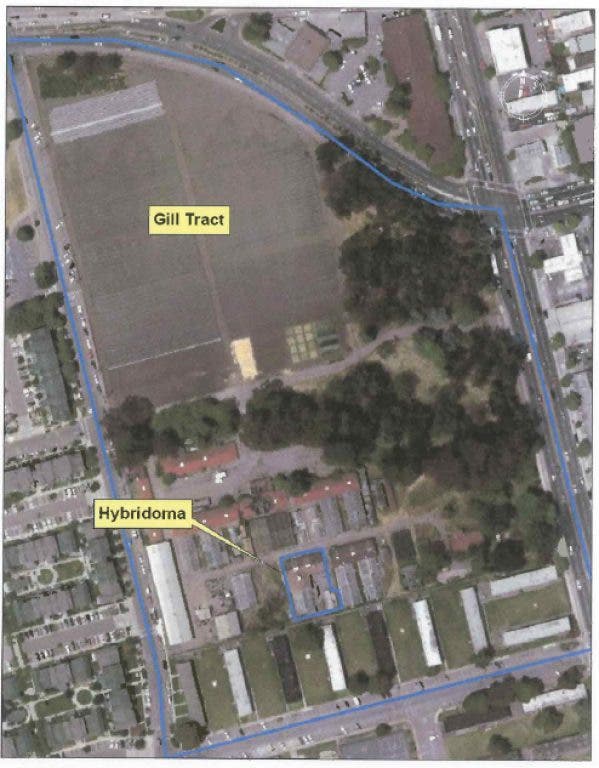
There never was any indication that radioactive materials were used anywhere at Gill Tract except within the Hybridoma Center. The soil sampling was done only to be doubly cautious, and it did not find elevated concentrations of radioactive materials. See Item 3 for the hypothetical dose that could be received if the soil contained radioactivity in concentrations at the level set as the acceptance criteria.
7. Are radiological levels on the Gill Tract and/or surrounding university property any higher than surrounding areas in Berkeley and Albany?
Levels at Gill Tract and nearby could be either higher or lower than in Berkeley or Albany due to the natural variations in background levels. However, as documented in the Gill Tract Final Status Survey Report, radiological levels aren't higher at Gill Tract due to past use of radioactive materials on the property.
8. Were any of the researchers on the site ever exposed to levels of radiation beyond the norm/acceptable?
The Radiological Historical Use Assessment found no indication of such an incident involving anyone working at the Gill Tract site.
CDPH has very detailed and specific requirements about when an incident involving radiation or radioactive materials must be reported, exactly when it must be reported, how it must be documented, etc. Also it is important to be aware that the regulatory limits for radiation doses to workers are set conservatively – a person would have to receive a radiation dose much larger than the limit before there would be an expectation of any possible immediate or long-term health effect.
Despite the large number of researchers using radiation/radioactivity at UC Berkeley, it is extremely rare that there is an incident where a regulatory limit is exceeded and CDPH reporting is required.
9. Why does UC Berkeley use radioactive materials anyway?
Radioactive materials are invaluable in research, medicine, quality control in manufacturing, and in a wide variety of applications that improve health and safety. One list of specific uses of radioactive materials can be found here.
10. Is there any chance that children at the elementary school may have been exposed to elevated levels of radiation – due to the use of radioactive materials at Gill Tract – now, or at any time in the past?
Based on monitoring data, there is no plausible way that anyone offsite could have been exposed to elevated levels of radiation due to the use of radioactive materials at Gill Tract, from the start of the radioactive materials use to the present.
11. There have been reports that recently a person using a hand-held Geiger counter found indications of radioactivity. Is this cause for concern?
There is not cause for concern. The radiation survey performed at Gill Tract and reviewed by the California Department of Public Health in 2009 was rigorous and found no contamination. Never-the-less, after hearing this recent report, a Radiation Safety Specialist from the UC Berkeley Office of Environment, Health and Safety went to the site and took several measurements on June 8, 2012. The locations of the measurements can be viewed here. No readings above background were found in that monitoring. Note that a Geiger-Mueller detector is expected to have an above-zero reading due to naturally occurring background radiation (see answer to question 2). When outdoors, this reading may be slightly higher near the ground than at a person's waist level due to naturally-occurring radioactive material in the soil and in fertilizers.
12. How does the historic use of trace amounts of radioactive material for research at the Gill Tract relate to the proposed mixed use development on San Pablo Avenue?
The small lab where research was conducted using radioactive materials was not on the mixed use project site (see map showing project site and site of former lab). Soil sampling adjacent to the former lab did not find any evidence of contamination. The State Department of Public Health has reviewed the sampling results and cleared the Gill Tract for all uses. The EIR for the proposed mixed use development considered this issue and determined that the State's sign off was sufficient to confirm there is no potential significant environmental impact associated with the past radiological research.
REFERENCES
1. The referenced reports are available as one PDF: Gill Tract Final Status Survey (pages 1-101) and Gill Tract Radiological Historical Use Assessment (pages 102-115)
2. NCRP Online
3. Occasionally radiation or radioactivity measurements are reported without an explicit statement about either how it compares to natural background levels or whether the measurement has been corrected to subtract the contribution from natural background radiation/radioactivity. Though background subtraction is the normal practice, making an explicit statement reduces the possibility of confusion.
4. Assessment of Variations in Radiation Exposure in the United States (Download as PDF)
Get more local news delivered straight to your inbox. Sign up for free Patch newsletters and alerts.