Politics & Government
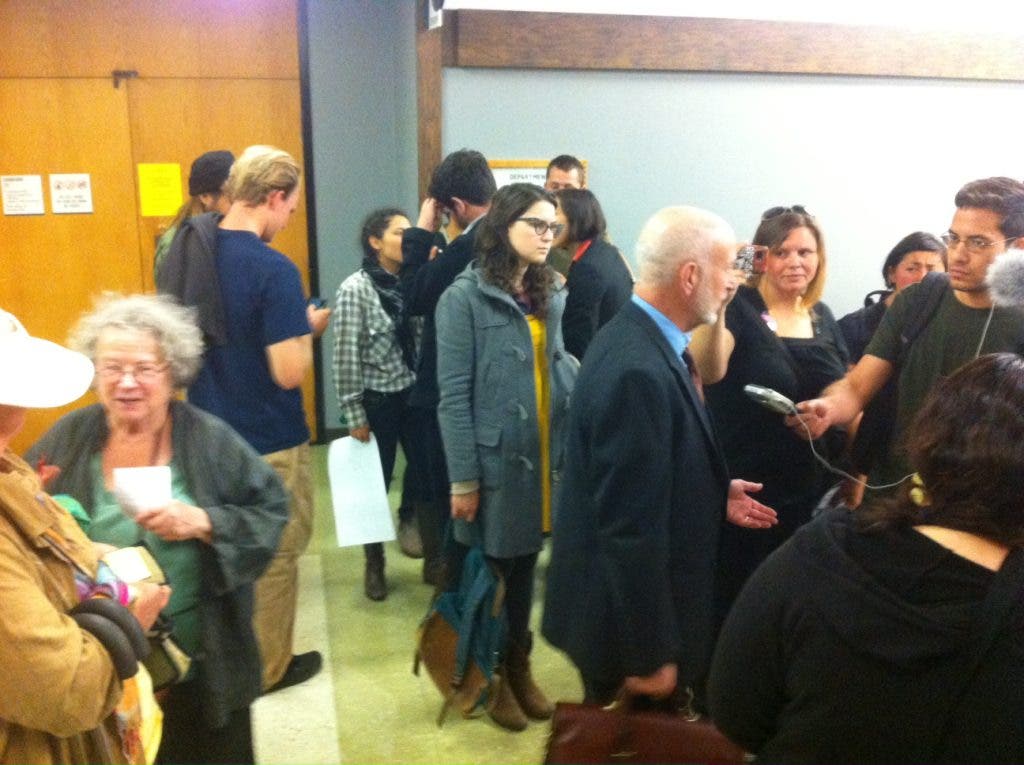
'Occupy the Farm' Hearing Packs Hayward Courtroom with 50 Supporters
The hearing, related to a request for an injunction to ban a group of alleged 'Occupy the Farm' members from the Gill Tract, took place before Judge David E. Hunter in Hayward on Thursday morning. Click "Keep me posted" for future updates.


Attorneys for the University of California regents duked it out in the courtroom with lawyers Dan and Michael Siegel, representing a group of urban farming activists with Occupy the Farm, in a battle Thursday morning to determine whether a judge will to keep activists out of the .
The regents have requested an injunction to prohibit 13 individuals—as well as anyone "aiding or abetting" them—from "entering, trespassing or otherwise occupying, living on or cultivating crops on the property ... known as Gill Tract" ... or "aiding or abetting anyone engaged in any of the foregoing prohibited conduct."
Superior Court Judge David E. Hunter, after listening to about an hour and a half of oral arguments in his courtroom at the Hayward Hall of Justice, said he would take the matter under consideration.
Find out what's happening in Albanyfor free with the latest updates from Patch.
Dan Siegel said he expected a decision within 24-48 hours. His son, Michael Siegel, said the judge could potentially take even longer to issue his written order about the outcome of the university's request for an injunction.
On May 16, Hunter against Gill Tract activists, pending the injunction hearing, which is filed by the University of California against urban farming advocates, calling themselves "Occupy the Farm," who and spent three weeks camping on and farming the land.
Find out what's happening in Albanyfor free with the latest updates from Patch.
About 50 people packed into Hunter's courtroom, including some who sat on the floor. Many wore bright pink buttons sporting drawings of a barn and farm animals, and the phrases "occupy the farm" and "take more land."
The attorneys argued about who the injunction might affect, and what types of activities it could prohibit.
M. Kay Martin, one of three attorneys present for the regents, told the judge that the university had narrowly tailored its injunction to prevent criminal trespass on university property.
Martin said, though the Siegels' brief asserted the university sought to chill rights of expression protected by the state and federal constitutions, that the regents were specifically concerned about people trespassing on the Gill Tract property.
"Fears of impacting constitutional rights are simply unfounded," she said.
Dan Siegel took issue with her assertion, saying that the way the injunction order had been written could potentially leave anyone who advocated for farming at the Gill Tract, or raised money for the political cause, open to legal action.
He said the exact location meant by the phrase "Gill Tract," in the injunction request, also needed to be clarified, adding that the term could mean anything from the roughly six acres of remaining farmland to what he described as the original 110 acres of the property.
Judge Hunter, too, suggested it would be in the university's best interest to make clear the types of activities that would be prohibited, especially for people who might be found to be "aiding and abetting" or "acting in concert with" the defendants.
The two sides also disagreed about whether the Gill Tract property was public or private land; Siegel said, since the regents are a public agency, that the research field is "no more private than this courthouse."
Martin countered that "not all property owned by the regents is public," or accessible at all times, and said the field had been locked and fenced with "restricted access" and "No Trespassing" signs posted.
Siegel said the injunction would be an unnecessary measure, from a legal standpoint, since criminal trespass is already forbidden under the Penal Code. Police, he said, were already empowered to cite or arrest individuals for trespassing, making the injunction redundant.
Martin said the injunction would serve as an additional, much-needed, deterrent in the face of what she described as continued threats by Occupy the Farm to return to the Gill Tract and take back the land for a community farm.
This measure would be particularly important, she said, due to the undertaken on the property.
The attorneys also disagreed about what could be admitted as evidence in the case; Siegel said some statements attorneys for the university had submitted about parties involved with Gill Tract occupation activities should have been protected because they were part of negotiations about the property.
Attorneys for the regents said, on the contrary, there had been "no discussion of settlement or any claims of offers of settlement" at the one official talk undertaken by between advocates and university representatives.
Siegel said attorneys for the regents failed to prove that any of his clients knew they were trespassing at the Gill Tract.
In his opinion, he said, the attorneys were trying to punish defendants for what he called "felonious farming, willful water-sharing," and "maybe even malicious mulching."
He called the university's case "a performance of hyperbole" and said the regents needed to provide much more evidence about who was camping, and who was told to leave but continued to stay.
"The burden of proof has not been met," he said. He added, after the hearing that though someone had allegedly cut the locks to the Gill Tract field, that, afterward, "the gates were open and hundreds, if not thousands, visited the site. The vast majority walked up, saw open gates, felt welcome and they entered."
Martin argued that it was "ludicrous" to assert that people visiting the Gill Tract would not have known they were trespassing. She said, in fact, the regents had met their burden of proof, and that attorneys for the defendants had offered no evidence to rebut it.
In addition to the documents attached to this story as PDFs above, attorneys for the university filed four additional statements from officials and police; they are not yet available online.
Attorney Dan Siegel argued Thursday that, because the judge had stipulated earlier in the month that neither side could file "reply papers," the declarations filed May 31 should be stricken from the record.
Click the "Keep me posted" button below for an update when we publish future stories on this topic. Read more on Albany Patch about the Gill Tract occupation.
If there's something in this article you think , or if something else is amiss, call editor Emilie Raguso at 510-459-8325 or email her at albany@patch.com.