Schools
Who's Who: Admissions Officer Sees Students Evolve
Every week we'll feature a brief chat with someone who lives, works or plays in Albany.
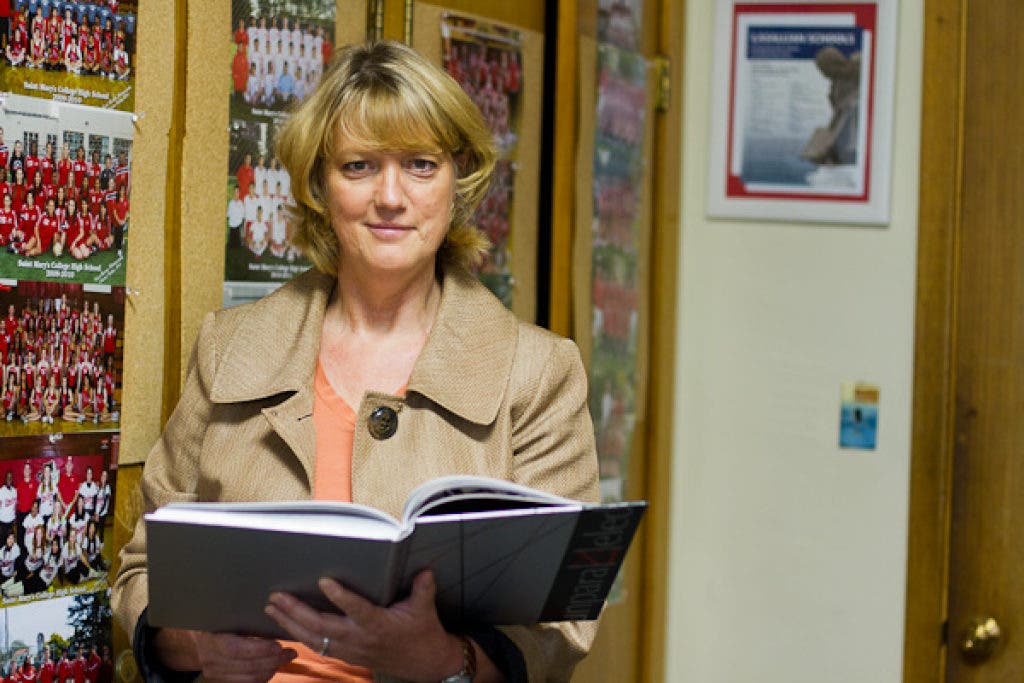
Name: Linda Laufenberg Yaris
Age: 56
Occupation: Associate Director of Admissions at
Find out what's happening in Albanyfor free with the latest updates from Patch.
How does the admissions process at Saint Mary’s begin? We have events for people who want to find out about Saint Mary’s. We usually hold an open house; this year it’s on Nov. 20. Anyone can come and see the classrooms, talk with teachers, athletic coaches, administrators. There are demonstrations and classroom interactive presentations.
How many students come from Albany? Twelve. The student body is about 600, and 294 students (49 percent) come from Alameda County.
Find out what's happening in Albanyfor free with the latest updates from Patch.
How long have you been here? I’ve been here about 15 years.
I grew up right around the corner on Ordway. I have very fond memories of saving my pennies and going to the 5 & 10 on Gilman, and of going to summer camp at .
I remember coming over here when I was little and not realizing it was a school. The Brothers had a statue, and it had a little cabinet where you could store things underneath. I had little dishes stored there. They never bothered me; I thought it was a park.
Saint Mary’s seems to be part of both Berkeley and Albany. We have a Berkeley address because the front end of campus crosses Codornices Creek, but 90 percent of the school property is in Albany. If there’s an emergency, the and respond. The campus is on Peralta Park; it’s one of the last land-grant areas in Albany-Berkeley.
What is the mission of the school? The mission of the school comes from St. John the Baptist De La Salle, who founded the Christian Brothers. He was a French priest; he revolutionized teaching back in his time. Education in that time was usually just for the very rich. He found himself helping a group of men run a school for poor boys; he developed teaching manuals and learning styles. He really believed that you had to develop the whole person. That meant being with them, teaching them “social graces.” To educate a student, you needed to touch their hearts and make a difference in their lives.
Saint Mary’s was started almost 150 years ago in San Francisco. It was a college with a high school department. Then it moved to Oakland for a while. Then it moved to this property in 1927. At that point, Saint Mary’s College moved to Moraga.
Your website photo of the student body shows tremendous diversity. Being ethnically diverse is one of our goals. We try to do 50 percent girls and 50 percent boys; after that, it is pretty reflective of the Bay Area. The diversity is pretty unique in that students who graduate from here and think they’re going to a diverse [college] campus come back and tell us, “It’s nothing like the diversity we had at Saint Mary’s.”
Does the diversity extend into the students’ religious backgrounds? We are a Catholic high school, so we do have a religious studies program for all four years, and 55 percent of our students are Catholic. The other 45 percent are a variety of other faiths.
So many of the conflicts today have religious origins that I don’t think it’s bad for students to have an understanding of where that comes from. The Lower Division studies Christianity and Catholicism. Upper Division classes include “Does Religion Really Matter?” “Media and Ethics”; some philosophy.
Some of the discussions you have in the religious studies classes are some of the best you can find on campus. There’s a mutual respect in which a person feels they can expect to express their personal views and likewise listen to others’.
Where does financial aid come from for students whose families can’t pay full tuition? Financial aid comes from the alumni and the work of the development office. Last year they gave almost two million dollars in financial aid. Close to 40 percent of the students are on some kind of financial aid.
The students do a fundraiser every year. The students are all involved, even though they don’t know which students receive financial aid.
What do you like best about your job? The thing that’s fun for me is I get to see them come in as little 13- and 14-year-olds. By the time they graduate, by the time they’re 18, they’re confident and going off to college. They’re who they’re going to be. I get to see that whole story evolve. They get to find out what they’re good at and what they’re passionate about.
Everybody makes mistakes ... ! If there's something in this article you think should be corrected, or if something else is amiss, call editor Emilie Raguso at 510-459-8325 or email her at emilier@patch.com.