Neighbor News
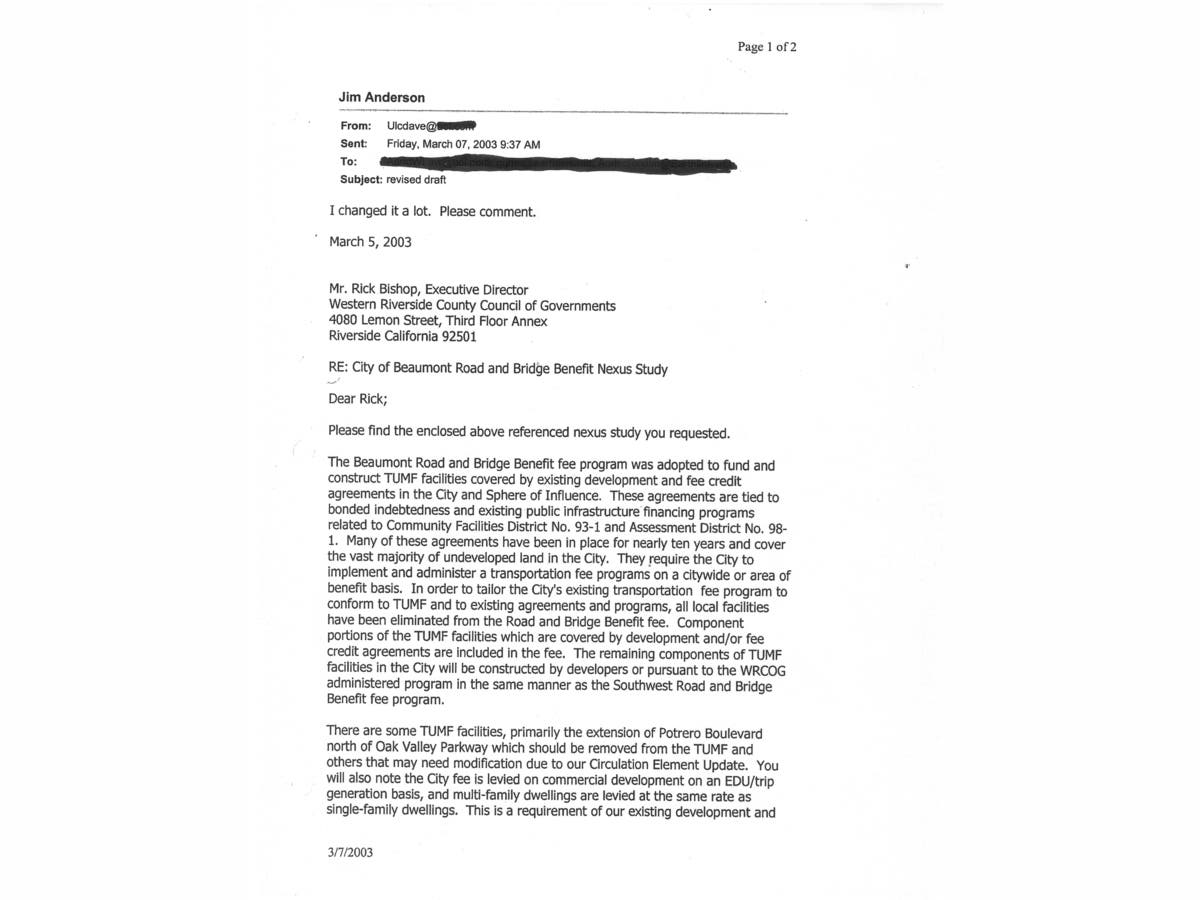
Beaumont Road and Bridge Benefit Nexus Study Jan 2003 and letter to WRCOG explaining Beaumont's Position
This study and letter explain how Beaumont has existing agreements that must me honored in order for the county TUMF program to work.


City of Beaumont
Transportation Uniform Mitigation Fee
Facility Fee Study
Find out what's happening in Banning-Beaumontfor free with the latest updates from Patch.
Prepared for:
Beaumont City Council
Find out what's happening in Banning-Beaumontfor free with the latest updates from Patch.
Brian DeForge, Mayor
Jeff Fox, Mayor Pro Tem
Roger Berg, Council Member
Larry Dressel, Council Member
Placido Valdivia, Council Member
Prepared by:
Public Works Department
Community and Economic Development Department
January 7, 2003
I. Introduction and Purpose of the Study
The purpose of this study is to estimate and apportion the total cost to design and construct certain regional transportation facilities which are needed to support the logical and orderly development of the City of Beaumont and surrounding region. The study will be used to establish a uniform transportation facility fee (TUMF) to fund the design, construction and upgrade of certain transportation facilities necessary to serve future development in the City and western Riverside County. The report provides an estimate of costs for those facilities along with a calculation of transportation facility fees to be levied on a “fair share” basis in accordance with Government Code Section 6600, et. seq., and upon measurable units of expected future land uses.
Currently, there are several vacant parcels within the City which are planned for future development. As new development occurs in the City and surrounding region, existing transportation facilities will be impacted by new residents and businesses, increasing their use and requiring them to be upgraded to accommodate the increased use. Additionally, new roads and related transportation facilities will needed to accommodate expected use by new development. Certain complete facilities or component portions thereof may be constructed pursuant to public financing districts and some may be constructed by developers to mitigate impacts of specific development projects pursuant to conditions of approval for those projects. It is opriate therefore to establish the transportation facility fee to reasonably apportion the cost of those facilities included in this study on a fair share basis among future developments and to provide for fee credits and reimbursements when those facilities are otherwise constructed or funded.
The facilities to funded by the transportation facility fee are listed below and are depicted on the TUMF Facility Master Plan included this study. The facilities depicted on the TUMF Facility Master Plan are identified and described in detail in the Preliminary Engineer’s Cost Estimate, or as may be otherwise approved by the City Council. The City Council may use the transportation facility fee to fund equal facilities having an equivalent benefit. Facilities to be funded by the transportation facility fee are listed below together with their estimated cost.
TransportationFacility Estimated Cost
SR 60/Potrero Boulevard Interchange $ 25,580,685
< I-10/Oak Valley Parkway Interchange $ 13,923,585
< Potrero Boulevard $ 12,614,788
< I-10/Highland Springs Avenue Interchange $ 6,246,988
< OakValley Parkway/ 14 th Street $ 6,224,021
< I-10/Pennsylvania Avenue Interchange $ 3,494,110
< Highland Springs Avenue Extension $ 3,119,719
< Pennsylvania Avenue $ 1,745,482
< First Street/Velie Avenue $ 1,645,434
Total $ 74,594,811
A preliminary estimate of the cost to design and construct the facilities to be funded by the transportation facility fee is provided in the Appendix of this study. The estimated costs are based upon recent unit costs for similar projects which have been publicly bid in the City using prevailing wages. Where no such recent costs were available, estimates were prepared by the City Public Works Director using RS Means unit cost data adjusted for the local area. All costs for facilities should be adjusted for inflation on a regular basis by the City Council in accordance with the Engineering News Record construction cost index for the Los Angeles area.
The facilities included in the TUMF Facility Master Plan are key regional transportation arteries which will move traffic in and around a confluence of three major highways which converge in the City of Beaumont; Interstate 10, State Route 60 and State Route 79. Needed improvements to these and other regional facilities in western Riverside County will be funded through a recently approved voter initiative known as Measure A. It is appropriate for the transportation facilities to be funded and developed by the proposed City fee to function in conjunction with and complement those to be funded and constructed by Measure A. The ultimate construction of Measure A funded facilities and those to be funded by a combination of the proposed transportation facilities fee and by future development in the City of Beaumont will address not only impacts created in the City of Beaumont, but will also address the impacts of development in western Riverside County generally. The transportation facilities to be funded by the proposed fee and by developers in Beaumont in accordance with the Circulation Element of the General Plan are significantly larger and more extensive than they would otherwise be required to be, but for traffic generated regionally outside the City.
II. Transportation Facility Fee Calculation
The purpose of this section of the study is to provide a description of the facilities to be funded by the transportation facility fee and an estimate of costs to design and construct those facilities. This section also provides an estimate of how much future development will benefit from each of the facilities based on “equivalent dwelling units” or EDU’s. The study provides a reasonable measure of the number of new EDU’s that will be developed which includes all the vacant land that will benefit from the facilities once they are constructed. Each facility to be funded and constructed for the benefit of undeveloped land is depicted respectively on theTUMF Facility Master Plan map included this study. The study and fee is based upon the total estimated cost of the facilities divided by number of EDU’s that will benefit from and will be responsible to pay the cost of designing and constructing the planned transportation facilities.
In order to establish a reasonable estimate of the number of EDU’s different types of land uses will generate, the study establishes the relative demands of residential, age restricted residential, commercial and industrial land uses on the generic types of facilities. The average demand placed on the transportation facilities of a single dwelling unit with an average population of 3.2 persons per unit is used as the baseline of measurement for other land uses. In the case of transportation facilities it is assumed, based upon generally accepted traffic generation data utilized by the City as part of the Comprehensive Public Facility Financing Program, that a single dwelling unit generates 9.5 Average Daily Trips per Day (ADT), the average age restricted dwelling unit generates 5.23 ADT and the average industrial and commercial use generates 163.02 ADT per acre of development. Therefore each acre of industrial or commercial development will generate an average of 17.16 EDU’s of demand for transportation facilities (163.02/9.5). The study makes an adjustment in the EDU factor for industrial and commercial uses and for age-restricted dwelling units. The study assumes that 50% of the trips generated by commercial and industrial development will be generated from residential development in the City of Beaumont and 50% will be generated by shoppers and employees originating outside the City and that 50% of the trips associated with commercial and industrial land uses are included in the 9.5 ADT of a residential EDU. This is a reasonable assumption considering the central location of the City of Beaumont and the regional nature of a significant portion of commercial and industrial land uses designated for future development in the General Plan. A listing of the EDU factors used in this study is provided below.
Land Use Transport. EDU’s
Residential Dwelling Unit 1.00
Age Restricted Dwelling Unit 0.55
Industrial/ Commercial Acre (50% City) 17.61
In order to estimate the number of new EDU’s to be developed in the future, the study uses a listing of the number of EDU’s in major projects and an estimate of residential, industrial and commercial EDU’s which may develop on remaining undeveloped parcels within the City and the City’s Sphere of Influence. The list of projects and undeveloped areas along with the estimated number of EDU’s each project and area will generate is shown on the table entitled EDU Summary in the Appendix of this study. Where a specific project could not be identified for undeveloped land, an estimate of acreage and EDU’s was made by generic land uses reasonably expected to be developed in each area based on past development patterns in the City and the current General Plan land use designation.
A. Transportation Facilities
Transportation facilities to be funded by the proposed transportation facility fee include the construction of a new freeway interchange, the widening of three interchanges and the realignment, extension and/or rehabilitation of certain road segments that provide primary access to Interstate 10, State Route 60 and State Route 79 including segments of Oak Valley Parkway/Fourteenth Street, Highland Springs Avenue, First Street/Velie Avenue and Pennsylvania Avenue. Additionally, the proposed fee will fund construction of Potrero Boulevard, along with upgraded arterial highway channel crossings of the Union Pacific Railroad main line track, San Timoteo Creek, Noble Creek and Marshall Creek. Facilities to be funded by others through Measure A or other regional funding programs include Interstate 10, State Route 60, State Route 79 and related facilities including the upgrade of the Interstate 10/State Route 79 Interchange and/or the construction of a new Interstate 10/State Route 60/State Route 79 connection.
For the purposes of this study, the total number of EDU’s to be developed is estimated to be 36,924 EDU’s. The total cost of transportation facilities is estimated to be $74,594,811.
B. Transportation Facility Fee Calculation
The proposed transportation facility fee is calculated by dividing the cost of the planned facilities by the number of EDU’s which will benefit from or use the facility. For purposed of calculating the proposed facility fee, the total number of EDU’s remaining to be built in the City was adjusted by subtracting the number of EDU’s for which building permits have been issued, those reduced EDU impacts related to the development of an estimated 2,500 age restricted dwelling units and those related to commercial and industrial trips generated by residential development in the City. EDU reductions are calculated for age restricted residential, commercial and industrial uses to compute the fair share cost of the facilities for each generic land use. The fair share cost is calculated by dividing the reduced or “adjusted” number of transportation EDU’s each generic land use will generate into the total number of future EDU’s for which building permits will be issued in the City. The proposed transportation facility fee for each generic land use is calculated by dividing the fair share cost of facilities by the number of estimated EDU’s for which building permits are estimated to be issued in each land use category. The reduction in EDU impacts associated with age restricted residential, commercial and industrial land uses is reflected in the reduced fee per EDU.
The total number of EDU’s estimated to be issued building permits, the Fair Share Cost of facilities and the proposed facility fee for each generic land use are summarized on the Fee Schedule below. The transportation facility fee will be levied by the Building Department prior to the issuance of building permits for all new development or expansion of existing development. All expansions of industrial and commercial development less than or equal to 750 square feet will be exempt from the transportation facility fee.