Schools
SEISMIC SAFETY: Some Banning, Beaumont School Projects Uncertified
A 19-month investigation finds some school projects in Banning and Beaumont lacking paperwork for certification, other older buildings in need of re-evaluation, and lax oversight by the Division of the State Architect.


Some school buildings in the San Gorgonio Pass are not certified for earthquake safety standards required by state law, and others have been identified by a collapse-risk study in 2002 as "not expected to withstand future earthquakes," according to an investigation by the non-profit California Watch.
In Banning, state records show there are 16 different school projects that are not certified for earthquake safety under Field Act standards enacted more than 75 years ago, according to California Watch.
In Beaumont, state records show there are 12 different school projects that are not certified for earthquake safety under the Field Act, which became law shortly after the Long Beach Earthquake in 1933, according to California Watch.
Find out what's happening in Banning-Beaumontfor free with the latest updates from Patch.
Lax record-keeping at the state level is just one of the problems identified by California Watch. Some of the state records are outdated, and include listings for facilities in the Pass that are no longer used as schools.
There are also current school buildings in Banning and Beaumont identified in an AB 300 collapse-risk survey with potentially dangerous seismic hazards in need of further structural evaluation, according to California Watch.
Find out what's happening in Banning-Beaumontfor free with the latest updates from Patch.
The uncertified Banning and Beaumont school projects are among more than 19,000 school projects statewide identified by California Watch as uncertified.
The 19-month California Watch investigation, which was released Thursday, uncovered holes in the state's enforcement of seismic safety regulations for public schools.
The state of California began regulating school architecture for seismic safety in 1933 with the Field Act, but data taken from the Division of the State Architect’s Office shows more than 19,000 school projects statewide never got final safety certifications. In the crunch to get schools built within the last few decades, state architects have been lax on enforcement, California Watch reported.
Whether "uncertified" means unsafe is unclear, and school district officials in Banning and Beaumont said this week they had not been notified of safety concerns by the State Division of Architect.
"At the core of everything is kids' safety," Beaumont Unified School District Superintendent Barry Kayrell said Thursday. "Aside from providing a quality education, student and staff safety are paramount.
"If somebody tells me we have an unsafe condition, we're going to fix it," Kayrell said in an interview at Beaumont district headquarters. "I have not personally been notified by the state of anything like this."
Kayrell said he has been Beaumont Unified superintendent five years.
"I can't comment on projects that were built before I got here," Kayrell said. "But every one of our projects has to go through a very prescribed DSA (Division of State Architect) process from start to finish, including checks and balances.
"We have to have state-approved inspectors for everything from soil compaction to steel and bolt-strength. We don't leave anything unturned."
The director of facilities for Banning Unified School District disputed California Watch's findings, and said the only uncertified school he was aware of in Banning Unified is Cabazon Elementary.
"Cabazon is on that list because it was completed in 2000 and the paperwork was never completed," said Ken Miller, Banning Unified director of facilities since 2007. "In some cases I'm only as good as my predecessors. We're having to retrieve documents from archives and submit them to the state."
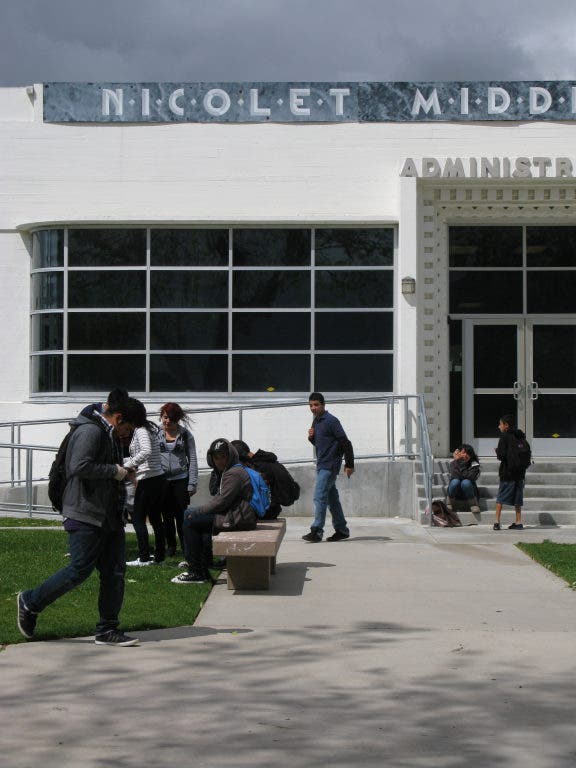
In an interview at Banning district headquarters, Miller also said he learned just a few days ago that six different buildings at Nicolet Middle School were identified in 2002 as in need of further evaluation - from the lobbyist organization Coalition for Adequate School Housing, not from the State Division of Architect.
"This is now considered a priority," Miller said. "I can only take action when I'm made aware of something, and that's exactly what I did."
Banning Unified School District Superintendent Lynne Kennedy said she'd have preferred to hear about the concerns at Nicolet Middle School from the state.
"We always appreciate being advised when there is something the public should be aware of," Kennedy said. "But it would be helpful to hear about information before it becomes public.
"We want to be aware, but we want to be treated by the state as partners, not adversaries," Kennedy said. "I recognize the need to study this and to have our director of facilities involved. But we don't want to be at a disadvantage."
The uncertified projects in Banning and Beaumont identified by California Watch are known as "Letter 3" projects, which have not been certified due to paperwork logjams, according to a spokesman for the Division of State Architect.
"We don't believe there are any significant safety issues with Letter 3 projects," Division of State Architect spokesman Eric Lamoureux said Wednesday.
The six AB 300 school buildings at Nicolet Middle School include an alternative education building, a cafeteria, a building with six classrooms and the auto shop, Miller said.
According to a State Division of Architect's recently updated AB 300 Survey and Report and Updated Survey Listing, buildings of concern in Beaumont include three buildings at San Gorgonio Middle School that house 20 different classrooms, a gymnasium and locker rooms at San Gorgonio Middle, and a lunch shelter at Beaumont High School.
All of the buildings were built in the 1950s, 1960s or early 1970s, according to the state listing.
According to the state, the Division of State Architect sent a letter to all school districts in January 2003 advising the districts of the AB 300 report, and offering to provide to any district that requested it a copy of the AB 300 survey data pertaining to that district.
"The letter also stressed that inclusion of a building on the inventory does not, in itself, say anything about the safety of the building," the Division of State Architect's updated AB 300 web page states. "Only a detailed evaluation by a structural engineer can determine whether any building will be expected to be safe, or if a retrofit will be needed."
California Watch reporters have worked the past 19 months examining Division of the State Architect school records, including construction and engineering reports, internal memos, e-mails and archival records.
Their investigation found lax oversight at the state level and poor communication with school districts at the local level.
State regulators have for several years ignored hundreds of building and school renovation projects that structural engineers flagged as potentially dangerous, and allowed nearly 20,000 school projects - many with critical information missing from inspection files - to open without Field Act certification, according to California Watch.
The Field Act became law after the magnitude 6.3 Long Beach earthquake in March 1933, which destroyed 70 schools and left another 120 schools with major structural damage, according to the State Division of General Services.
The schools were unoccupied at the time, but "hundreds of children might have perished if the earthquake had occurred only a few hours earlier," according to the Division of General Services.
Current school projects considered potential "collapse risks" were identified in a 2002 statewide inventory of seismic hazards required by law under AB 300.
The state Legislature approved AB 300 in 1999, requiring the Department of General Services to conduct a collapse-risk inventory of the state's K-12 school buildings.
Although the collapse-risk report begins, "Public school buildings in California are the safest in the nation," it concluded that 7,537 buildings - making up 14 percent of the total square footage in the state’s public K-12 schools - were not expected to withstand future earthquakes, and urgently needed further structural evaluation to gauge needed repairs, according to California Watch.
This story was produced using data provided to Patch by California Watch, the state's largest investigative reporting team and part of the Center for Investigative Reporting. Read more about Patch's collaboration with California Watch.
Get more local news delivered straight to your inbox. Sign up for free Patch newsletters and alerts.