Health & Fitness
Berkeley’s Early Development Depended on Public Transit Built by Private Entrepreneurs
Francis Kittredge Shattuck and James Barker negotiated with Leland Stanford, owner of the Central Pacific Railroad, to lay a spur line into central Berkeley. The line opened in 1876.
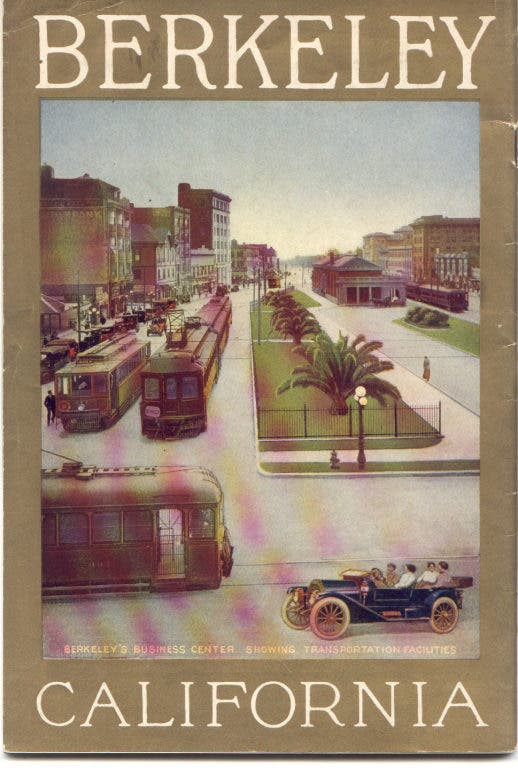

Only three years after the University of California opened its first campus in 1873, Francis Kittredge Shattuck and James Barker negotiated with Leland Stanford to lay a spur track of his Central Pacific Railroad (in 1885 renamed the Southern Pacific) into central Berkeley.
Shattuck and Barker anticipated a future population growth and were positioning themselves to direct that growth to properties they owned. At the time in 1876 the University of California had a student body of just 310 and a teaching staff of 38. This was hardly enough students, or a total population, to justify the capital outlay of building a rail line but they were optimists looking toward the future.
Shattuck owned the area that is now downtown Berkeley and gave downtown’s main street its name. Barker owned the area around Dwight Way and Shattuck Avenue. Both men vied for the center of downtown and Shattuck won. Shattuck Avenue and Center Street has been the hub of public transportation ever since, and the reason Shattuck Avenue is so wide. The two "islands" in the middle of Shattuck Avenue, between Center Street and University Avenue, Berkeley Place and Shattuck Square, were the location of the early train stations and switching yards.
Find out what's happening in Berkeleyfor free with the latest updates from Patch.
Berkeley's first electric streetcar lines were operating by 1891. At the time there were still many old-fashioned horse drawn trolleys and steam driven railcars on four different sized tracts. In 1893, Francis Marion "Borax" Smith (famous for his "20 Mule Team" borax products) inspired by C. P. Huntington who successfully held a monopoly on the interurban streetcar lines in Los Angeles, began purchasing all the private streetcar lines in Alameda and Contra Costa Counties.
By 1903 Smith had unified and modernized these companies and then expanded them into a coordinated transit system that eventually included ferries. It was called the Key System. The AC Transit System that today operates in Alameda and Contra Costa Counties, established by the voters in 1960, is the legacy of the Key System as is Key Route Boulevard that traverses Albany and El Cerrito.
Find out what's happening in Berkeleyfor free with the latest updates from Patch.
As Smith was creating his transit system, he was also buying large tracts of farm and ranch lands for subdivision and development through his Realty Syndicate company. He also partnered with various developers and created a network of companies.
When the Key System streetcars began running on College Avenue in 1903, the farmland along the route was subdivided for housing and small commercial districts. The Arlington Line was extended to Kensington in 1912 opening up that grazing area for development. Buses began to replace streetcars in Berkeley as early as 1921, but the trains continued to run until the late 1940s.
The Bay Area Electric Railroad Association was formed in 1946 to preserve and interpret the history of electric railroads. At the Western Railway Museum and Archive Center at Rio Vista Junction in Solano County a visitor can not only see historic electric streetcars, but also take a ride on them. (www.wrm.org)
Susan Dinkelspiel Cerny is the author of Berkeley Landmarks and An Architectural Guidebook to San Francisco and the Bay Area. This article contains excerpts from articles that appeared in the Berkeley Daily Planet, Feb. 10, 2001 and April, 2003 by Susan Dinkelspiel Cerny. A third article by Cerny about streetcars, published Sept. 7, 2002, can be found here.