Health & Fitness
Piedmont Avenue and the Legacy of Frederick Law Olmsted in Berkeley
In 1864, the College of California asked landscape planner Frederick Law Olmsted to develop a plan for their new campus and a residential neighborhood.
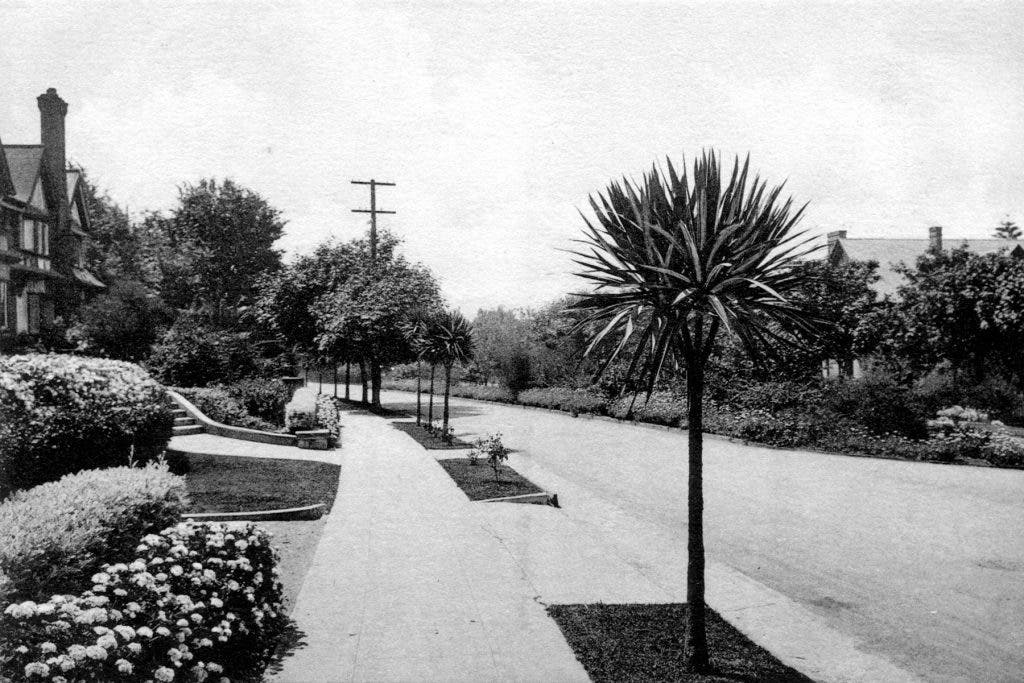


My previous history blog recounted . There is an interesting aspect of that history that is not well known.
In 1864 the trustees of the College of California commissioned the well known landscape planner Frederick Law Olmsted (1822-1903) to develop a plan for their new campus and also asked him to design a residential neighborhood southeast of the college property, between the college grounds and the proposed state school for the deaf and blind (now the Clark Kerr Campus).
In 1857, Olmsted and architect Calvert Vaux won a design competition for Central Park in New York City. Olmsted subsequently supervised the park's construction until the outbreak of the Civil War. After serving with the Sanitary Commission (a precursor to the Red Cross) during the war, Olmsted took a position in 1863 as supervisor for the Mariposa Mining Estate in California.
Find out what's happening in Berkeleyfor free with the latest updates from Patch.
As the landscape designer of Central Park and the author of numerous articles, Olmsted was in high demand for his services. Among the projects Olmsted worked on during the two years he was in California were the first plan for Yosemite Valley and the Mariposa Big Trees, Mountain View Cemetery and the plans for the College of California.
The residential subdivision Frederick Law Olmsted designed for the College of California, was called the “Berkeley Property” and extends from College Avenue to Prospect Street and from Gayley Road to Dwight Way and includes Hillside Avenue and Hillside Court. At Channing Way and Piedmont Avenue there is a landscaped circle. The Berkeley Property merges and blends with the existing grid pattern of the streets to the west at College Avenue.
Find out what's happening in Berkeleyfor free with the latest updates from Patch.
Piedmont Avenue (originally Piedmont Way) is the main divided roadway bisecting the residential subdivision and is the most clearly defined and surviving feature of Olmsted’s 1865 plan for the College of California. It is Olmsted's first curvilinear parkway with a divided roadbed and a landscaped medium, a feature that would become one of his defining design elements of his numerous future projects.
The “Berkeley Property” was Olmsted’s first fully developed landscape plan for a residential subdivision as well and he accompanied the plan with an extensive written report outlining the social and healthful benefits of his physical plan. Olmsted's ideas, formulated for this residential neighborhood were based on the English garden suburb.
Olmsted believed that "...large domestic houses, on ample lots with garden set backs, enhanced by sidewalk boulevards and plantings that would become luxuriant and graceful to shelter the visitor from the sun [would] express the manifestations of a refined domestic life.” The neighborhood was to serve as a retreat from the congested life in the city.
By the first decade of the 20th century Piedmont Avenue was lined with impressive houses designed by prominent architects and set in lush gardens. Although today these homes are mostly used for student housing, the appearance of the street, with its green median and some remaining overhanging trees, retains many of the qualities Olmsted envisioned. There are plans to replant the two-block medium between Bancroft and Channing that had become an impromptu and unsightly parking strip until the city installed bollards and a chain barrier.
Frederick Law Olmsted’s designs for Eastern Parkway in Brooklyn, the Buffalo Parkway system, and Boston parkways had their beginnings here. During the next thirty years, after leaving California, Olmsted designed hundreds of parks and residential subdivisions where the most important feature was the preservation, enhancement, and use of natural features. Olmsted’s legacy can be seen in residential subdivisions across the country.
After Olmsted’s retirement in 1895, his firm was carried on by his sons John Charles Olmsted and Frederick Law Olmsted, Jr., as the Olmsted Brothers. The Olmsted Bros. firm designed several projects in Berkeley including the gardens of the recently landmarked Duncan McDuffie House at 22 Roble Road.
The firm’s office records are preserved at the Frederick Law Olmsted National Historic Site located at 99 Warren Street in Brookline, Massachusetts. The National Park website provides a brief synopsis of Olmsted’s significance to American planning:
“Frederick Law Olmsted (1822-1903) is recognized as the founder of American landscape architecture and the nation's foremost parkmaker. Olmsted moved his home to suburban Boston in 1883 and established the world's first full-scale professional office for the practice of landscape design. During the next century, his sons and successors perpetuated Olmsted's design ideals, philosophy, and influence.”
The National Park’s website also has archival material and list of projects:
Olmsted wrote an enormous amount of reports, letters, thoughts and observations that were published during his lifetime. Some can be found at Online Books by Frederick Law Olmsted.
An excellent book that recounts Olmsted’s years in California is highly recommended. Olmsted, Frederick Law. The Papers of Frederick Law Olmsted, Volume Five: The California Years, 1863-1865, pages 488-516. Victoria Post Ranney, editor. Baltimore: The Johns Hopkins University Press, 1990.
Piedmont Way was designated a California Historical Landmark in May of 1989. A plaque was placed at the intersection of Bancroft and Piedmont in 1990 and bears this inscription:
PIEDMONT WAY WAS CONCEIVED IN 1865 BY FREDERICK LAW OLMSTED, AMERICA’S FOREMOST LANDSCAPE ARCHITECT, AS THE CENTERPIECE OF A GRACIOUS RESIDENTIAL COMMUNITY CLOSE BESIDE THE COLLEGE OF CALIFORNIA. OLMSTED ENVISIONED A ROADWAY THAT WOULD FOLLOW THE NATURAL CONTOURS OF THE LAND AND BE SHELTERED FROM SUN AND WIND BY “AN OVERARCHING BOWER OF FOLIAGE.” THE CURVILINEAR, TREE-LINED PARKWAY WAS OLMSTED’S FIRST RESIDENTIAL STREET DESIGN. IT HAS SERVED AS THE MODEL FOR SIMILAR PARKWAYS ACROSS THE NATION.
CALIFORNIA REGISTERED HISTORIC LANDMARK NO. 986
PLAQUE PLACED BY THE STATE DEPARTMENT OF PARKS AND RECREATION IN COOPERATION WITH THE FRIENDS OF FREDERICK LAW OLMSTED PAPERS, APRIL 26, 1990.
Susan Dinkelspiel Cerny is the author of Berkeley Landmarks and An Architectural Guidebook to San Francisco and the Bay Area. This article is adopted from articles by Cerny that appeared in the Berkeley Daily Planet, March 3, 2001 and August 22, 2003.