Arts & Entertainment
East Bay Teens Continue Dr. King's Work
This event was part of Mosaic's Youth Leadership Project Curriculum (YLPC), which began offering a weekly workshop series this year.


By Sanjev deSilva
For seventeen-year-old Jeremiah Mellor, watching the film “Selma” strengthened his determination to keep working to overcome racism.
“We should keep up the fight not for our egos but to better our people’s lives,” Mellor said.
Find out what's happening in Berkeleyfor free with the latest updates from Patch.
Mellor was part of a group of teens who saw the film at the Grand Lake Theater in Oakland. The special screening of “Selma” was lead by The Mosaic Project, a group known for decades to Berkeley and Oakland public school parents for promoting diversity, and was partially sponsored by #Selma4Students, a campaign started by the film’s creators to make free tickets available for young people. With Mosaic staff and community members, the teens walked to the theater to view the film together.
After the film, some of the teens were visibly emotional, some angry, but most expressed a determination to carry on the work that the Rev. Martin Luther King, Jr. began. When asked what King might have done in response to recent events in Ferguson and New York, student Roxy Rozo-Marsh said, “I think he would have been leading peaceful protests, like the ones that happened in Oakland and New York, and encouraged the public to act in the face of injustice.”
Find out what's happening in Berkeleyfor free with the latest updates from Patch.
Student Hayden Payne agreed.
“He would have mobilized a response like the one in Selma,” Payne said. “He would have generated national awareness while pushing for specific changes and goals.” Mellor replied, “I feel Martin Luther King would have rallied the people and given them guidelines. [He would have] used Eric Garner’s case to both unite and call for a stronger movement.”
Bobby Mitchell, a student attending the film, said it gave him “historical clarity. I had not realized that Malcolm X and Martin Luther King were alive at the same time.”
The teens also expressed critiques of the film, noting how the Black Freedom Movement didn’t always acknowledge the actions of the women involved.
Mosaic staff member Richelle Gernan said, “We talked about our disappointment with the portrayal of Coretta Scott King as merely a housewife and the lack of speaking lines for Diane Nash; this mimics the lack of recognition for women’s contribution and leadership in the Black Freedom Movement in the fifties, sixties, and seventies.”
This event was part of Mosaic’s Youth Leadership Project Curriculum (YLPC), which began offering a weekly workshop series this year. The program trains teenagers to mentor fifth graders at the Mosaic Outdoor School.
“This program gives teens a better context for peaceful activism, while teaching communication and leadership skills,” said Gernan. Sandra Martin, facilitator for the Mosaic Outdoor School agreed. “The workshops throughout the year are a chance for the youth leaders to explore and discuss topics of social justice, and create a space where we begin to take action to make the changes we want to see in the world,” Martin said.
The group discussed what activism means today.
“From the ‘Justice for Oscar Grant’ to #BlackLivesMatter campaigns, there have been movements here in Oakland and Berkeley that many of us have been involved in,’ said Katianna Carey-Simms.
The teens discussed the effect that marching and protesting have on the general public across the country. “We’re trying to look beyond what is generally accepted as activism. Being leaders in school, starting clubs or groups aimed at teaching social justice counts as activism. Even simply engaging in conversations about oppression and racism on a daily basis is a form of activism,” said Lara Mendel, Executive Director of The Mosaic Project.
The group finished the meeting by discussing today’s leadership, media, and tactics in contrast to the events in Selma. They found that while much has changed in the past fifty years, many injustices remain in place – one of the reasons that Mosaic started the Youth Leadership Project Curriculum.
“We have much further to go before we can all live in the just, diverse, and inclusive world that Dr. King envisioned,” said Gernan. “We hope that others would like to join us in working to stop the cycle of violence around these issues and building a more constructive and peaceful path toward change.”
Sanjev deSilva is the Director of the Youth Leadership Project, a program sponsored by The Mosaic Project. Any interested young people are welcome to attend the YLPC workshops, offered Fridays from 5 to 8pm at the Mosaic offices in Oakland. Contact Mosaic for more information. Youth ages 15 to 22 can contact Mosaic if interested in being cabin leaders at the Mosaic Outdoor School. Adults wishing to work with or support The Mosaic Project can call Sanjev at 510-452-3377 or email him at sanjev@mosaicproject.org.
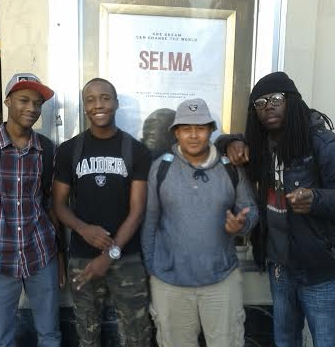
Photo is by Sanjev deSilva:
Caption for photo: Bobby Mitchell, Jeremiah Mellor, R. James and Harris Cox were among the teens who saw the film “Selma” with The Mosaic Project at the Grand Lake Theater.
Get more local news delivered straight to your inbox. Sign up for free Patch newsletters and alerts.