Schools
Eco-Art at Rosa Parks and Jefferson Schools
Environment Lessons in the Classroom (4-part series)




By Ann Krueger Spivack
Eco-art hero Jen Burke has made a career of encouraging children to express themselves through art. In 2000, when Burke realized that a building on the city’s public park, Totland, had stood empty for 28 years, she came up with a plan to offer low-cost and no-cost art classes for children. Today, almost fifteen years later, her Young Artists Workspace project is still going strong. Named an Alameda County Arts Leader for 2014, Burke was an obvious choice when Colleen Mahoney sought an artist and teacher to help with her eco-art projects.
Mahoney, the founder of A Kid By Nature, has brought lessons about planet stewardship to Rosa Parks and Jefferson Elementary Schools. With help from Burke, Susan Silber and A.J. Wacaser, Mahoney was showing young students what happens to all the plastic they encounter on a daily basis. Even the youngest students understand Mahoney’s point that there is no “away” when an item is thrown away.
Find out what's happening in Berkeleyfor free with the latest updates from Patch.
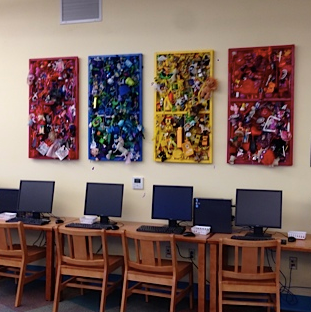
Mahoney led a toy drive, encouraging families to drop off their unwanted toys. She transported some toys to charities, some were exchanged between students, and many broken toys became part of the eco-art panels being created by Kim Beeson’s kindergarten class at Rosa Parks School and Sean Keller’s fourth-grade class at Jefferson School.
Previous: Rosa Parks Elementary Students Look at Plastic Waste Differently
Find out what's happening in Berkeleyfor free with the latest updates from Patch.
Burke came up with the idea of color-coding the art panels, grouping together all yellow toys, all red toys, and so on. “It’s a visually effective piece when you group by color,” Burke said. The students wire toys to the mesh screens, creating a finished product that, while intriguing, holds a bigger message.
Jackson Smith, a student in Sean Keller’s class at Jefferson School, explains what he’s learned from the art panels and class discussions about plastic. “We’re constructing art projects using old plastic toys that we don’t want to just throw into any landfill. We want to reuse them. I brought in a ton of toys that I didn’t want anymore. It feels really good to do this when you know each toy you put on [the art project] could be saving a bird’s life.”
Burke had shown the fourth-graders a four-minute documentary by Chris Jordan called Midway Island. Burke said, “You can see how deeply the kids absorb this idea of how plastic harms wildlife. Birds eat plastic, attracted to the bright colors, and often die as a result. The toys these kids fix to the panels won’t be part of the landfill, won’t be part of the plastic ending up in oceans.”
Burke has worked on found-object art projects in the past. How did Mahoney come up with the idea of working with Burke and eco-art to teach kids about plastic?
“Collaborating on these art pieces give the kids a hands-on learning experience,” Mahoney said. “We learn better when we can touch and examine the objects we’re discussing. The discussions we have about the impact of plastic bags, bottles, bottle caps, food wrapping and containers all tie into the art project. We see the kids make the connection between the environment and plastic products, including toys. The kids know that some toys are never even taken out of their packaging, some aren’t ever played with, or they’re used for a very short period of time. We talk about the impact all this plastic can have on soil, air, water, and wildlife.”
“This project puts plastic in a different context,” Burke said. “As a result of this project, the children have a different perspective. After this project, they go home and they really see all plastic in their homes and have a greater understanding of what all this accumulation means for wildlife and the planet.”
The eco-art panels will be on display in the Jefferson School library and the Rosa Parks School library through January.
Parents interested in art classes can contact Jen Burke at www.youngartistsworkspace.org. Burke teaches children ages 4 through 12 at the Young Artist Work Space and work with middle- and high-schoolers, ages 13 through 17, at the Westside Studio.
Teachers interested in learning more about eco-art projects like this one can contact Mahoney at A Kid By Nature or email her at colleen@akidbynature.com.
Next: bringing eco-education to a wider audience
Photos: Jen Burke, founder of Young Artists Workspace
Fourth-grade student Jackson Smith holds up some of the toys he brought to the toy drive
Toys are grouped on the panels according to color
Get more local news delivered straight to your inbox. Sign up for free Patch newsletters and alerts.