Health & Fitness
'The Taste' Enters the Network Society
A panel at The Taste in Beverly Hills served up a dish about the future of dining experiences. It's all about the tweets!
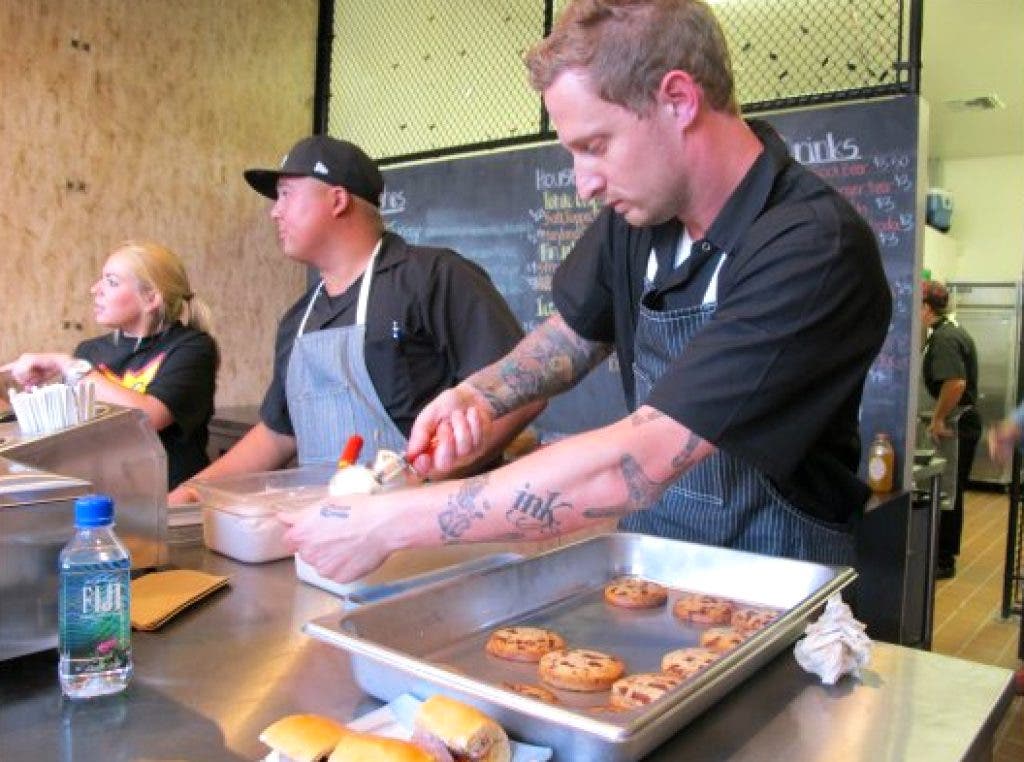
food and wine festival of 2011 took place over the long Labor Day weekend. I was fortunate enough to be invited to "," which was held behind the on Saturday.
Interestingly, the address provided for the event was the old Robinsons-May building at 9900 Wilshire Blvd. I imagined the vacant department store turned into a Foodie Mecca by local flavor providers and wineries from up the coast. It was actually held outside beneath two gigantic tents and a smaller one. It was in the latter I had an epiphany about a combination of three of my favorite discussion topics—food, technology and the Network Society.
Maybe I should explain what a Network Society is in the realization that not all of us are as geeky as yours truly. The term was popularized by Spanish sociologist Manuel Castells in the late 1990s and early 2000s. The idea is that the industrial age has been replaced by a Network Society rather than “The Information Age,” which is another popular term for the times in which we live. However, that’s like naming the industrial era “The Coal Society” or “The Steam Society.” It’s not the elements of a society which defines it, but rather how its inhabitants organize those elements and themselves. And with all the social networks and networked technologies that shape our lives, it seems more appropriate to refer to the current society as The Network Society.
Find out what's happening in Beverly Hillsfor free with the latest updates from Patch.
So what does this have to do with restaurants?
Well, I attended a really interesting panel titled “Tasting & Tweeting: The Use and Abuse of Social Media in Restaurants,” moderated by one of my food writing idols, L.A. Weekly food critic Jonathan Gold. On the panel were three of Los Angeles' most celebrated young chefs: Michael Voltaggio, Craig Thornton and Walter Manzke. Voltaggio and Thornton are heavy tweeters. Voltaggio even admitted to being so engulfed in the Twitter phenomenon that emotional outbursts in tweet form have caused him a great deal of embarrassment time and again. That didn’t prevent him from wearing a T-shirt announcing the Twitter handle for his new restaurant on Melrose Avenue, "ink." (follow his Tweets at @MVinkla).
Find out what's happening in Beverly Hillsfor free with the latest updates from Patch.
But as much as it’s really interesting to learn how these young chefs of the L.A. restaurant scene use Twitter to announce fun and surprising events (like when Thornton decided to pass out free foie gras on the street in Echo Park), it was something else that floored me. Voltaggio told an enthusiastic audience about how he engages in a dialogue on Twitter with people who critique his food. He takes note whenever someone on Twitter focuses on a part of the dish that he hadn’t originally assigned a leading role. When someone just doesn’t like a dish, finds it too salty, too sweet, or finds the consistency weird, Voltaggio’s on it. He’s apparently happy to change a dish—as long it doesn’t conflict too much with his creative vision—in order to create a better product.
This is called User Driven Innovation and is something that has been penetrating the corporate world for some years now. It’s a paradigm shift from the industrial society, where someone would have a vision and stick to it. If the market didn’t like the product, it would take a while before this truth would set in, at which point it would often be too late. With the fast communication and instant response of User Driven Innovation, you can adjust your product to fit the market while the window of opportunity is still there. That’s exactly what Voltaggio is doing.
I’ve never seen real User Driven Innovation in the fine food world before. In the case of Twitter and food, the temporality really gets interesting. Because Twitter is so real-time, a foodie can share an experience with the whole world the minute he or she has eaten their first forkful of food. And as the dining experience unfolds—maybe even as the flavor develops on the palate—the rest of the world can know what is going on.
Gold shared a story about how Twitter’s speedy socialization has affected him. While dining at a restaurant, his cell phone buzzed. Someone had mentioned him on Twitter…they’d spotted him about to take the first bite of his food and promptly tweeted about it.
Of course, smartphones in restaurants can be a nuisance, no doubt about it. Especially in our part of town, where industry posers talk way too loud for it to be coincidental. However, if used silently to share experiences like this, they can bring the restaurant experience into the interconnected, über-sharing world of Network Society. It also gives Generation Y a reason to get interested in food beyond the fast and cheap stuff offered at the drive-through. And that’s not a bad thing.