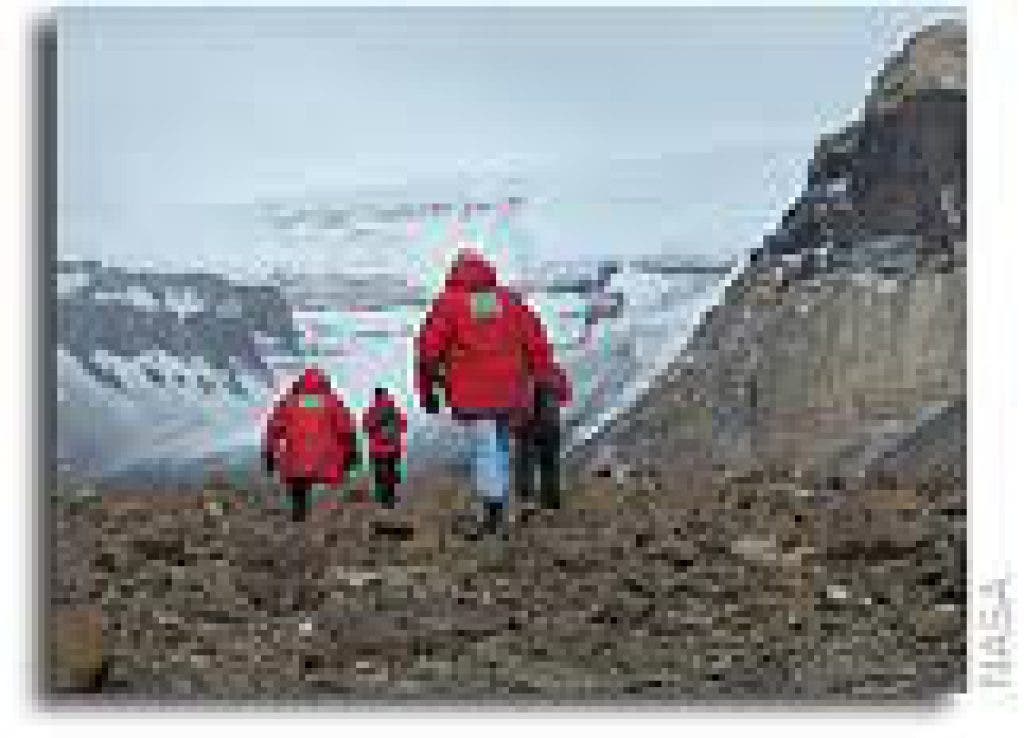

If you want to meet a Martian, you have to go where the Martians are – Mars! So how does NASA prepare for this future introduction of Human to Martian? They start with the mission of the Phoenix Mars Lander and stay on Earth and go to Antarctica. Why Antarctica you ask? OK, maybe you didn’t ask, but I’m going to tell you anyway.
If you show up at the Burlingame Public Library on Saturday, October 29 at 2 p.m. you’ll learn from NASA’s Chris McKay, a biologist at the Ames Research Center, how they went to one of the most Mars-like places on Earth and helped assist the Phoenix in its mission of soil and ice analysis on Mars. Six scientists spent two weeks in the Antarctic Dry Valley and used the tools the Phoenix Lander would use to dig through permafrost to the soil and water ice below.
By using the same tools and chemistry lab that would accompany the Phoenix to Mars, they could help determine that the results they got on Mars were valid. The chem lab also checks for favorable environments for life on Mars, as well as habitability.
Find out what's happening in Burlingame-Hillsboroughfor free with the latest updates from Patch.
NASA’s website tells us the four science goals for the Phoenix mission is to:
--Determine whether Life ever arose on Mars
--Characterize the Climate of Mars
--Characterize the Geology of Mars
--Prepare for Human Exploration
Find out what's happening in Burlingame-Hillsboroughfor free with the latest updates from Patch.
Biologist Chris McKay will be able to tell you the results of his team’s efforts to determine whether microbes live close to the ice in the dry permafrost of Antarctica because if microbes are found in Earth’s dry permafrost, this can help to determine the habitability on Mars.
Habitability, like travelling to Mars and meeting a Martian and breaking Martian bread? Perhaps someday.
NASA’s Phoenix Mars Lander: http://www.nasa.gov/mission_pages/phoenix/main/index.html
Burlingame Public Library: http://www.burlingame.org/library