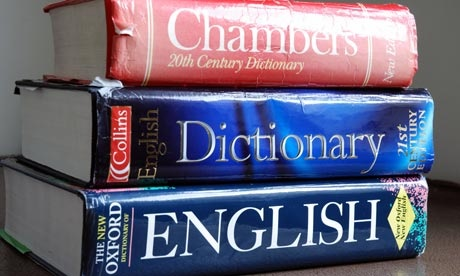
In the third lecture, "The Human Hands Behind Dictionaries," in Professor Anne Cuzan's course, "The Secret Life of Words: English Words & Their Origin," the author discusses how dictionaries deal with our ever-changing vocabulary and grammar. Word meanings are changing (sometimes to an opposite concept – such as "peruse" changing from "carefully examine" to "scan or browse quote"). New words are being added ("chillax – to chill out or relax, remain calm).
So, how do dictionaries handle this constant change? First, after the word has gained some currency, it can be submitted to the dictionary's own usage board that is made up of several hundred individuals with language backgrounds or connections, including English scholars, authors and linguists. The board includes prescriptive linguists (how the language has been used traditionally and historically) and descriptive linguists (how the language is actually used). The lecturer subscribes to: The First Principle of Descriptive Linguistics: If it Sticks Around it is Right.
The usage board votes on new and changing words for inclusion in the dictionary, adding usage notes for the words, and can also assign the designation ”slang" or "colloquial" or "nonstandard" or "offensive."
Some words have hung around and Prof. Cruzan thinks are worthy of inclusion in the dictionary, even if they were formerly illegitimate, non-standard or internally redundant, such as: irregardless; ain't; mob; debone; or unravel. Even the Oxford English Dictionary (OED) added the formally illegitimate word, "yada, yada" in 2006 but assigned it the usage-label "colloquial." OED defined the new word as: indicating that further details are predictive or evident from what has preceded. Some people feel that dictionaries should not exercise judgement and set standards. Professor Cuzan, however, heaped praise on the OED because it is the repository for the history of every word that was ever in the language - a stunning accomplishment.
Prof. Cuzan, a descriptive linguist, accepts the continuing change in our language usage, both written and spoken, and leaves the determination of the meaning of a word or phrase to the communication occurring currently. The prescriptive people prefer being language-usage purists, however, the dictionary writers (lexicographers) are mostly descriptive-leaning board members. For this reason, Professor Cuzan suggests that dictionaries should have dates attached to their titles because each dictionary is a snapshot of language usage at that given time.