Politics & Government
Gov. Brown Orders First-Ever Mandatory Water Reductions
The statewide mandatory rules call for a decrease in water use by 25 percent through February 2016.


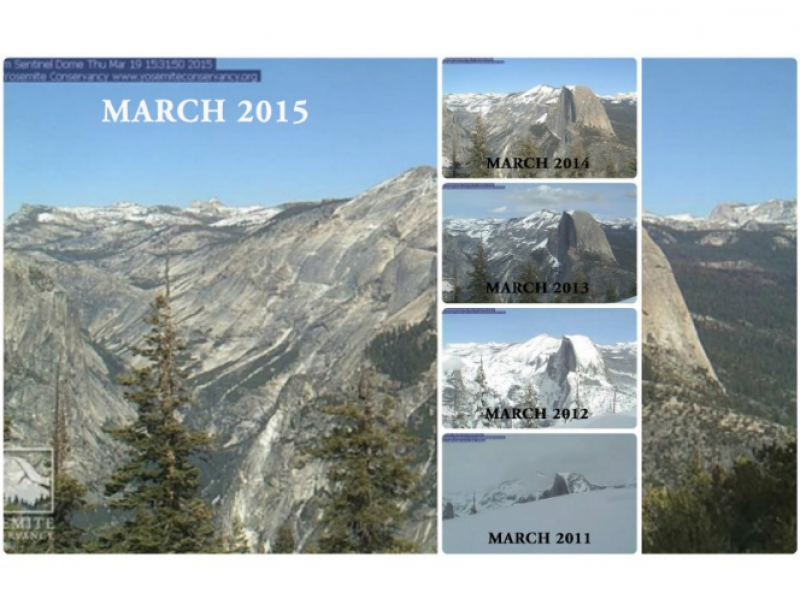
Images by the Yosemite Conservancy Half Dome webcam show the decreasing snowpack at the California landmark since 2011.
--
With California’s mountain snowpack at record lows, Gov. Jerry Brown took the unprecedented step today of making water reductions in the drought-ridden state mandatory, the governor’s office announced. The question of how exactly the 25 percent statewide reduction in urban water usage will be accomplished has been left to the state’s individual water agencies.
Find out what's happening in Campbellfor free with the latest updates from Patch.
The state’s Water Resources Control Board will set a sliding scale for target reductions between agencies, depending on their current per-capita water use. Agencies that fail to make the reductions could face fines of up to $10,000 per day, water resource board Chair Felicia Marcus said today. “We do have that authority and we won’t be afraid to use it,” Marcus said.
- Related:
- Warming Temps, Droughts Are Linked; Climate Change Contributing: Study
- California “Has Only About One Year of Water Supply Left in its Reservoirs”
- Gov. Brown Signs $1 Billion Emergency Drought Package
San Francisco, for example, is ahead of the curve on conservation already, with a per-capita residential water use of under 50 gallons per day.
Find out what's happening in Campbellfor free with the latest updates from Patch.
This is partly because of the lack of residential lawns there, but also because of the significant steps San Francisco has already taken to conserve water, Marcus said. While reduction in indoor water use is important, the biggest urban use for water is in outdoor irrigation on ornamental landscapes and lawns.
Anyone who operates large lawns -- such as golf courses, cemeteries and colleges -- will have to make significant cutbacks. Marcus stressed that every district is going to have sacrifices to make. She said the water board would work on setting conservation pricing structures with the local agencies.
“A number of agencies are going to have to step up mightily,” but areas conserving already will also have to step up, she said.
Some agencies, such as the Santa Clara Valley Water District, have already set even more ambitious goals: that district is going for 30 percent because of concerns about groundwater use, Marcus said.
Brown went along this morning on a manual snowpack survey at 6,800 feet in the Sierra Nevada, an unusual trip for an active governor. The trip proved even more unusual because, for the first time in 75 years, they found no snow.
“Today we are standing on dry grass where there should be five feet of snow,” Brown said in a statement. “This historic drought demands unprecedented action.”
Overall, statewide snowpack was at only five percent of the historic average for this date. The previous historic lows were 25 percent in 2014 and 1977, state officials said.
The mandatory reductions, the first such regulations in the history of California, are only a part of the steps Brown’s office announced today to reduce water usage. Changes to municipal landscaping, new regulations for agricultural water users, and improvements in water technology are on the way as well, state officials said.
The state will work with local agencies to replace 50 million square feet of lawns and ornamental turf with drought-tolerant landscaping, Department of Water Resources Director Mark Cowin said.
Meanwhile, the state will make updates to legislation regulating landscape irrigation, requiring more efficient irrigation, limiting the use of high water-use plants, and improving stormwater capture and greywater use, Cowin said.
Farmers have not been exempt from restrictions either, state officials said. Brown today took steps to improve data collection for agricultural water suppliers and broadened the number of suppliers providing data in an effort to increase efficiency, Cowin said.
While agriculture accounts for a majority of the state’s water use, officials stressed that the industry has already made significant cutbacks as water supplies have dwindled. Farmers have fixed allocations that have been significantly cut back, and hundreds of thousands of acres are now fallow.
But advocacy group Food & Water Watch California argued restrictions for industry use have not gone far enough.
Food & Water Watch Director Adam Scow said in a statement that groundwater irrigation for the production of pistachios and almonds in dry land west of the San Joaquin Valley is “a wasteful and unreasonable water use, especially during a severe drought.”
“It is disappointing that Governor Brown’s executive order to reduce California water use does not address the state’s most egregious corporate water abuses,” Scow said. “The Governor continues to allow corporate farms and oil interests to deplete and pollute our precious groundwater resources that are crucial for saving water.”
Scow also said Brown should stop the practice of hydraulic fracturing, or fracking, in California as the practice of extracting natural gas can contaminate groundwater supplies. State officials urged residents not to point fingers and argue over who uses more water, but instead to concentrate on reducing water usage.
They pointed out that city-dwellers are dependent on California-grown food as well.
“Drought is not an issue over who is impacted the most but rather drought is impacting all of us,” state Department of Fish and Wildlife Director Chuck Bonham said. “The task in front of us is how do we make it through this together.”
--BAy City News
Also on Patch:
- How to Tie-Dye Easter Eggs with Silk Ties: A Step-by-Step Guide
- Missing Marin Academy Grad Found Dead On LA Freeway On-Ramp
- Be Careful Out There! 5 Dead in Bay Area Weekend Crashes
- How to Make Perfect Hard Boiled Eggs
- Teen Settles Civil Suit Brought By Family Of Audrie Pott
- WATCH: 58,000 Tons of Bay Bridge Coming Down Piece by Piece
Get more local news delivered straight to your inbox. Sign up for free Patch newsletters and alerts.