Crime & Safety
New Technology is Helping to Solve Old Mysteries
County's forensic analysis department is shedding light on cases that are decades old.

Editor's Note: This is the second story in a three-piece series on the Santa Cruz County’s forensic anthropology and latent print departments. Read the first story, a profile on forensic anthropologist Lauren Zephro, .
In 1993, the remains of Pogonip Jane were found in a shallow grave in the Santa Cruz park she got her name from. To this day, the young woman, whose skull was crushed, remains unidentified. Over the years, homicide and cold case investigators, along with forensic analysts have worked hard to determine who she is and to find her family.
Pogonip Jane is not the only unsolved homicide in the county though. According to the Santa Cruz County Sheriff’s office website, there are over a dozen, and sometimes it just takes time, a fresh pair of eyes, and advances in technology and forensic science to break a case wide open.
Find out what's happening in Capitola-Soquelfor free with the latest updates from Patch.
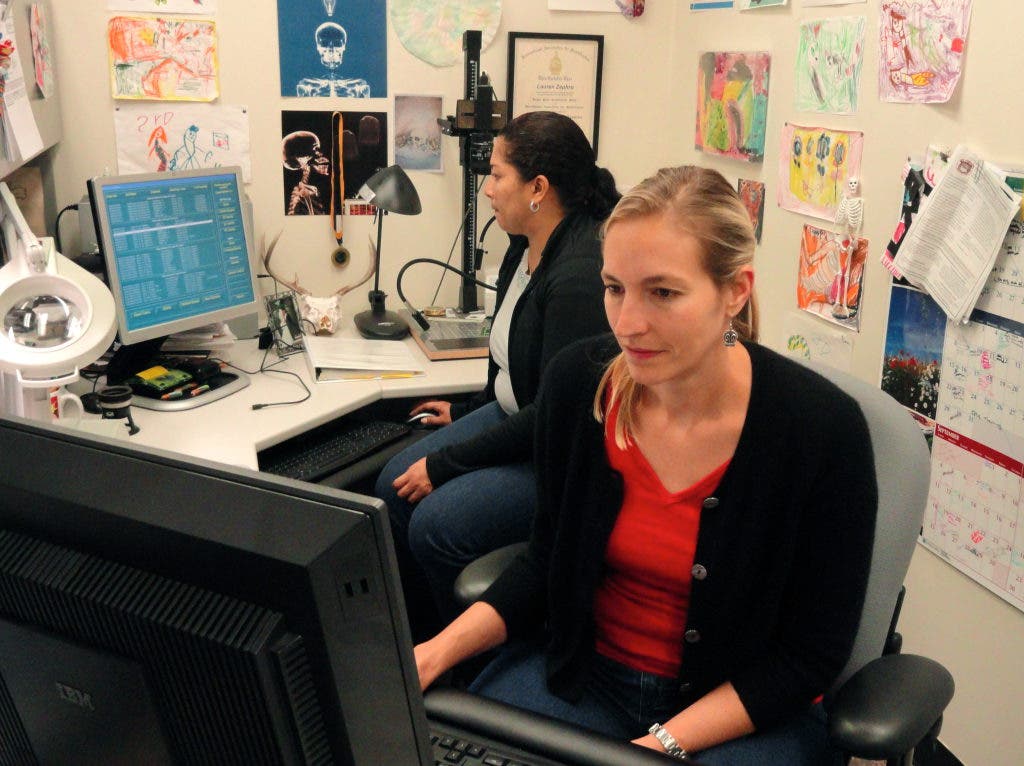
Since joining the Santa Cruz County Sheriff’s Office in 2008, forensic anthropologist Lauren Zephro, along with her “other half,” community services officer Julie Tauriac, has been taking a fresh look at old cases and applying the forensic science of today to help solve some of the mysteries of yesterday.
“As a part of unsolved homicides and unidentified people, we don’t give up on those people,” Zephro said. “We constantly reevaluate what we have in light of new information and better technology.”
Find out what's happening in Capitola-Soquelfor free with the latest updates from Patch.
Pogonip Jane
Though the mystery of who Pogonip Jane still remains today, Zephro took another look at the case when she joined the sheriff’s office and made a discovery that changed what investigators were looking for.
“When this skeleton was found, it was originally thought that she was in her early 20s,” Zephro said. Pogonip Jane was aged at 18-25 at the time.
Zephro reexamined the remains using a fairly new technology that wasn’t available in the 90s—cementum analysis—a scientific procedure that looks at the cementum increments on tooth roots. Similar to tree rings, cementum adds rings to the tooth root and can give analysts a more accurate age range, as well as time of year the death occurred.
“Looking at the cementum, I thought, ‘This isn’t someone who is in their 20s, this is someone who is a child,’” Zephro said. “We came up with an age range of 14-18, so that really shifts the population you are looking at in a tremendous and very significant way.”
In fact, according to a Santa Cruz Sentinel article, a young man went to the sheriff’s office in the year after Pogonip Jane’s remains were found saying he thought the remains could be that of his sister. But because his sister was far younger than investigators believed Pogonip Jane to be at the time, his report wasn’t pursued.
Cementum wasn’t the only thing that was looked at to give a clearer picture of who Pogonip Jane might be though.
“There is another technique we did, which correlates isotopes with geographic location,” Zephro said. “So, you know the idea of, you are what you eat, in this case, you are the tap water that you drink.”
Zephro sent tissue samples of Pogonip Jane to IsoForensics, a lab in Utah doing a very new kind of research that essentially can pinpoint where a person has travelled by examining hair roots for isotopes from drinking water.
“With the hair we sent in, we were able to do a four month block of the time before she died and it suggested she had gone between Santa Cruz and Santa Barbara, back and forth at least a couple of different times,” Zephro said.
Armed with that knowledge and the new age range, investigators now have more information to work with as they continue their search for Pogonip Jane’s identity and family.
1972 Capitola Homicide
It’s not just forensic science that has advanced. Even fingerprint technology has advanced tremendously.
“It’s not your grandma’s fingerprint examination anymore,” Zephro laughed.
New fingerprint technology is what helped Zephro identify a suspect and close an unsolved homicide case in Capitola dating back 16 years.
The murder of 32-year-old Peter Martin Mitchell, a Capitola pizza restaurant owner, in his home in 1972 was one of two unsolved homicides in the city. When Zephro came on board at the sheriff’s office, she approached the other law enforcement agencies in the county offering her help. A Capitola detective gave her Mitchell’s case to take a second look at.
The case came down to fingerprints.
“There were 32 prints that were lifted and looked at already,” Zephro said. “But some fundamental things had not been completed.”
So she began at the beginning, first eliminating the victim’s prints and those people that had a right to be in the residence. Then she narrowed down the prints that were unidentified.
“There was a print on a broken dish that was used to hit the victim with,” Zephro said.
Using computer software that wasn’t available in the 70s, Zephro was able to clarify the fingerprint and make it larger to help identify it.
“These were things that were so hard to do even 10 years ago,” she said. “Everything was done in the dark room. What I can do in 10 minutes could take a week back then.”
After searching for the print in local, state and FBI databases, Zephro got hits on two fingerprints back to the same person—Edward Burton Fall—a drifter who had been in Capitola at the time of Mitchell’s death and was believed to have been hitchhiking and picked up by Mitchell. Though Fall died in 2004, with the new fingerprint evidence, investigators closed the case believing Fall was the one responsible for Mitchell’s death.
“Everything just kind of came together at that moment,” Zephro said. “It doesn’t always come together though. I work on a lot of cold cases where it’s just like 'no luck this time.' So to have one come together like this is pretty amazing. In 1972 I was a year old and it’s just pretty incredible.”
As Zephro continues to work on other cases, helping to give a voice to those who no longer can speak for themselves, she said one important message to carry away is that her work is science and it’s not absolute, but if you just keep at it, you can make some amazing discoveries.
“Science is a body of knowledge that is constantly changing, and in forensic science, it’s not just applying these techniques, but it’s constantly reevaluating and developing methods, testing those methods to see how accurate they are and applying them to cases,” she said.
Get more local news delivered straight to your inbox. Sign up for free Patch newsletters and alerts.