Business & Tech
Be Proactive About Termites and Dry Rot
You don't need to wait to move to have a termite inspection—and it could be a good maintenance idea.
Most people only get a termite report on their home when it’s time to sell. It’s definitely an important part of selling your home (or buying a home), but it’s also a great idea to get a termite report from time to time. This will help you stay on top of the maintenance of your home.
A termite report isn’t just going to tell you about bugs eating your home. It’s that, but more.
The sprinklers that are faithfully watering your lawn every other day, are also spraying the window trim. Over time, this can result in dry rot. A termite report will include all areas of dry rot, leaks, areas of fungus, and (of course) termites.
Find out what's happening in Danvillefor free with the latest updates from Patch.
I always suggest a termite report as one of the “getting ready for market” things to do. A seller may wish to clear the termite report—and then advertise the home as having “section 1 clearance.” But even if the seller does not do any of the work, they will have a general idea of the cost required to do so. When an offer comes in and a buyer is requesting a clear section 1 (a rather customary request), then the seller can make an informed decision.
The termite report is broken down into “section 1” and “section 2” items.
Find out what's happening in Danvillefor free with the latest updates from Patch.
Section 1 items are the serious ones: Actual infestation (bugs) or dry rot. Generally, section 1 items are cleared when the house changes hands. Everything is negotiable, and a few years ago when “as-is” was a common way to sell homes, no work was done for a buyer. But in a “normal” market, section 1 is a repair customarily requested by buyers and agreed to by sellers as part of the escrow process.
Section 2 items are typically negotiable between buyer and seller. They include things that, if left unattended, could become section 1 items. For example, missing grout in the tub where water may eventually cause damage.
So what if you have termites? It’s not uncommon. I had about 25 listings last year—I would say at least half of them had subterranean termites. To eliminate this type of termite, the process is to drill and inject a chemical treatment—and hopefully eradicate the colony below ground. Subterranean termites come up from underground via tubes that they build. These tubes are not terribly noticeable to us—but the termite inspector will see them as if they are neon.
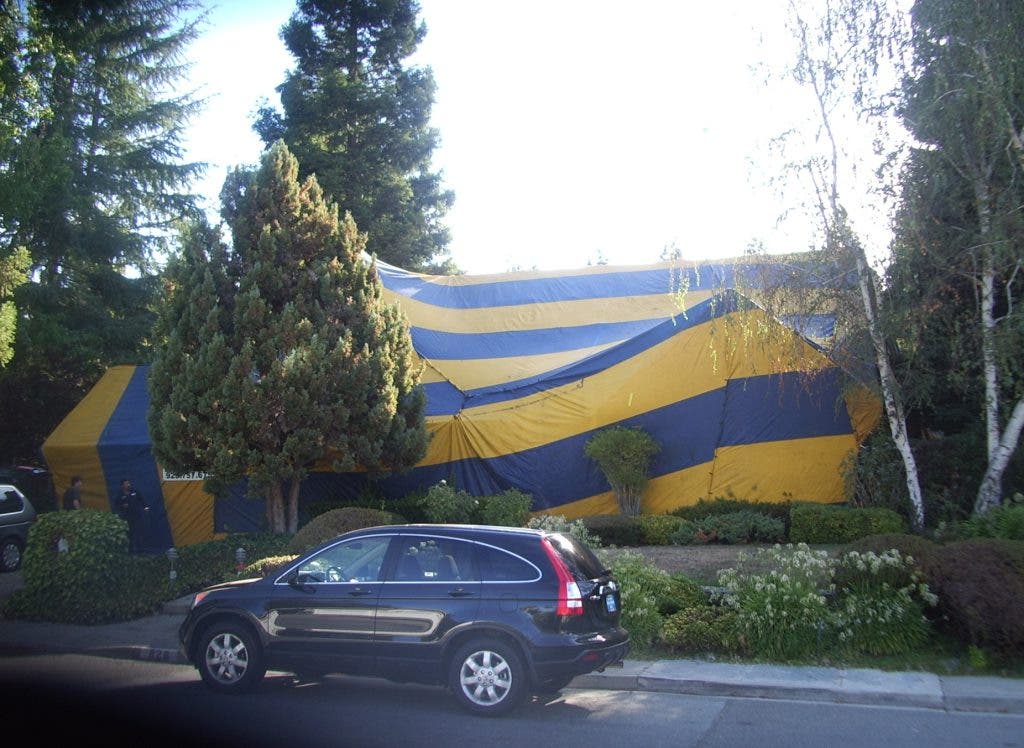
It’s less common to have drywood termites—and much more costly to eliminate them. These termites are flying bugs, so the only solution is fumigation. If you’ve ever seen a giant circus tent over a house, that’s what’s going on. We bought our house a few years ago, and the termite report called for fumigation. I resisted the idea of tenting our house, but it wasn’t long before I saw signs of trouble.
I found a termite in my home office. I wasn’t sure what it was, but I called my favorite termite inspector (John Taylor) and sent him a photo of the offending bug. Sure enough—John said we would need to tent the house.
We planned it around our Labor Day weekend camping trip, so we didn’t have to find a hotel room for the fumigation. We packed up all of our food, and we were locked out of our house (just in case—you might run back in for something you forgot, and get gassed to death, so they literally lock you out).
It was horrible to see our cute house all decked out like a circus. Why can’t the fumigation tents be forest green? Why such bright celebratory colors? I guess the fumigation companies want to make sure we notice what a great job they are doing.
You would be wise, moving or not, to get a termite inspection done. Depending on your square footage, it will cost between $150 to $300, and you’ll learn a lot about your home. The inspector will go in the crawl space and the attic.
It’s a great way to stay on top of the maintenance work that you may need to do.