Health & Fitness
Sword-fighting Shakespeare in ‘The Dogs of War’ at UC Davis
"The Dogs of War," presented by UC Davis ITDP, is a gripping and turbulent rendition of Shakespeare's Wars of the Roses plays.
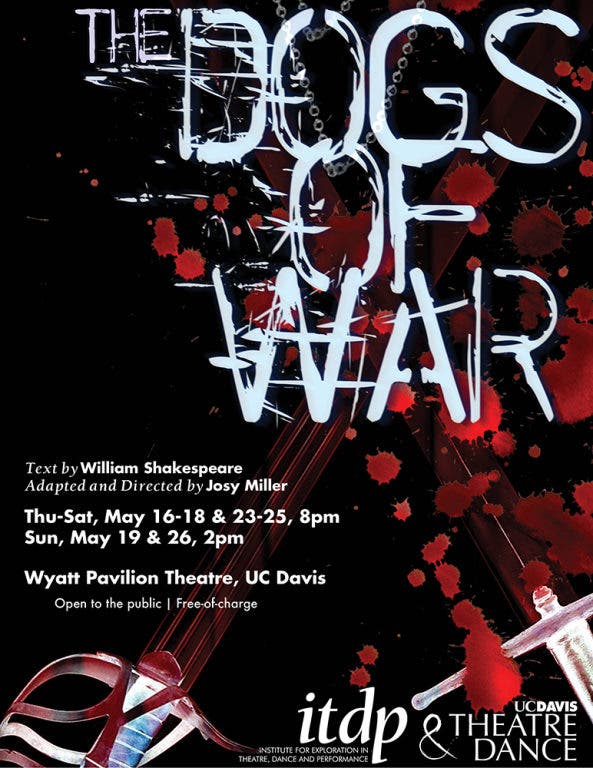


UC Davis ITDP presents “The Dogs of War,” a production exhibiting the grittier side of Shakespeare using the text from his War of the Roses plays. Adapted and directed by Josy Miller, this visceral interpretation features scenes of soldiers, women, children and ghosts as it re-examines the war through common people. “The Dogs of War” opens Thursday, May 16 and plays through Sunday, May 26 at Wyatt Pavilion Theatre, UC Davis. There will be a talk-back with the director immediately following the opening night production. “The Dogs of War” is rated PG-13.
The play emerged through a series of conversations between Miller and Department of Theatre and Dance professor Peter Lichtenfels about what is left unsaid in Shakespeare’s plays. The two found that scene after scene, the voices of common people were being repressed by those of people in authority. The goal of the production became to recover these lost voices and give them a place to be heard.
Though “The Dogs of War” title is a line from Shakespeare’s “Julius Caesar” describing soldiers as embodiments of violence, Miller found significance in it for reclaiming the voice of all commoners.
Find out what's happening in Davisfor free with the latest updates from Patch.
“Over and over again in the histories, common people—and soldiers in particular—are compared to dogs. Sometimes this is in derogatory ways, but sometimes in ways that elevate them as embodiments of violence. The kings use language such as "fleshed soldiers" to describe their troops, a phrase that refers to the practice of giving hunting dogs pieces of raw flesh to make them hungry for the kill. What does it do, then, to refer to a human being as "fleshed," to think about the ways in which we cultivate soldiers to hunger for the kill?
Miller relates her question to the modern world using contemporary scenic and costume designs, working the piece into her Performance Studies doctoral focus on the utility of beauty and empathy in performance for social change.
Find out what's happening in Davisfor free with the latest updates from Patch.
“The reality that individuals that have the power to decide to go to war are different bodies than those that pay the cost (physically, emotionally, economically) seems to me to be of absolutely pressing concern in our current socio-historical moment,” says Miller. “By centralizing the experiences of the common people, we make an invitation for the audience to recognize themselves in these bodies, rather than distancing the characters as clowns or peripheral ‘others.’ The change that we make in ourselves through this kind of empathic engagement is the social change in which I am interested.”
Miller uses a Chorus to map the history of the populace for the audience through “Richard II,” “Henry IV-Parts 1 and 2,” “Henry V,” “Henry VI-Parts 1, 2 and 3” and “Richard III.” She arranges the script in a way that creates a new episodic story. Scenes that disrupt the narratives of “necessary” or “heroic” war, which often underlie productions of the Wars of the Roses plays, especially inspired Miller.
“The Dogs of War” explores what would happen if the audience had to stay with the soldiers on the battlefield; if there was no castle to provide a haven from the violence of battle. Intricately choreographed sword fighting and projection design appeal to viewers accustomed to the fast pace of the digital era.
Miller hopes not only that Shakespeare lovers will attend and respond, but also that those who consider the Bard elitist, or inaccessible, or boring, will come experience a lively and exciting version.
For more information, please visit: UC Davis Theatre & Dance Website
About ITDP
The UC Davis Department of Theatre and Dance's ITDP (Institute for Exploration in Theatre, Dance and Performance) offers opportunities for undergraduate and graduate students, faculty and staff from across the campus community to further research through practical exploration and application. The goal is to expand understanding of creative power, of different kinds of knowledge, especially the embodied, and of communication that offers insight into different cultures and peoples. ITDP encourages cutting edge research and production across fields of practice and in dialogue with the diverse community of Davis and beyond.