Community Corner
UC Davis Doctoral Candidates Honored At National Conference
Brendon Boudinot and Sarah Silverman won President's Prize honors at the recent annual Entomological Society of America meeting.


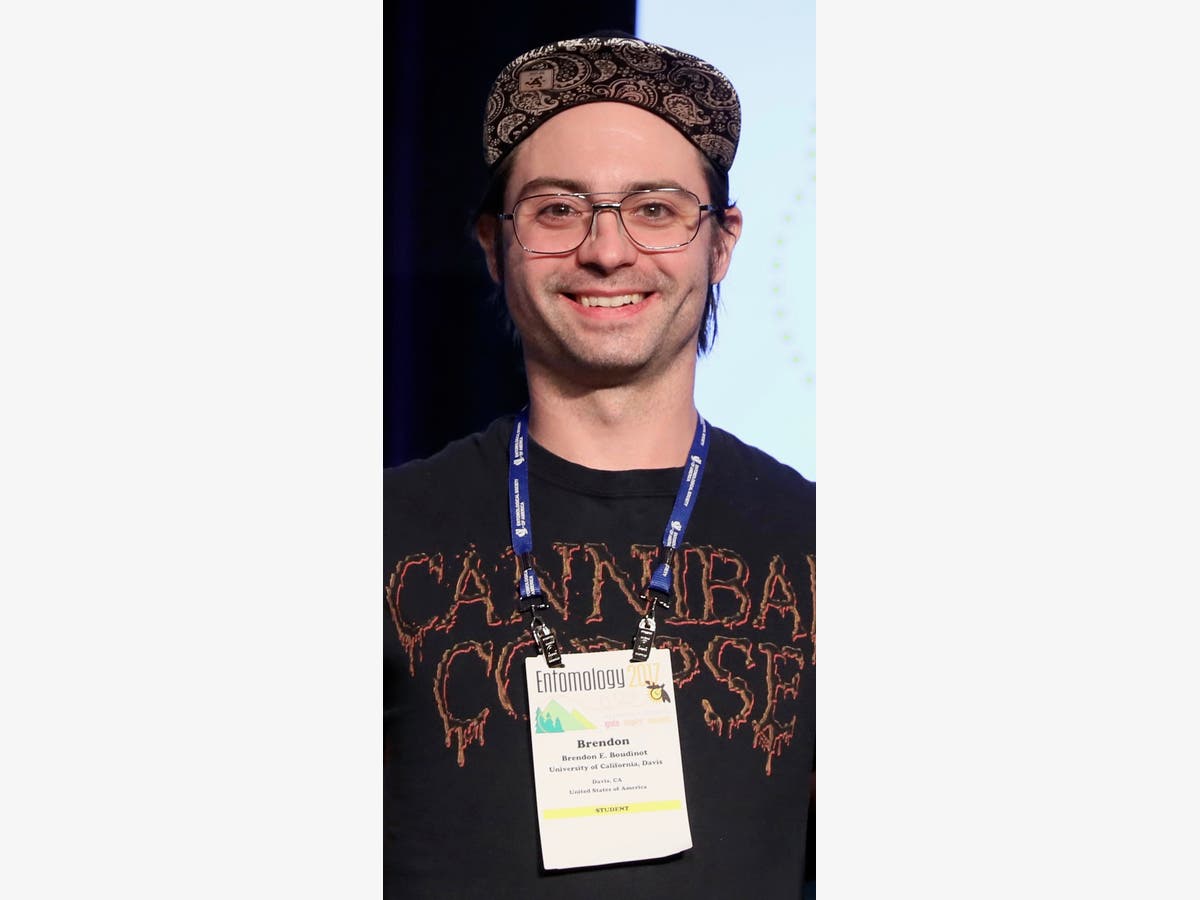

DAVIS, CA — Ant specialist Brendon Boudinot, doctoral candidate in the Phil Ward lab, UC Davis Department of Entomology and Nematology, won a first-place President's Prize at the 2017 meeting of the Entomological Society of America (ESA), held recently in Denver. This is the third year he has won first-place honors in the President's Prize competition.
Sarah Silverman, a doctoral candidate who is studying insect demography at UC Davis with major professor James R. Carey, won a second-place award in her category.
Boudinot, who studies classification and evolution of morphology, delivered a 10-minute oral presentation in the Systematics, Evolution and Biodiversity Section on "The Protopodal Theory of Genitalic Evolution in the Hexapoda (Arthropoda: Mandibulata: Pancrustacea)."
Find out what's happening in Davisfor free with the latest updates from Patch.
Boudinot completed his undergraduate work at the Evergreen State College, Olympia, Washington and spent a year working as a research technician at the University of Utah before starting his graduate work in 2014 with adviser Phil Ward. He focuses his research on evolution and ecology, approached from the perspective of systematics.
“I integrate several lines of inquiry to answer historical evolutionary questions, including morphological and molecular phylogenetics, paleontology, and traditional comparative morphology,” Boudinot related. “I specialize on the skeletomusculature system of the male genitalia of the Hexapoda and the classification of the Formicoidea.”
Find out what's happening in Davisfor free with the latest updates from Patch.
Silverman gave a 10-minute oral presentation in the Diptera-Mosquitoes category of the Medical, Urban, and Veterinary Entomology Section, on “Population as Cohort: Interpreting the Mortality Patterns of Wild-Caught Adult Mosquitoes of Unknown Ages.”
Silverman completed her bachelor's degree in environmental science at McGill University in Montreal. For her undergraduate thesis, she studied the phenology of wild Osmia bees. Her work at UC Davis is in the field of insect demography.
“I specifically study insect lifespan in the wild, as well as the the age-structure of insect populations in the wild using an innovative methodological approach: the capture of live-insects in the wild which are then maintained and observed in the lab until death,” she said.
At its annual meetings, the ESA offers graduate students the opportunity to present their research and win coveted prizes. The first-place President's Prize recipient receives a one-year free membership in ESA, a $75 cash prize, and a certificate. The second-place winner receives a one-year free membership in ESA and a certificate.
The oral presentations are evaluated on scientific content (50 percent) and presentation (50 percent). For scientific content, judges score them on introduction and background with pertinent literature cited; objectives clearly stated and concise; materials and methods (study design) clear and concise; results and discussion clear, concise and accurate; and significance of results to field of study. Judges evaluation the presentation on organization, slides and delivery.
Boudinot's previous President's Prizes were for work on the male genitalia of ants, and for providing the first male-based identification material for the ant genera of the New World.
Ants are highly diverse, with over 13,000 known species, Boudinot said. "They are, however, but one stitch in the diversity of all insects, and we are entering a new era for the study of morphology in the 21st century."
The genitalia of male insects are fascinating, he said.
"Both male and female insect genitalia are derived from the appendages of a pair of abdominal segments. Evidence from the skeletomusculature indicates that these structures are really legs of a crustacean ancestor that have been modified for numerous reproductive tasks--from copulation and insemination, to singing and silk-spinning."
By Kathy Keatley Garvey, UC Davis Department of Entomology and Nematology
Photos of Brendon Boudinot and Sarah Silverman courtesy of Kathy Keatley Garvey
Get more local news delivered straight to your inbox. Sign up for free Patch newsletters and alerts.