Schools
UC Davis Scientist Receives Grant to Study Desert Pollinators
Congrats to Leslie Saul-Gershenz of the Department of Entomology and Nematology.


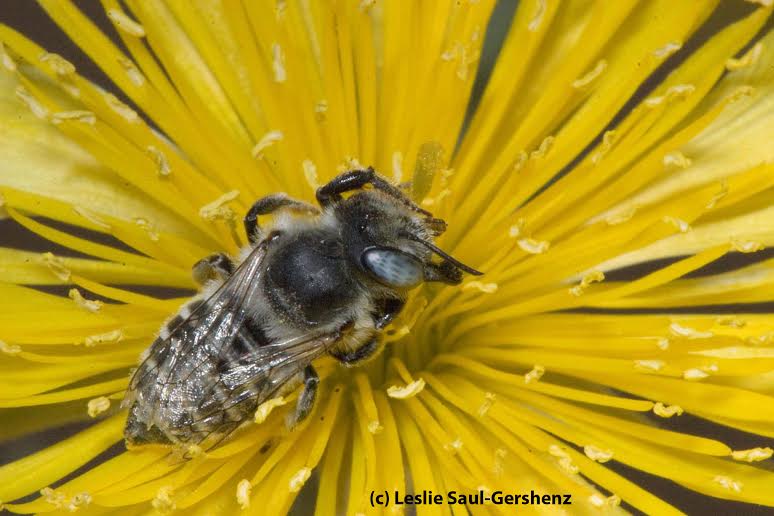
A digger bee, Megachile sp., is one of the desert pollinators that Leslie Saul-Gershenz studies. (Photo by Leslie Saul-Gershenz)
-------------------------
By Kathy Keatley Garvey
Find out what's happening in Davisfor free with the latest updates from Patch.
An evolutionary ecologist at the University of California, Davis, has received a grant to characterize the impact to desert pollinators, such as solitary ground-nesting bees, from utility-scale solar installations on public lands.
Leslie Saul-Gershenz, a postdoctoral scientist in the UC Davis Department of Entomology and Nematology beginning January 2016, received the $220,000 grant from Cooperative Ecosystem Studies Unit of the Bureau of Land Management for the first year of the study.
Find out what's happening in Davisfor free with the latest updates from Patch.

“The grant will fund research to determine the type and extent of impacts that utility-scale solar installations on public lands may have on pollinator-plant webs in desert ecosystems,” Saul-Gershenz said. “Pollinators play a vital role in maintaining functional ecosystems. This project addresses the need for documenting instances of impacts from fragmentation of pollinator trap lines, loss of vegetation habitat for different life stages of pollinators, disruption of dependencies between endemic plants or endemic invertebrates and their respective companion pollinators or host plants, and potential demographic population declines from pollinator mortalities induced by specific types of renewable energy technology.”
Her co-principal investigators are pollination ecologist Neal Williams, associate professor in the department, and Lynn Kimsey, director of the Bohart Museum of Entomology and UC Davis professor of entomology. They will collaborate with native pollinator specialist Robbin Thorp, distinguished emeritus professor of entomology at UC Davis and a Bohart Museum associate; research associate Thomas Zavortink of the Bohart Museum; Terry Griswold of the U.S. Department of Agriculture’s Agricultural Research Service Bee Biology Lab; and John Ascher of the National University of Singapore.
Saul-Gershenz is known for her bee-parasite research on solitary ground-nesting bees in the genus Habropoda and its nest parasite, a blister beetle, Meloe franciscanus. The larvae of the parasitic blister beetle produce a chemical signal that mimics the sex pheromone of female solitary bee to lure males to the larval aggregation. The larvae attach to the male bee and then transfer to the female during mating. The end result: a larva winds up in the nest of a female bee, where it eats the nest provisions and likely the host egg.
The Mojave and Sonoran Deserts are biological hot spots of biodiversity supporting more than 689 species of bees and 1512 species of plants in the Mojave Desert alone, Saul-Gershenz said.
Get more local news delivered straight to your inbox. Sign up for free Patch newsletters and alerts.