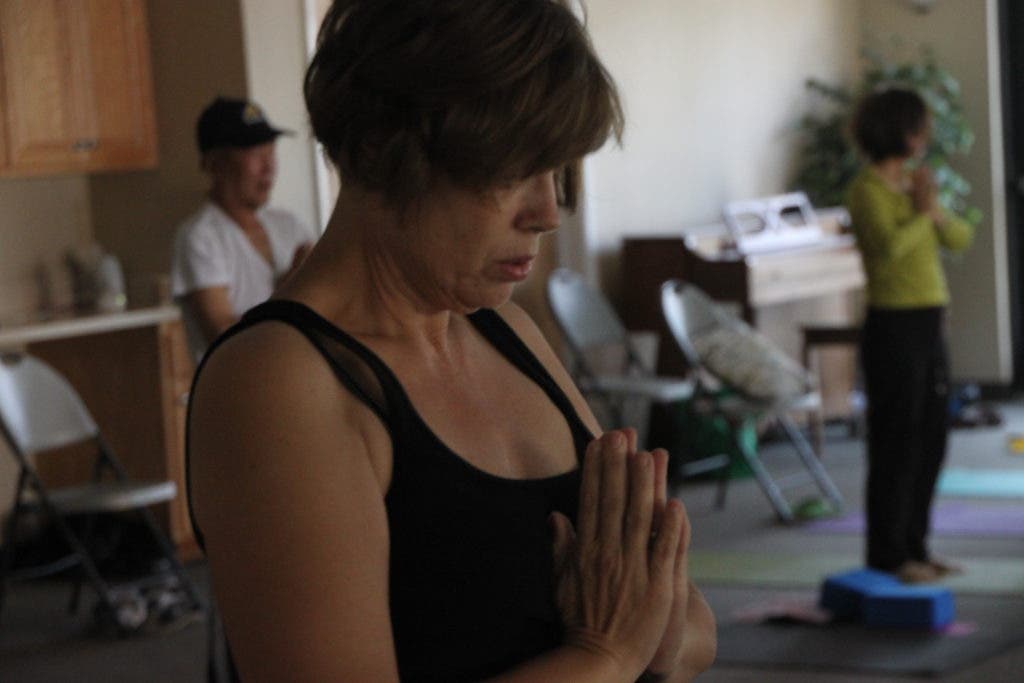
Here are some thoughts about how drishti can improve not only our practice but also our larger perspective.
The Sanskrit word "drishti" can be translated as gaze, or vision. By selecting appropriate destinations for our gaze while we move through asanas, we can focus our attention and concentration on our practice. The drishti concentrates the energy and action of each asana, and also helps to focus our minds.
The role of gaze, or drishti, in yoga is just as important as alignment. Newer students, who are often anxious as to where/how/when to move, might find their eyes traveling around the room. Not only do the new students find the poses difficult, their lack of focus distracts them from getting into the essence of yoga: uniting body and mind with the breath.
Why should we keep drishti in mind through each session? The best answer to that question would be to discuss what happens, visibly and mentally, when we lose focus during our practice.
There is always a self-consciousness that comes as we evaluate our bodies in a mirror. Luckily, our usual practice room has no mirrors, so we aren’t distracted or discouraged by how we “look” as we move into and out of our asanas!
Even when I am not demonstrating, sometimes new students look to me as “the” guide for alignment. That’s not helpful, as my body’s alignment has its own quirks and shouldn’t be a basis for comparison. It’s better to listen to the verbal cues and to place our own bodies in the space around us. Remember, each practice is as unique as the individual.
Looking around the room to compare one asana to another leads to judgment and competition. Both of those outcomes are counterproductive. Accept your body as it is that day, in that moment. Maintain curiosity and wonder. Listen to your body. My job as instructor is to monitor your practice to keep you from overextending yourself, but you know your body better than anyone else. If our eyes are roving and comparing, we aren’t centered on our own practices.
Looking at the clock or checking our cell phones for messages is a clear sign that focus has shifted from the practice and into the distractions and demands of our lives. For many of us, one of the primary reasons for our practice is to discipline ourselves to take a firm “time out” from competing demands. Staying in the here and now throughout our practice will keep us from getting short-changed.
As we practice, our gaze is ever-shifting: from an outstretched hand, to a foot, to our fingertips, even to our navels.
Each asana has a drishti, a place to gain energy and focus while maintaining the pose. Here are some general guidelines for drishtis:
In standing yoga poses in which the spine is neutral, the gaze follows the action of the arms.
Find out what's happening in Diamond Bar-Walnutfor free with the latest updates from Patch.
In chair pose (utkatasana) and warrior I (virabhadrasana I), the gaze moves up with the energy of the lifted arms. In warrior II (virabhadrasana II), look toward the front hand. During a vinyasa sequence, move the arms back to center (for example, to namasté position at the heart) on each exhale, letting the gaze follow, and reach the arms back into the pose on each inhale, letting the gaze follow. Keep the rest of the body steady.
In poses that include side bending and spine twisting, for example, in triangle pose (utthita trikonasana), revolving triangle (parivritta trikonasana), side angle lunge (utthita parsvakonasana) and revolving lunge (parivritta parsvakonasana), gaze toward the top hand, which reaches in the direction of the side bend or spinal twist.
In challenging balance yoga poses such as tree pose (vrkasana), use the gaze to assist stability.
In general, gazing slightly forward and toward the floor makes balancing yoga poses easier. Looking up to the ceiling tends to make the pose more challenging.
Forward bends, such as seated forward fold (paschimottonasana) and bound angle (baddha konasana), have two common variations: with the spine straight and rounded. If the spine is straight, the gaze is at the feet or in front of the body; if the spine flexes into a full forward bend, the gaze moves to the legs. Try a vinyasa moving between the two expressions of a forward bend (inhale as spine straightens and gaze lifts; exhale as spine rounds and gaze move to legs).
Find out what's happening in Diamond Bar-Walnutfor free with the latest updates from Patch.
Savasana is a time to withdraw the senses, including vision. Turn the gaze within. Use this time to recharge your mental batteries. With closed eyes, imagine looking into the lower eye sockets and bring the attention to the calm, even breathing.