Community Corner
These Mysterious Creatures Are Washing Up On CA Beaches. Here's What To Know
No, it's not a jellyfish.


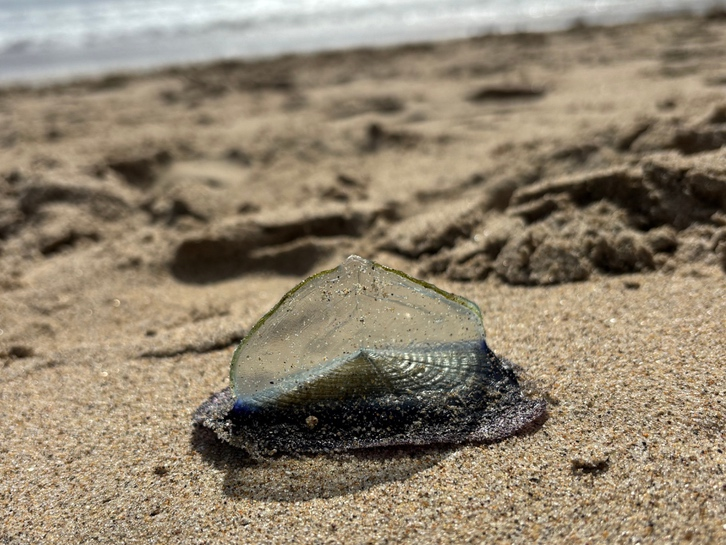
SAN FRANCISCO, CA — No, those aren't jellyfish scattered across California's beaches.
Masses of blue translucent creatures known as Velella velella have been washing ashore across California, from Southern California to San Francisco in recent days.
Thousands of these blue creatures could be seen washed ashore at Baker Beach on Monday in San Francisco. On Thursday, thousands, if not millions, washed ashore along Manhattan Beach in Los Angeles County, according to KTLA.
Find out what's happening in San Franciscofor free with the latest updates from Patch.
The Velella velella, commonly referred to as "by-the-wind sailors" due to the sail-like structure that makes up the top of their body, are not jellyfish despite their close resemblance. However, they pack a similar punch.
Experts say the creature's triangular-shaped sail is diagonal to the soft tissue that surrounds it like a sailboat, allowing the animal to effortlessly glide along the surface of the ocean.
Find out what's happening in San Franciscofor free with the latest updates from Patch.
Wind directions will at times send the creature toward the coastline, stranding it, according to the San Francisco Chronicle, which first reported the recent mass appearance of these creatures along the city's beaches.
"When the prevailing winds shift, such as during a storm, the Velella are driven towards the coast, where they often are stranded on beaches in great numbers," according to the Point Reyes National Seashore website.
The Vellela have a lifespan of one year, during which they go through two phases: a polyp stage, where most people see them in their sail-like phase, and a medusa stage, where they look like a jellyfish.
But despite having a medusae stage, it is not considered a "true" sea jelly because Velellas are colonial hydroids with individual male and female polyps that serve different roles within their colony.
Experts say unsuspecting swimmers, surfers or people walking along the sand might often confuse their sting with that of a jellyfish.
Although the Velella possesses stinging cells that help it feed in open water and protect itself, just like jellyfish and other cnidarians, they're not powerful enough to penetrate human skin.
Still, the sting can cause mild skin irritation that can spread by touch if not washed off with a mild soap.
"They can sting more when they are floating in the water and less so when they've been thrashed in the surf before beaching onto the coarse sand," Roundhouse Aquarium's Program and Operations Director Marissa Wu previously told Patch. "Then the Velella velella tend to be worn out and quite harmless by the time folks discover them among the beach wrack."
More California News:
- Shots Fired Outside R&B Singer's LA Home, 1 Arrested: Reports
- Provocateur Ambush Interviews Gay Couple In West Hollywood, Suffers Broken Camera
- Tate Slams Fieri With Misogynistic, Racist Slur After Viral UFC Encounter
- Pizza Place Raffling Off Mystery Contents Of Long-Unopened Safe
- School Board Trustees Face Fallout For Comparing Teen Athletes To Strippers In Photo
- World's Tallest Basketball Player, 7-Foot-9 Olivier Rioux, Signs With CA College
- $400M Listing For Mega Mansion Aims To Be Country's Most Expensive Home Ever Sold
- Bay Area United Flight Has Close Call With Drone Over San Diego
- D4vd Lured Teen, Used Chainsaw To Dismember Her — How He Did It, According To Prosecutors
Get more local news delivered straight to your inbox. Sign up for free Patch newsletters and alerts.