Health & Fitness
Living Health: The 3/4 Rule
This is the third post in a series entitled "Living Healthy." Each week we're bringing you some tips that we've gathered over the years on how to stay healthy naturally.
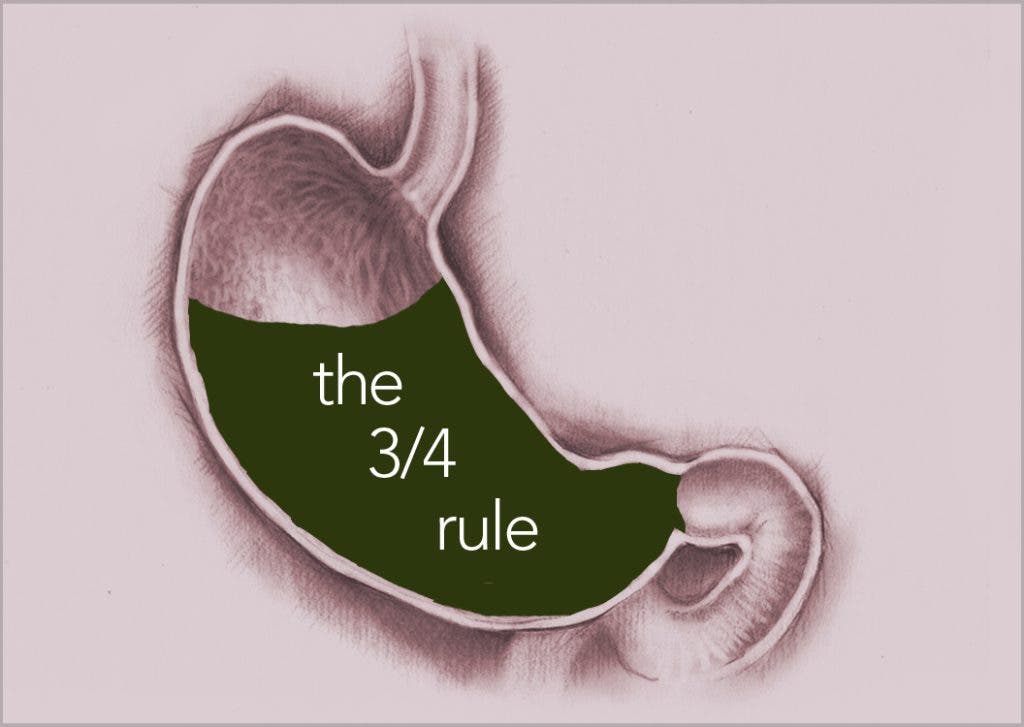
This is the third post in a series entitled “Living Healthy." Each week we’re bringing you some tips that we’ve gathered over the years on how to stay healthy naturally.
For many years, our family has followed a few guidelines that have kept us away from MDs and allopathic medicines (AKA drugs). People often ask us how we could go 20 years without ever going to the doctor for some disease or the other (the last time I went was for a physical to be on the swim team in high school). This blog series is our chance to share that with you.
When it comes to eating, most of us eat with our eyes and not with our stomachs. What do I mean, you say? Well, what I mean is that portionwise, we tend to eat according to how good the food looks and not how hungry we are. Although this fact might not seem like a huge problem, especially for those of us who are at least conscious of what we eat, it can actually have pretty big impacts on our long term health. In Ayurveda (Indian traditional medicine), it is said that the digestive system is where all disease begins. This system is where we take in the bulk of the nutrition for our body. When one overeats, the digestive system becomes overburdened, and has to try to process all that food quickly. The result is that although we might be eating highly nutritious food, we are not digesting all of that food properly.
Find out what's happening in Diamond Bar-Walnutfor free with the latest updates from Patch.
When the digestive system is overburdened like this constantly, the body becomes sluggish, weak, and prone to disease, especially if it leads to constipation. To counteract this problem, many of us resort to digestive aids, laxatives, etc., which can actually make the problem worse (especially if you are using chemical laxatives like ex-lax).
To prevent overeating, I use what I call the 3/4 rule. Its pretty simple: only eat until you're stomach is about 3/4's full. What does that mean? Well, I'm sure you know what it feels like to be overstuffed. If you're overstuffed, you have trouble taking deep breaths, feel like you can't move, and you immediately start feeling a bit tired. Being full is basically the same thing, but to a lesser degree. But 3/4 full is very different. At 3/4 full, you are satisfied, but not hungry. You don't feel like running, but you're definitely okay with a brisk walk. And you are comfortable taking deep breaths. That's 3/4 full.
Find out what's happening in Diamond Bar-Walnutfor free with the latest updates from Patch.
To help you get to this goal, I've outlined a few steps to follow:
Chewing slowly and thoroughly is an imperative to good digestion. When you chew slowly, your food starts to break down even before it gets to your stomach. It also gets broken down into smaller pieces which your stomach can break down easily. Lastly, it helps you with the next step of this process which is to
Pay attention to your stomach. Periodically stop when you're eating and take a look at how your stomach is feeling. If you're no longer hungry, and feel satisfied with what you ate, it is time to stop.
Finish chewing and swallowing till you pick up the next spoon. This will help you eat more slowly, and give you time to follow step #2.
The last step is the one I have the most trouble convincing people of:
It's better it gets wasted in the compost than wasted in your stomach. If you're full, you're full. There's no point in "finishing it off" and "not letting it go to waste" if its just going to end up rotting in your stomach. Besides, you're going to compost it anyways (right?).
So that's it, four easy steps for keeping your body (and your mind) running smoothly, at least when it comes to mealtime. Hope you found this post helpful. If you have any questions or comments, please leave them in the comments section below, and I'll be sure to get back to you.
Rishi Kumar is the founder of The Growing Home and Learning Center and Growing Your Home. He has spent the last seven years researching the topics of health and sustainability, and is now working to share his knowledge with his community.