Politics & Government
Dixon Then and Now: Dixon Police Once Chased Horse Thief with Bicycles
Several of Dixon's long-tenure police chiefs had a lot of community support


Back when Dixon was founded in 1868, the population grew slowly, added to by Silveyville residents moving over to be next to the rail line.
Unfortunately, wherever there’s a town, there’s bound to be crime, whether of the high-profile variety (robbery, assault, burglary, murder) or less serious ones (drunkenness, drug abuse, libel, and so on). A recent column talked about the problems created by Dixon’s own
I gather from looking at old stories in the that by 1876, Dixon had a constable in the person of T. B. Barnes, a night watchman with the last name of Allen, and a justice of the peace, S. C. Stevens.
Find out what's happening in Dixonfor free with the latest updates from Patch.
Dixon’s justice of the peace held court rather informally within the city and was responsible for disposing of minor cases such as misdemeanors. Dixon’s justices, along with the constables, were elected by the town board (today’s city council). I don’t know if the justices were paid, but each town or township had one (nearby townships at the time included Maine Prairie, Tremont and Silveyville). You’ve probably heard about justices of the peace performing marriages.
Early on, Dixon’s justice of the peace held court in a room in the Masonic building (1898), then in the rear of the fire building (1909), and then into a room in the Odd Fellows building (1910).
Find out what's happening in Dixonfor free with the latest updates from Patch.
The justices changed often. In 1879 Dixon’s justice of the peace was Mr. Cotton, while in 1883 that person was Mr. C. P. Brown.
The position of constable may not have been full-time, and sometimes constables worked as bill collectors as well. They changed frequently, too. In 1884, that position was variously held by Thomas Barnes, B. F. Newby and William Rhem.
In 1885, Mr. Buck, the night watchman, was paid $68 per month, or nearly $20,000 per year in today’s dollars. On the other hand, in 1888 the constable was paid only one-third of that. Perhaps he was a constable only when called upon. Another term used for the job was marshal.
Some of the longest-serving constables back then were B. F. Newby (28 years), Mr. Staton (1895-1903), William C. Rhem (1884-1899) and Dan McKinnon (1903-1918). Constable McKinnon was the only ever killed in the line of duty.
Here are some stories from the Tribune archives about what Dixon’s early lawmen had to deal with:
In 1888, “A tramp approached a party of men … and asked for money to buy something to eat. S. C. Little … enquired why a man of his … health was reduced to the necessity of begging. The tramp became belligerent, and when an officer approached to arrest him, he fled and was not overtaken until he took refuge in (a) bath house. He pled guilty and Judge Fames sent him to the county jail for a term of ten days.”
In 1893, “A gang of tramps attempted to terrorize the town … but were stopped early in their career by constables Newby and Rhem, who locked them up for disturbing the peace. They were sentenced to ten days each in the county jail.”
And then there were the more serious crimes, which likely had the town talking for months. In 1895, John Marshall shot and killed his brother-in-law, C. F. Agee, and then attempted to commit suicide. Days earlier, Marshall’s wife had left him to go live with her mother and Mrs. Agee, and was considering a divorce.
In 1895, officers on bicycles (including Constable Newby) chased a horse thief, later commandeering a horse and cart, and finally apprehended the crook 12 miles from town. The man was taken to Fairfield on the afternoon train to be examined for insanity by a judge.
According to the Tribune in 1896, Constable March of Elmira “came to town in quest of a keg of beer stolen from a saloon-keeper of that place. He failed to find the stolen beer and had the further misfortune to have his coat stolen while he was here. … (The constable) should never expect to recover beer that reaches town by any means during hot weather like the present.”
In 1889, “Mrs. Ida Ichtertz … who lives about eight miles southeast of here, and a farm hand named Robert J. Northrop were arrested in Davisville” for stealing grain near Dixon. “Mrs. Ichtertz is the mother of four children. She has been exceedingly dissolute in her habits for some time. … Her husband is a hard-working farmer and has always borne an excellent reputation. He was at one time the possessor of several hundred acres of land and was in comfortable circumstances, but his wife’s indiscretions have proven disastrous to him and he now manages to provide for himself and family by dint of hard work.”
Early on, Dixon saw the need for a city jail. In 1888, the began to look into the construction of a two-story brick building, which was built the following year. The first floor held a two-cell jail and upstairs were rooms for the town board and town clerk, making this building Dixon’s first city hall. Later on, the city’s chief of police had an office in one of the rooms. The building for many years was located adjacent to the old fire station on North Jackson Street, which is now the . It was a dour- and dingy-looking place but served its purpose for a number of years.
In 1889, some of the town’s kids took to passing whiskey to prisoners through the jail’s barred windows
During the prohibition years (1919-1933), Dixon’s law enforcement people were put in the position of enforcing a no-liquor-law that was widely flouted. Drawing from an interview with a Mr. Barker (perhaps of the Barker family than ran a grocery store in Dixon), … “Several people here in the city of Dixon … they were good people in the community but they had an opportunity to make a little money which was easier than farming or day labor so they took advantage of it (to make moonshine). … People were very confidential about where the wine or beer or the distillery was done.”
The Tribune ran a story in 1922 titled, “Bootlegger Captured” describing how John Lucks “… was caught by Marshal H. C. Groves and Constable Frank Newby (bringing 25 gallons of moonshine into Dixon for delivery), promptly taken before Justice Dailey and fined $300 (but was leniently not sentenced to jail and kept his car).”
Lucks told the arresting officers, “It was good moonshine too, none of your jackass, poison stuff. … This is the first time I have paid a fine, but it has cost me something to fix things so I could get by in other places.”
With the coming of automobiles came other new kinds of crime, including speeding and drunk driving. In 1922, when liquor was still banned, “Albert Clegg and Melvin Lowe of Winters were arrested at the west crossing of the Southern Pacific railroad by (Dixon) Marshal H. C. Grove … They were in so badly an intoxicated condition that they stalled their car … Both men informed the Court that they got the liquor at the Dodini farm while on their way to Dixon.”
About that time, in 1922, Marshal Grove was appointed as Dixon’s first chief of police. He served until 1944, when Lester “Bud” Peters took over the job for another 25 years. When Peters died in 1985, a nephew said, “He had a great relationship with the community. He gave everyone a fair shake.” These good old days of popular police chiefs who held down the fort for decades ended for a while.
After Don Young was chief for six years, Fred Pryor served in the top job for only three years before being fired in 1978 by the city council. Said Pryor to the Tribune, “I think that part of my problems were that (Councilman) Ted Hickman had a personal vendetta against me … When I made chief, he told one person that if I ever tried to get rid of (police officer) Bareford he would come back and haunt me and I guess he did.” Also, apparently, Pryor felt that some of the men in his department had contacted council members behind his back, and vice versa, which Pryor said wasn’t ethical.
Today, Ted Hickman, now a columnist for the newspaper and realtor, says that the fired policeman, Ralph Bareford, was a very principled, conscientious officer who was offended by some coarse behavior among department personnel. Hickman also said that some police officers around that time told him (Hickman) to leave town, and that Pryor wasn’t a very hands-on chief, preferring to wear civilian clothes on the job.
It seems that Dixon is never without some sort of controversy.
Following Pryor, chiefs Jim Van Cleaf and Roy Ennis (Ennis was also fired) only served for three years each. Finally in 1985 (now serving on the city council) was appointed chief and served 16 years. then held the post for eight years before current chief , a UC Berkley grad, was appointed.
Current crime trends in Dixon include noticeable declines in theft and larceny and total number of arrests. The number of auto thefts and arrests for drunkenness has held pretty steady.
Currently, the , in addition to the chief, has slots for two captains, four patrol sergeants, 11 patrol officers and one community services officer, detectives, and an investigations sergeant. Other personnel are a youth resource officer and code compliance officer. Support staff includes an admin assistant and personnel handling records and evidence, and community action and awareness. There are also reserve police officers and volunteers/cadets.
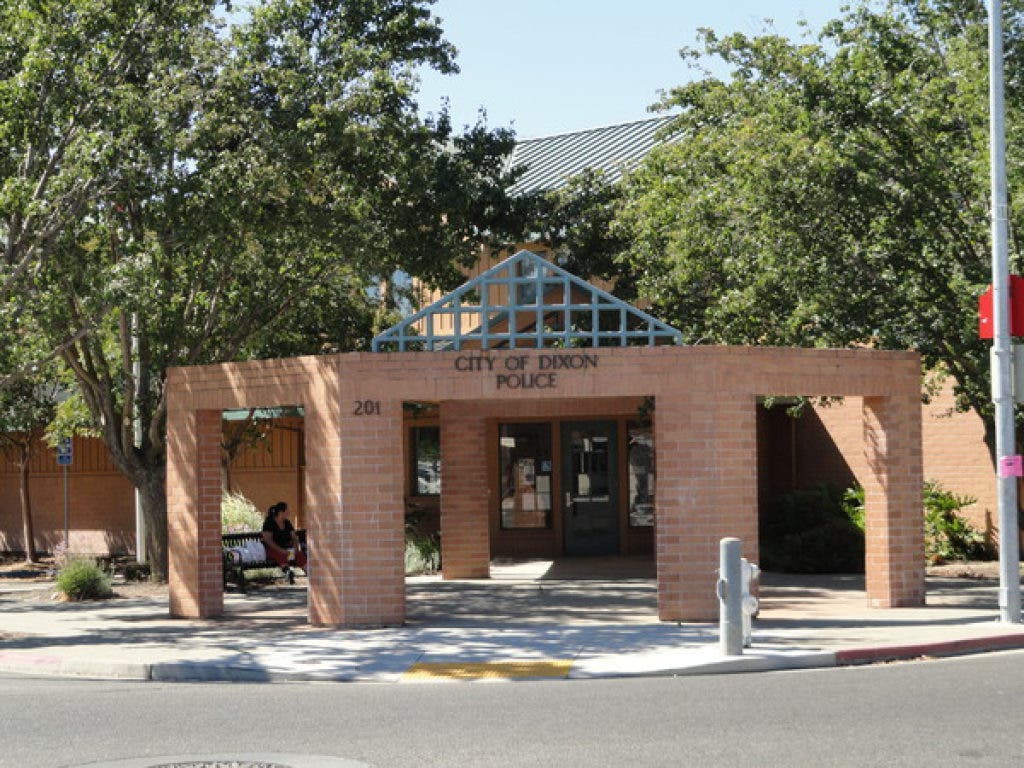
Today’s modern police building was built approximately 15 years ago.